What is tokenomics and how do token distribution, inflation mechanics, and governance utility work in crypto projects

What is tokenomics and how do token distribution, inflation mechanics, and governance utility work in crypto projects

This comprehensive guide explores tokenomics as the economic blueprint governing cryptocurrency projects through token supply, distribution, incentives, and governance structures. Learn how well-designed token distribution across team, investors, and community stakeholders creates sustainable crypto economics and long-term project viability. Discover inflation and deflation mechanics—including halving schedules and burn mechanisms—that balance supply dynamics with value preservation while maintaining scarcity. Understand how governance utility empowers token holders to shape protocol evolution through voting rights and strategic decision-making. Real-world examples like Bitlayer demonstrate how transparent tokenomics frameworks build investor confidence and community participation. Whether you're evaluating project sustainability or optimizing token economics, this article provides actionable insights on assessing tokenomics design, unlock schedules, staking mechanisms, and strategic resource allocation that
2026-01-20 08:20:37
What is EUL: Understanding End User License Agreements and Their Importance in Software Distribution

What is EUL: Understanding End User License Agreements and Their Importance in Software Distribution

Euler is a permissionless decentralized lending protocol launched on Ethereum in 2022, addressing inefficiencies in DeFi lending markets through innovative governance and asset accessibility. This article provides a comprehensive analysis of Euler's technical architecture built on Ethereum's blockchain, exploring how smart contracts automate lending operations while maintaining transparency and security. The EUL token serves as the native governance token, with current market performance showing a circulating supply of 18.69M tokens and market cap of approximately $39.33 million as of January 2026. Readers will discover Euler's core use cases in non-custodial lending, community participation mechanisms, and strategic position within the competitive DeFi ecosystem. Whether you seek to understand decentralized lending infrastructure, participate in protocol governance on Gate, or explore DeFi investment opportunities, this guide offers essential insights into Euler's technology, market dynamics, and future deve
2026-01-20 06:42:55
DAO Gaming Investment: How Decentralized Guilds Are Transforming the Play-to-Earn Industry

DAO Gaming Investment: How Decentralized Guilds Are Transforming the Play-to-Earn Industry

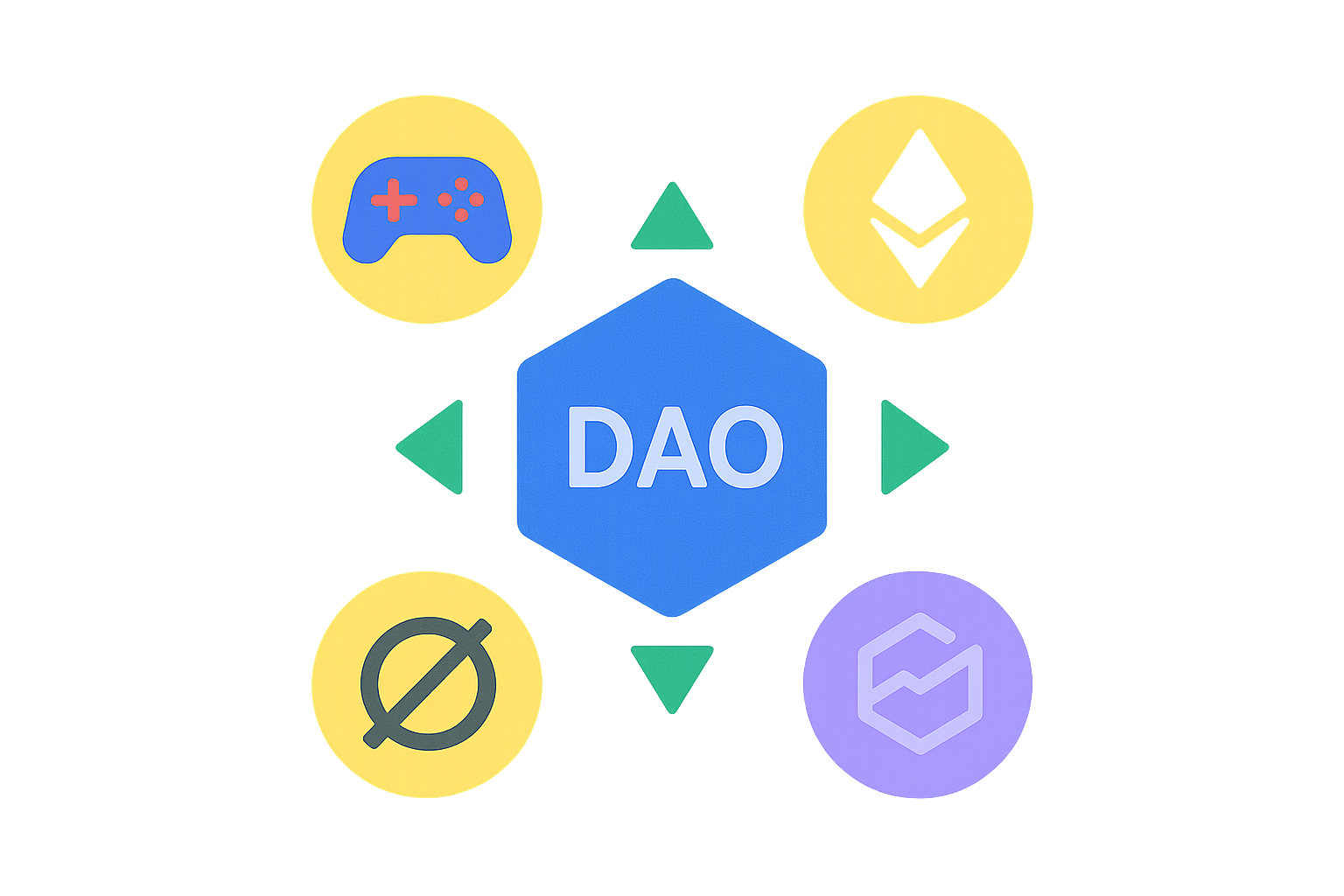
This comprehensive guide explores Decentralized Autonomous Organizations (DAOs) revolutionizing Play-to-Earn gaming investment through community-governed asset acquisition and blockchain technology. The article examines how DAOs like Yield Guild Games combine gaming guilds with investment funds to democratize access to high-value virtual assets, scholarship programs, and revenue generation for global players. It analyzes the DAO gaming investment model's mechanics, including virtual asset acquisition, community governance, and subDAO localization strategies, while addressing economic potential in a market projected to grow from 37.5 billion to 183 billion dollars by mid-2030s. The piece explores blockchain and AI integration transforming gaming ecosystems, evaluates challenges such as regulatory risks and pay-to-win dynamics, and outlines future trends including quality focus and mainstream adoption. Essential reading for investors, gamers, and Web3 enthusiasts seeking to understand this transformative inters
2026-01-20 01:17:22
What is OSMO: A Comprehensive Guide to Osmosis Protocol and Its Role in Decentralized Finance

What is OSMO: A Comprehensive Guide to Osmosis Protocol and Its Role in Decentralized Finance

Osmosis is an advanced decentralized exchange (DEX) and automated market maker (AMM) protocol built on the Cosmos ecosystem, designed to address limitations of traditional DeFi platforms. This comprehensive guide explores Osmosis's technical architecture, market dynamics, and ecosystem applications. The article covers the protocol's origin, operational mechanisms including Proof of Stake consensus and cross-chain interoperability via IBC, and OSMO token economics with current market metrics. Discover how Osmosis enables customizable liquidity pools, governance participation, and DeFi innovation while examining challenges, community engagement, and future development roadmap. Whether you're a trader, developer, or DeFi participant, this guide explains how to purchase OSMO on Gate, participate in governance, and leverage Osmosis's unique features within decentralized finance.
2026-01-20 00:42:58
Is Audius (AUDIO) a good investment?: A Comprehensive Analysis of the Decentralized Music Streaming Platform's Potential and Risks

Is Audius (AUDIO) a good investment?: A Comprehensive Analysis of the Decentralized Music Streaming Platform's Potential and Risks

This comprehensive guide analyzes whether Audius (AUDIO) represents a viable investment opportunity within the decentralized music streaming sector. The article examines AUDIO's current market position (trading at $0.02981 with a $41.4 million market cap), historical price performance showing a 78.35% decline over the past year, and multi-year price projections ranging from $0.0197 to $0.0653 by 2031. Core investment considerations include the token's unlimited supply mechanism, governance utility, moderate liquidity across 35 exchanges, and technical infrastructure comprising content nodes and discovery networks. The analysis addresses critical investment risks including market volatility, regulatory uncertainties, competitive pressures, and moderate trading volumes. Recommended strategies differentiate between conservative dollar-cost averaging approaches, active technical trading for experienced investors, and institutional allocation frameworks. The verdict balances AUDIO's decentralized music platform po
2026-01-20 00:22:50
Shiba Developers Project: Exploring the Future Expansion of the Shiba Inu Ecosystem

Shiba Developers Project: Exploring the Future Expansion of the Shiba Inu Ecosystem

The Shiba Inu ecosystem has evolved from a meme coin into a comprehensive digital platform with robust utility and innovation. This article explores the ecosystem's transformation through multiple strategic initiatives including Shibarium Layer 2 blockchain for scalability, enhanced security protocols, and decentralized governance via Doggy DAO. The project introduces new tokens—LEASH v2, TREAT, and SHI stablecoin—to diversify utility and create multiple value streams. Developers are integrating artificial intelligence for optimized user experiences and governance tools, while establishing real-world partnerships with entities like Gate for trading and sustainable initiatives. The vision extends to creating a self-governing digital nation through decentralized mechanisms and community participation. The article details the ecosystem's ambitious roadmap including Layer 3 development, metaverse expansion, mobile applications, and enterprise solutions, positioning Shiba Inu developers as pioneers in combining bl
2026-01-19 23:15:00
What Are Governance Tokens?

What Are Governance Tokens?

This comprehensive beginner's guide explores governance tokens, the fundamental tools enabling decentralized decision-making in blockchain projects. Governance tokens grant holders voting rights on critical protocol decisions, treasury allocation, and strategic direction across DEXs, DAOs, and blockchain games. The guide traces their evolution from Ethereum's pioneering role through landmark projects like The DAO and MakerDAO's MKR token, demonstrating how governance mechanisms drive community engagement and protocol success. Learn how on-chain and off-chain voting systems operate, understand the distinctions between governance tokens and utility tokens, and discover the advantages—including true decentralization and economic alignment—alongside challenges like whale concentration and voter apathy. Explore innovative anti-whale mechanisms and emerging legal frameworks reshaping DAO governance, plus practical insights on acquiring governance tokens through trading on Gate and maximizing your participation in d
2026-01-19 22:52:13
Hex, Richard, and ETH: How Richard Heart's Legal Victory Redefines Crypto Regulation

Hex, Richard, and ETH: How Richard Heart's Legal Victory Redefines Crypto Regulation

Richard Heart achieved a historic legal victory against the SEC, with a federal court dismissing all claims against him and establishing a significant precedent that truly decentralized, open-source protocols may fall outside securities jurisdiction. This landmark ruling directly impacts HEX, an Ethereum-based certificate of deposit enabling high-yield staking, and PulseChain, a Layer 1 blockchain addressing Ethereum's scalability and gas fee challenges. Despite persistent criticisms regarding centralization, transparency, and tokenomics sustainability, both projects maintain active communities and technical functionality. The case illuminates the SEC's regulatory challenges in applying traditional securities laws to decentralized systems, reshaping how regulators approach blockchain technology. For the crypto industry, this victory reinforces the critical importance of genuine decentralization, transparent governance, and immutable code as both technical principles and legal defenses. The outcome establishes
2026-01-19 22:49:41
What is SXP: A Comprehensive Guide to Swipe's Native Cryptocurrency Token

What is SXP: A Comprehensive Guide to Swipe's Native Cryptocurrency Token

This comprehensive guide explores SXP (Solar), a community-driven Layer 1 blockchain platform launched in 2019 by Swipe and rebranded in 2022. Solar operates through decentralized network governance, secure cryptographic transactions, and public ledger technology without central control. As of 2026, the token maintains approximately 23,979 active holders with a market capitalization of $42.15 million, currently trading at $0.063 on Gate and other exchanges. The platform addresses cryptocurrency asset storage and multi-asset management challenges while enabling decentralized governance and blockchain infrastructure. Solar's ecosystem supports blockchain services, community-driven decision-making, and DeFi applications. Despite market volatility and competitive pressures, Solar's focus on decentralization, security, and community participation positions it as a governance-oriented blockchain solution for both new and experienced participants.
2026-01-19 22:43:33
Balancer, ETH, and Tornado: Inside the $116M DeFi Hack You Should Know About

Balancer, ETH, and Tornado: Inside the $116M DeFi Hack You Should Know About

Explore the $116M Balancer hack: examining smart contract vulnerabilities, Tornado Cash’s involvement, systemic risks in DeFi, and key security takeaways to protect against attacks in decentralized finance.
2026-01-19 22:30:11
What is LISTA: A Comprehensive Guide to Linear Scans with Learned Cost Models for Approximate Nearest Neighbor Search

What is LISTA: A Comprehensive Guide to Linear Scans with Learned Cost Models for Approximate Nearest Neighbor Search

This comprehensive guide explores LISTA, a decentralized stablecoin lending protocol powered by liquid staking derivatives on BSC. Launched in 2024, Lista DAO addresses inefficiencies in DeFi through its innovative lisUSD stablecoin and liquid staking mechanisms. The article covers Lista's technical architecture leveraging blockchain security and smart contracts, market performance metrics including 142,103 holders and $44.6 million market cap, and ecosystem applications. It examines community sentiment, regulatory challenges, and competitive dynamics within the DeFi landscape. Readers will discover how to purchase LISTA on Gate and other exchanges, participate in governance, and understand the protocol's future development direction. Ideal for DeFi investors, developers, and those seeking alternatives to traditional stablecoin solutions.
2026-01-19 18:44:26
Uniswap Protocol Burn: How the 'UNIfication' Proposal Could Reshape DeFi

Uniswap Protocol Burn: How the 'UNIfication' Proposal Could Reshape DeFi

The UNIfication proposal represents a transformative governance initiative for Uniswap, a leading decentralized exchange on Gate, designed to reshape tokenomics and value distribution. This comprehensive framework activates a protocol fee switch, implements a 100 million UNI token retroactive burn mechanism, and consolidates ecosystem teams under unified growth strategy. The proposal addresses long-standing community concerns about UNI token holder value accrual through innovative mechanisms like the Token Jar and Fire Pit. By redirecting protocol fees to sustainable token burns while maintaining liquidity provider incentives via auction systems, Uniswap aims to create an aligned economic model benefiting all stakeholders. The consolidation streamlines governance structures while Uniswap Labs shifts from direct monetization to protocol-level growth. With substantial trading volumes exceeding $150 billion monthly and $229 million in fees, UNIfication positions Uniswap for sustainable DeFi ecosystem leadership
2026-01-19 17:25:20
What is YGG: A Comprehensive Guide to Yield Guild Games and Its Role in the Play-to-Earn Gaming Revolution

What is YGG: A Comprehensive Guide to Yield Guild Games and Its Role in the Play-to-Earn Gaming Revolution

Yield Guild Games (YGG) is a pioneering decentralized autonomous organization revolutionizing play-to-earn gaming by providing NFT investment opportunities and community-driven governance. Launched in 2021 to address earning barriers in blockchain gaming, YGG operates as an Ethereum-based DAO with 709.92 million tokens in circulation and 23,212 active holders. The token enables governance participation through staking and voting while facilitating NFT asset management across gaming ecosystems like Axie Infinity. Despite price volatility and competitive pressures, YGG maintains strong community engagement and clear strategic direction. With multiple trading pairs available on Gate and other exchanges, YGG represents a distinctive infrastructure for decentralized gaming economies. This comprehensive guide explores YGG's technical architecture, market metrics, ecosystem applications, and future potential for both newcomers and experienced cryptocurrency participants.
2026-01-19 16:42:45
DAO Investment Game: How Decentralized Organizations Are Revolutionizing Play-to-Earn Gaming

DAO Investment Game: How Decentralized Organizations Are Revolutionizing Play-to-Earn Gaming

Discover DAOs and their role within Web3. Dive into Play-to-Earn gaming, decentralized governance structures, income opportunities in blockchain games, subDAOs, and the projected future of P2E gaming, which could reach $183 billion by 2034.
2026-01-19 16:15:10
What is YGG: A Comprehensive Guide to Yield Guild Games and Its Impact on Play-to-Earn Gaming

What is YGG: A Comprehensive Guide to Yield Guild Games and Its Impact on Play-to-Earn Gaming

This comprehensive guide explores Yield Guild Games (YGG), a pioneering decentralized autonomous organization (DAO) revolutionizing play-to-earn gaming since 2021. YGG operates as a gaming guild combining NFT investment, community governance, and scholarship programs to democratize access to blockchain gaming economies. The article examines YGG's decentralized operational model, market performance metrics including current trading price and volatility patterns, and ecosystem applications across GameFi platforms. Readers will discover how YGG tokens function through staking and governance participation, strategic NFT portfolio management, and SubDAO regional expansion. The guide addresses market challenges, community sentiment, and participation opportunities on Gate, positioning YGG as a critical infrastructure provider in the Web3 gaming sector with significant growth potential despite current market volatility.
2026-01-19 14:44:00
Jumper to
Page