What Is Symmetric Key Encryption: Advantages and Vulnerabilities

What Is Symmetric Key Encryption: Advantages and Vulnerabilities

This article explores symmetric encryption, a fundamental cryptographic method using a single key for both encryption and decryption operations. It addresses critical aspects for enterprises and security professionals: core mechanisms, advantages including high-speed processing for bulk data, inherent vulnerabilities like key management challenges, and mitigation strategies. The guide covers common algorithms such as AES, DES, and 3DES, highlighting AES as the industry standard. Practical applications span data transmission, storage encryption, and financial systems. Key sections detail secure key generation using cryptographic random generators, safe storage via hardware security modules, and performance comparisons demonstrating symmetric encryption's superior efficiency over asymmetric methods. This comprehensive resource helps organizations implement robust symmetric encryption strategies while managing associated security risks effectively.
Blockchain
Web 3.0
Crypto Tutorial
Crypto glossary
2026-01-14 01:42:45
Kite: Complete Guide to the AI Agents Economy

Kite: Complete Guide to the AI Agents Economy

Kite is a Layer-1 blockchain infrastructure designed to power the emerging AI agent economy by enabling autonomous AI agents to function as first-class economic actors. The platform solves a critical bottleneck: granting AI agents financial autonomy while maintaining security through its innovative three-layer identity architecture, programmable constraints, and native micropayment channels. The KITE token serves as the network's medium of exchange, staking mechanism, and governance tool, enabling AI agents to pay for services, manage wallets, and coordinate with other systems at scale. Backed by experienced founders from Databricks and Uber, Kite combines cutting-edge blockchain technology with AI expertise to unlock a multi-trillion-dollar agent economy. The platform's SPACE framework—featuring stablecoin settlement, programmable rules, agent-centric authentication, compliance readiness, and economically viable micropayments—creates a secure foundation for machine-to-machine commerce. This article explores
AI
Web 3.0
Blockchain
DeFi
Crypto Ecosystem
2026-01-14 01:32:30
What is Kadena: Network Design with Next Level Scaling

What is Kadena: Network Design with Next Level Scaling

Kadena is a Layer-1 Proof-of-Work blockchain solving the blockchain trilemma through innovative Chainweb architecture combining 20 parallel chains to achieve 480,000 transactions per second while maintaining Bitcoin-level security and decentralization. Founded by JPMorgan and SEC veterans with cryptography pioneer Dr. Stuart Haber on board, Kadena offers enterprise-grade solutions with unique features including Pact Turing-complete smart contracts and energy-efficient mining. The KDA token powers the ecosystem with fixed 1 billion supply, while strategic partnerships with Fortune 100 companies and ecosystem developments like Kaddex DEX position Kadena for institutional adoption. Ideal for investors seeking scalable blockchain infrastructure with proven leadership and real-world enterprise applications.
Blockchain
PoW
Layer 2
DeFi
Altcoins
2026-01-14 01:22:44
What is RENDER: A Comprehensive Guide to Understanding Real-Time Rendering Technology and Its Applications in Modern Graphics

What is RENDER: A Comprehensive Guide to Understanding Real-Time Rendering Technology and Its Applications in Modern Graphics

Render Network is a decentralized GPU computing infrastructure built on Solana, addressing the inefficiency of centralized rendering services since its 2017 launch by OTOY. This comprehensive guide explores Render's technical architecture, market performance, and ecosystem applications for 3D rendering, AI computing, and GPU-intensive workloads. With over 113,000 token holders and a circulating market cap of $1.23 billion, Render demonstrates significant adoption in the decentralized computing space. The article covers key milestones, on-chain metrics, strategic partnerships, and community engagement on platforms like X. Whether for content creators, GPU providers, or cryptocurrency investors, Render offers compelling opportunities through its peer-to-peer compute marketplace, available on Gate and other exchanges, with strong growth potential despite competitive challenges and market volatility.
DePIN
AI
Solana
Blockchain
Altcoins
2026-01-14 00:45:01
What is ARB: A Comprehensive Guide to Arbitrum and Its Role in Ethereum Layer 2 Scaling

What is ARB: A Comprehensive Guide to Arbitrum and Its Role in Ethereum Layer 2 Scaling

Arbitrum is a leading Layer 2 scaling solution for Ethereum launched by Offchain Labs in 2021, utilizing Optimistic Rollup technology to address Ethereum's high transaction costs and network congestion. This comprehensive guide explores Arbitrum's technical architecture, market performance, and ecosystem applications. ARB token holders can participate in governance through the Arbitrum DAO while enjoying reduced gas fees and faster transactions. The guide covers core use cases in DeFi, NFTs, and gaming, current market metrics with 17,428 token holders, and how to acquire and store ARB tokens on Gate.com. Whether you're new to blockchain or experienced, this article provides essential insights into Arbitrum's role in Ethereum scaling and opportunities for community participation and ecosystem engagement.
Layer 2
Ethereum
DeFi
Blockchain
Web 3.0
2026-01-14 00:44:07
What is ATOM: A Comprehensive Guide to Understanding the Revolutionary Blockchain Protocol

What is ATOM: A Comprehensive Guide to Understanding the Revolutionary Blockchain Protocol

This comprehensive guide explores Cosmos (ATOM), the revolutionary blockchain protocol designed as the "Internet of Blockchains" that solves interoperability challenges through its innovative IBC protocol and Tendermint consensus mechanism. The article examines Cosmos's technical architecture, including its modular blockchain design and decentralized network structure, while analyzing its market performance with a circulating supply of 487.9 million ATOM tokens and $1.29 billion market capitalization as of January 2026. Readers will discover core use cases spanning cross-chain communication, DeFi applications, and developer tools, alongside practical guidance on purchasing ATOM via Gate, securing tokens, and participating through staking mechanisms. Whether you're a blockchain developer, investor, or enthusiast interested in next-generation interoperability solutions, this guide provides essential insights into Cosmos's ecosystem expansion, community engagement, and strategic positioning in the competitive mu
Cosmos
Blockchain
DeFi
Crypto staking
Altcoins
2026-01-14 00:43:45
What is KAS: A Comprehensive Guide to Kaspa's Native Cryptocurrency and Blockchain Technology

What is KAS: A Comprehensive Guide to Kaspa's Native Cryptocurrency and Blockchain Technology

Kaspa (KAS) is a Layer-1 blockchain implementing the innovative GHOSTDAG protocol to revolutionize blockchain scalability and transaction confirmation speed. Launched in 2021 by an anonymous development team, Kaspa operates as a decentralized network with over 541,000 holders and demonstrates strong community engagement. This comprehensive guide examines Kaspa's technical architecture combining proof-of-work consensus with blockDAG technology, analyzes its market performance including current pricing and on-chain metrics, and explores its ecosystem applications and mining infrastructure. Readers will discover how to participate through Gate.com exchanges, understand the competitive advantages and challenges facing Kaspa, and gain insights into its long-term roadmap for establishing scalable decentralized infrastructure for high-performance transactions.
Blockchain
PoW
Layer 2
Mining
Altcoins
2026-01-14 00:42:35
What Is a Bonding Curve in Crypto and How Does It Work?

What Is a Bonding Curve in Crypto and How Does It Work?

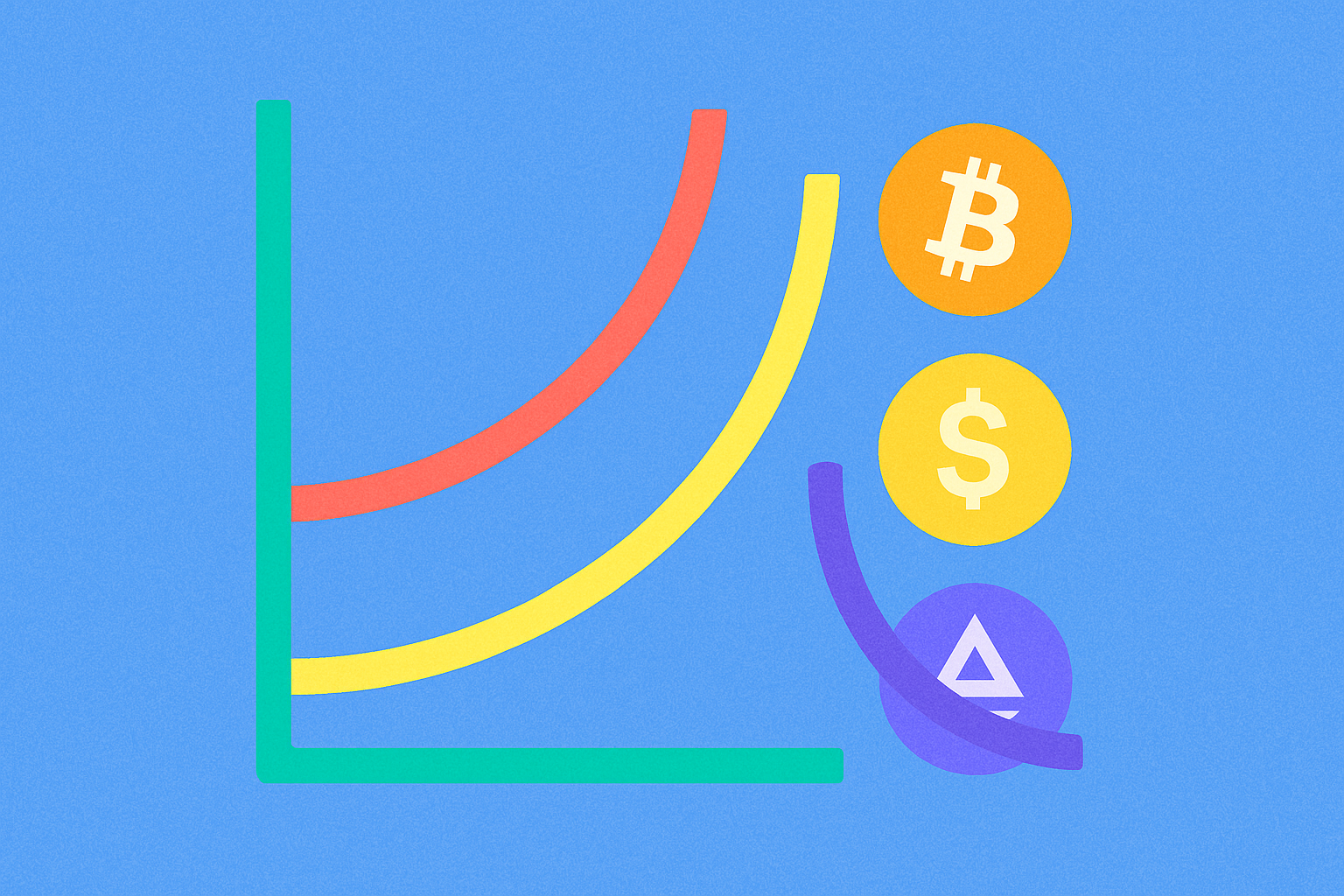
Bonding curves are automated market makers that dynamically calculate token prices based on supply using mathematical formulas, enabling continuous liquidity without centralized exchanges. This guide explores how bonding curves work through practical examples, revealing how early investors benefit from lower prices while developers maintain transparent, predictable token economics. The article covers real-world applications including decentralized exchanges like Uniswap on Gate, token sales, stablecoins, and DAOs, demonstrating their versatility across crypto ecosystems. Four primary bonding curve types—linear, quadratic, sigmoid, and negative exponential—serve different strategic objectives from rewarding early adoption to maintaining stable costs. While bonding curves offer significant advantages like fair pricing, automatic liquidity, and bootstrap funding, they carry risks including price volatility, whale manipulation, and smart contract vulnerabilities. Understanding bonding curve mechanics, curve shape
DeFi
Blockchain
Web 3.0
DAO
Stablecoin
2026-01-14 00:39:00
What Are RWAs? A Comprehensive Guide to Real-World Assets in Crypto

What Are RWAs? A Comprehensive Guide to Real-World Assets in Crypto

Real-World Assets (RWAs) represent a $35.75 billion market revolutionizing finance by tokenizing tangible assets—bonds, gold, stocks—onto blockchain networks. This comprehensive guide explains what RWAs are, how tokenization works through asset verification and oracle integration, and why they deliver fractional ownership, enhanced transparency, and access to DeFi tools. RWA types span stablecoins, government bonds, commodities, equities, and institutional funds, each offering unique benefits and traded on platforms like Gate. The sector grows through clearer regulatory frameworks (like EU's MiCA), advanced blockchain infrastructure, major institutional adoption, and global accessibility that democratizes investment opportunities. However, investors must navigate regulatory uncertainties, technical vulnerabilities, liquidity challenges, and management risks. Understanding RWA mechanisms, types, advantages, and risks enables informed investment decisions in this transformative asset class bridging traditional
RWA
Stablecoin
DeFi
Blockchain
Web 3.0
2026-01-14 00:34:55
2025 KAS Price Prediction: Expert Analysis and Market Outlook for Kaspa's Future Value

2025 KAS Price Prediction: Expert Analysis and Market Outlook for Kaspa's Future Value

Kaspa (KAS), a Layer-1 blockchain implementing the innovative GHOSTDAG protocol for parallel block creation, currently trades at $0.04852 with a $1.30 billion market cap on Gate and 31 other exchanges. This comprehensive analysis examines KAS's market position, historical price movements from its 2022 low of $0.00017105 to its 2024 peak of $0.207411, and identifies core drivers including token emission mechanics, institutional mining support, and ecosystem development. The article provides detailed price outlooks from 2026-2031 across conservative, neutral, and optimistic scenarios, with 2031 ranging from $0.03332 to $0.06725. Tailored investment strategies address beginners, experienced traders, and institutions, emphasizing dollar-cost averaging, technical analysis, and risk management through portfolio diversification. Essential risk considerations include price volatility, regulatory uncertainty for proof-of-work systems, and competition within the Layer-1 landscape, enabling informed decision-making for
Altcoins
PoW
Layer 2
Blockchain
Crypto Insights
2026-01-14 00:33:33
DeFi vs. CeFi: What Is the Difference?

DeFi vs. CeFi: What Is the Difference?

This comprehensive guide explores Centralized Finance (CeFi) and Decentralized Finance (DeFi) platforms, helping cryptocurrency users understand which model aligns with their needs. CeFi platforms like Gate offer user-friendly interfaces, regulatory compliance, and customer support, making them ideal for beginners seeking stability and convenient fiat on-ramps. DeFi protocols deliver greater autonomy, transparency, and privacy through smart contracts, appealing to experienced users prioritizing control over their assets. The article examines critical differences including trust mechanisms, regulatory frameworks, privacy considerations, and market size. While CeFi dominates in adoption and liquidity, DeFi innovates through composable financial products and permissionless access. Whether you value convenience and security or sovereignty and transparency, this guide clarifies each ecosystem's advantages, risks, and practical applications for informed decision-making in cryptocurrency investing.
DeFi
Blockchain
Crypto Tutorial
Crypto Trading
How to buy crypto
2026-01-14 00:25:58
What Is Enso? A Comprehensive Guide to Its Importance and Future in Web3

What Is Enso? A Comprehensive Guide to Its Importance and Future in Web3

Enso is a revolutionary Layer-0 platform simplifying cross-chain DeFi development by providing a unified interface and reusable building blocks called Shortcuts. The platform has reduced development time from six months to one week and achieved over $17 billion in on-chain transaction volume across 100+ projects. ENSO token serves multiple critical functions including network fee payments, validator staking, governance, and access to premium features. With a fixed supply model reaching 127.34 million tokens by year 10, the carefully structured tokenomics align long-term incentives between stakeholders. Enso partnerships with industry leaders like Uniswap and LayerZero, combined with recent milestones including community token sales and DeFi deposit launches, demonstrate strong market validation. While presenting high-potential opportunities in the expanding cross-chain infrastructure sector, investors should consider execution risks, competitive pressures, and token volatility as part of comprehensive due dil
DeFi
Web 3.0
Blockchain
Altcoins
Layer 2
2026-01-14 00:22:08
What is Momentum? A Comprehensive Guide to Sui's DeFi Liquidity Token

What is Momentum? A Comprehensive Guide to Sui's DeFi Liquidity Token

Explore the MMT token from Momentum Finance—covering governance, DeFi rewards on Sui, the ve system, and purchase methods. This comprehensive guide details tokenomics and key functionalities.
DeFi
Blockchain
Web 3.0
Altcoins
Crypto Tutorial
2026-01-14 00:18:15
ALGO vs CRO: Comprehensive Comparison of Two Leading Blockchain Platforms and Their Investment Potential

ALGO vs CRO: Comprehensive Comparison of Two Leading Blockchain Platforms and Their Investment Potential

This comprehensive guide compares Algorand (ALGO) and Cronos (CRO), two leading blockchain platforms with distinct market positioning. ALGO focuses on blockchain infrastructure efficiency driven by MIT cryptography expertise, while CRO emphasizes payment ecosystem integration through Crypto.com's platform serving over 100 million users. The article analyzes historical price trends, tokenomics, institutional adoption, technical ecosystems, and investment strategies across multiple time horizons. Current market data shows ALGO trading at $0.13884 with $1.23 billion market cap, while CRO trades at $0.10277 with $3.97 billion market cap. Through detailed risk assessment, price predictions through 2031, and strategic allocation frameworks, readers gain actionable insights for informed investment decisions based on their risk tolerance and investment horizon.
Altcoins
Investing In Crypto
Crypto Insights
DeFi
Blockchain
2026-01-14 00:18:03
Comprehensive Guide to TXID: How to Locate a Cryptocurrency Transaction ID on the Blockchain and Its Importance

Comprehensive Guide to TXID: How to Locate a Cryptocurrency Transaction ID on the Blockchain and Its Importance

Discover what a TXID is in blockchain technology and how to utilize it. This comprehensive guide provides a detailed explanation of transaction identifiers, outlines methods for tracking a TXID within your wallet, explains how to search for transactions on the blockchain, and demonstrates how to use block explorers to verify payments. Essential reading for crypto investors and traders.
Blockchain
Crypto Tutorial
Crypto glossary
Web3 wallet
Bitcoin
2026-01-13 23:53:03
Jumper to
Page