Explore the revolutionary role of Usual in the decentralized finance world as a secure fiat-backed stablecoin, launched in 2024 to combat financial inequality. The article delves into Usual's architecture, market performance with over 1 billion circulating tokens, and community dynamics. It addresses Usual's decentralized control and blockchain technology to ensure transparency and security in transactions. Challenges like market volatility and adoption hurdles are discussed, alongside strategic use cases and social media engagement. Learn how to acquire Usual on Gate and participate in its ecosystem development. Discover more through Usual's official website and whitepaper for in-depth insights.
Usual's Positioning and Significance
In 2024, Usual (USUAL) was launched as a secure and decentralized fiat-backed stablecoin issuer. It aims to address financial inequality and value redistribution through the $USUAL token.
As a pioneering decentralized stablecoin platform, Usual plays a crucial role in the DeFi and stablecoin sectors.
As of 2025, Usual has become an emerging player in the stablecoin market, with a circulating supply of over 1 billion tokens and an active community of 21,843 holders. This report will analyze its technical architecture, market performance, and future potential.
Origins and Development History
Background
Usual was created in 2024 to tackle the challenges of financial inequality and inefficient value distribution in traditional financial systems. It emerged during a period of growing interest in decentralized finance and stablecoins, aiming to provide a secure and decentralized alternative to existing fiat-backed stablecoins.
The launch of Usual introduced new possibilities for users seeking stable assets with decentralized ownership and value redistribution mechanisms.
Key Milestones
- 2024: Mainnet launch, introducing a decentralized fiat-backed stablecoin with innovative value redistribution features.
- 2025: Ecosystem growth, with the number of holders reaching over 21,000.
Supported by its community and development team, Usual continues to optimize its technology, security, and real-world applications in the stablecoin and DeFi sectors.
How Does Usual Work?
Decentralized Control
Usual operates on a decentralized network of computers (nodes) spread across the globe, free from control by banks or governments. These nodes collaborate to validate transactions, ensuring system transparency and attack resistance, granting users greater autonomy and enhancing network resilience.
Blockchain Core
Usual's blockchain is a public, immutable digital ledger that records every transaction. Transactions are grouped into blocks and linked through cryptographic hashes, forming a secure chain. Anyone can view the records, establishing trust without intermediaries.
Ensuring Fairness
Usual utilizes the Ethereum blockchain's consensus mechanism to validate transactions and prevent fraudulent activities like double-spending. Participants maintain network security through activities such as staking or running nodes, receiving USUAL tokens as rewards.
Secure Transactions
Usual employs public-private key encryption to protect transactions:
- Private keys (similar to secret passwords) are used to sign transactions
- Public keys (similar to account numbers) are used to verify ownership
This mechanism ensures fund security while maintaining a level of pseudonymity for transactions.
USUAL's Market Performance
Circulation Overview
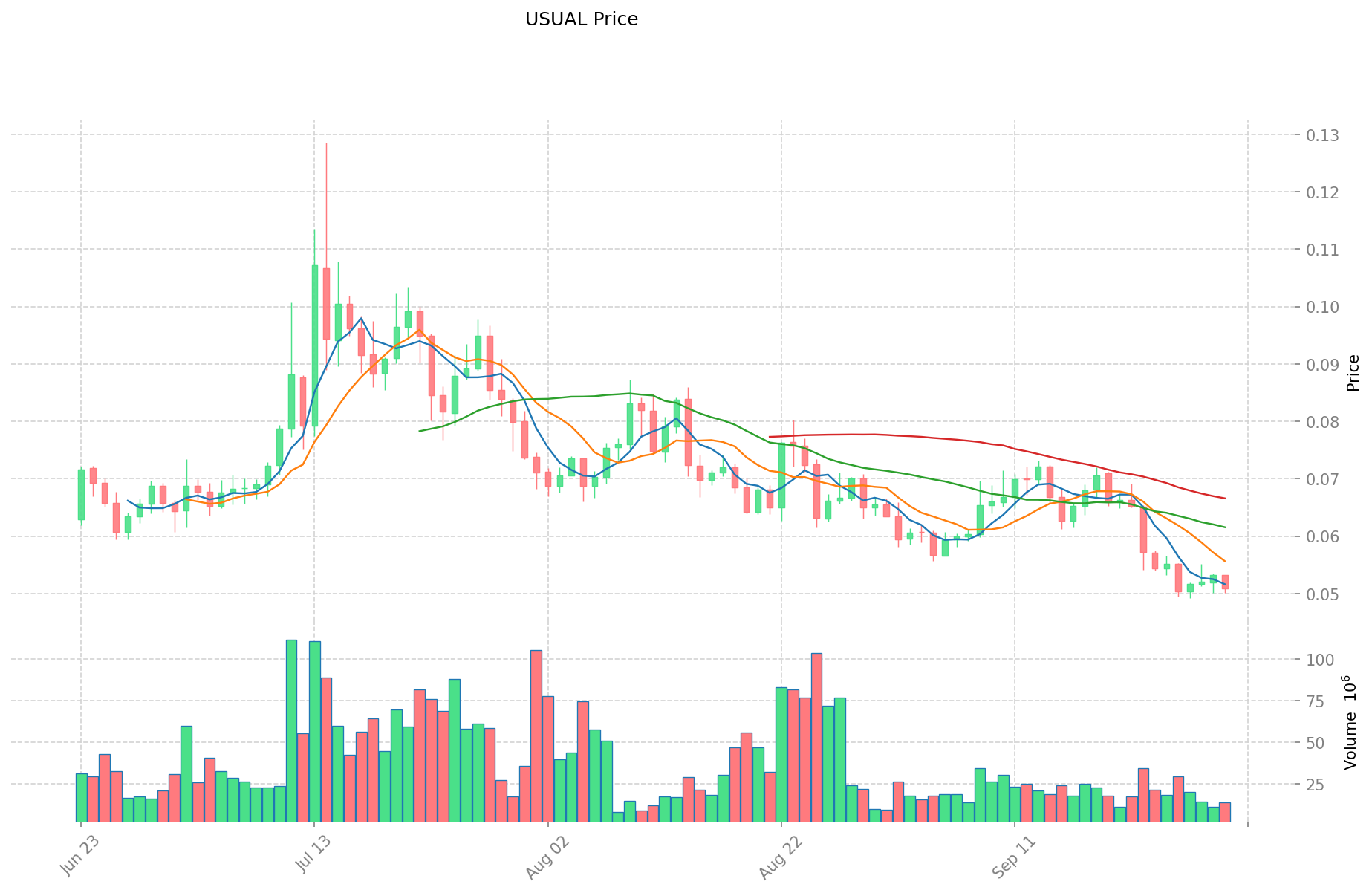
As of September 30, 2025, USUAL's circulating supply is 1,048,664,295.5183752 tokens, with a total supply of 898,406,854. The maximum supply is set at 4,000,000,000 tokens.
Price Fluctuations
USUAL reached its all-time high of $1.6555 on December 20, 2024.
Its lowest price was $0.04915, occurring on September 26, 2025.
These fluctuations reflect market sentiment, adoption trends, and external factors.
Click to view the current market price of USUAL
On-chain Metrics
- Daily Trading Volume: $864,071.7027763 (indicating network activity)
- Active Addresses: 21,843 (reflecting user engagement)
Usual Ecosystem Applications and Partnerships
Core Use Cases
Usual's ecosystem supports various applications:
- Stablecoins: Usual provides a secure and decentralized fiat-backed stablecoin solution.
- Value Redistribution: The $USUAL token enables ownership and value redistribution within the ecosystem.
Strategic Partnerships
Information on specific strategic partnerships is not available in the provided context.
Controversies and Challenges
Usual faces the following challenges:
- Market Volatility: The price has experienced significant fluctuations, with a 88.86% decrease over the past year.
- Adoption: As a relatively new project, Usual may face challenges in gaining widespread adoption and trust.
These issues have likely sparked discussions within the community and market.
Usual Community and Social Media Atmosphere
Fan Enthusiasm
Usual's community shows some activity, with:
- 21,843 holders of the token
- Active presence on X (formerly Twitter) under the handle @usualmoney
Social Media Sentiment
Sentiment on social media platforms like X may vary:
- Supporters might highlight Usual's role in providing a secure and decentralized stablecoin solution.
- Critics may focus on the significant price decline over the past year.
Recent trends suggest a challenging market environment, with the price near its all-time low.
Hot Topics
X users might be discussing Usual's:
- Price performance and market volatility
- Potential for recovery and future growth
- Role in the stablecoin ecosystem
More Information Sources for Usual
- Official Website: Visit Usual's official website for features, use cases, and latest updates.
- Whitepaper: Usual's whitepaper details its technical architecture, goals, and vision.
- X Updates: On X, Usual uses @usualmoney to share updates. Follower count and engagement metrics are not provided in the context.
Usual's Future Roadmap
Specific future roadmap details are not available in the provided context.
How to Participate in Usual?
- Purchase Channels: Buy Usual on Gate.com
- Storage Solutions: Use compatible ERC-20 wallets for secure storage
- Participate in Governance: Information on governance participation is not provided in the context
- Build the Ecosystem: Visit Usual's official documentation for development resources
Summary
Usual aims to redefine digital currency through blockchain technology, offering a secure and decentralized fiat-backed stablecoin solution. Its unique value proposition lies in redistributing ownership and value through the $USUAL token. While facing challenges such as market volatility and the need for wider adoption, Usual's innovative approach to stablecoins and value distribution sets it apart in the cryptocurrency landscape. Despite recent price declines, the project's focus on security and decentralization in the stablecoin space makes it a project worth watching for both newcomers and experienced players in the crypto market.
FAQ
What is the full meaning of usual?
USUAL stands for Utility Staking Unified Asset Layer, a protocol designed to enhance utility and staking in the Web3 ecosystem.
What does its usual mean?
USUAL stands for Utility-Specific User-Aligned Liquidity, a token designed to enhance liquidity and utility in specific Web3 ecosystems.
What is the meaning of as usual?
As usual means behaving or occurring in the typical or expected manner, consistent with past patterns or regular habits.
What does going as usual mean?
It means things are proceeding normally or as expected, without any significant changes or disruptions to the typical pattern or routine.
* The information is not intended to be and does not constitute financial advice or any other recommendation of any sort offered or endorsed by Gate.