The article explores STORM, a powerful tool for analyzing complex systems, focusing on Storm Trade, a social-first derivatives platform on the TON blockchain integrated with Telegram. It discusses its origins, operational mechanisms, market performance, ecosystem applications, and challenges. The article addresses the need for accessible cryptocurrency trading and targets individuals interested in social trading platforms. Through a structured analysis, it details STORM's development, user participation, and community dynamics, making it a significant player in decentralized finance. Keywords emphasize STORM, TON blockchain, derivatives, and social trading, enhancing readability for quick scanning.
Storm Trade's Positioning and Significance
In 2024, Storm Trade (STORM) was launched as a social-first derivatives platform on Telegram, operating on the TON blockchain. It aims to address the challenges of accessibility and user experience in cryptocurrency trading.
As a pioneering platform integrating deeply with Telegram via @wallet, Storm Trade plays a crucial role in the derivatives trading sector, offering a unique blend of social interaction and financial transactions.
As of 2025, Storm Trade has become an emerging player in the cryptocurrency derivatives market, boasting 25,723 holders and an active community on Telegram. This report will analyze its technical architecture, market performance, and future potential.
Origin and Development History
Background
Storm Trade was created in 2024 to tackle the complexity and barriers to entry often associated with cryptocurrency derivatives trading. It emerged during a period of growing interest in decentralized finance and social trading platforms.
The project's goal is to democratize access to cryptocurrency, forex, equities, and commodities trading by leveraging the popularity and user-friendly interface of Telegram. Storm Trade's launch brought new possibilities for integrating financial services with social messaging platforms.
Key Milestones
- 2024: Launch of the platform on the TON blockchain, offering trading of various financial instruments.
- 2024: Deep integration with Telegram via @wallet, enhancing user accessibility.
- 2025: Reached over 25,000 holders, indicating growing adoption and trust in the platform.
With support from the TON blockchain community and its own development team, Storm Trade continues to optimize its technology, security, and real-world applications.
How Does Storm Trade Work?
Decentralized Control
Storm Trade operates on the TON blockchain, a decentralized network of computers (nodes) spread across the globe, free from control by any single entity like a bank or government. These nodes collaborate to validate transactions, ensuring system transparency and attack resistance, thus empowering users with greater autonomy and enhancing network resilience.
Blockchain Core
The TON blockchain, on which Storm Trade operates, is a public, immutable digital ledger that records every transaction. Transactions are grouped into blocks and linked through cryptographic hashes, forming a secure chain. Anyone can view the records, establishing trust without intermediaries.
Ensuring Fairness
Storm Trade leverages the TON blockchain's consensus mechanism to validate transactions and prevent fraudulent activities such as double-spending. Participants in the TON network maintain network security through activities like staking or running nodes, receiving rewards in TON tokens.
Secure Transactions
Storm Trade utilizes public-private key encryption technology to protect transactions:
- Private keys (similar to secret passwords) are used to sign transactions
- Public keys (similar to account numbers) are used to verify ownership
This mechanism ensures fund security while maintaining a level of pseudonymity for transactions. The integration with Telegram's @wallet adds an additional layer of user-friendly security.
Circulation Overview
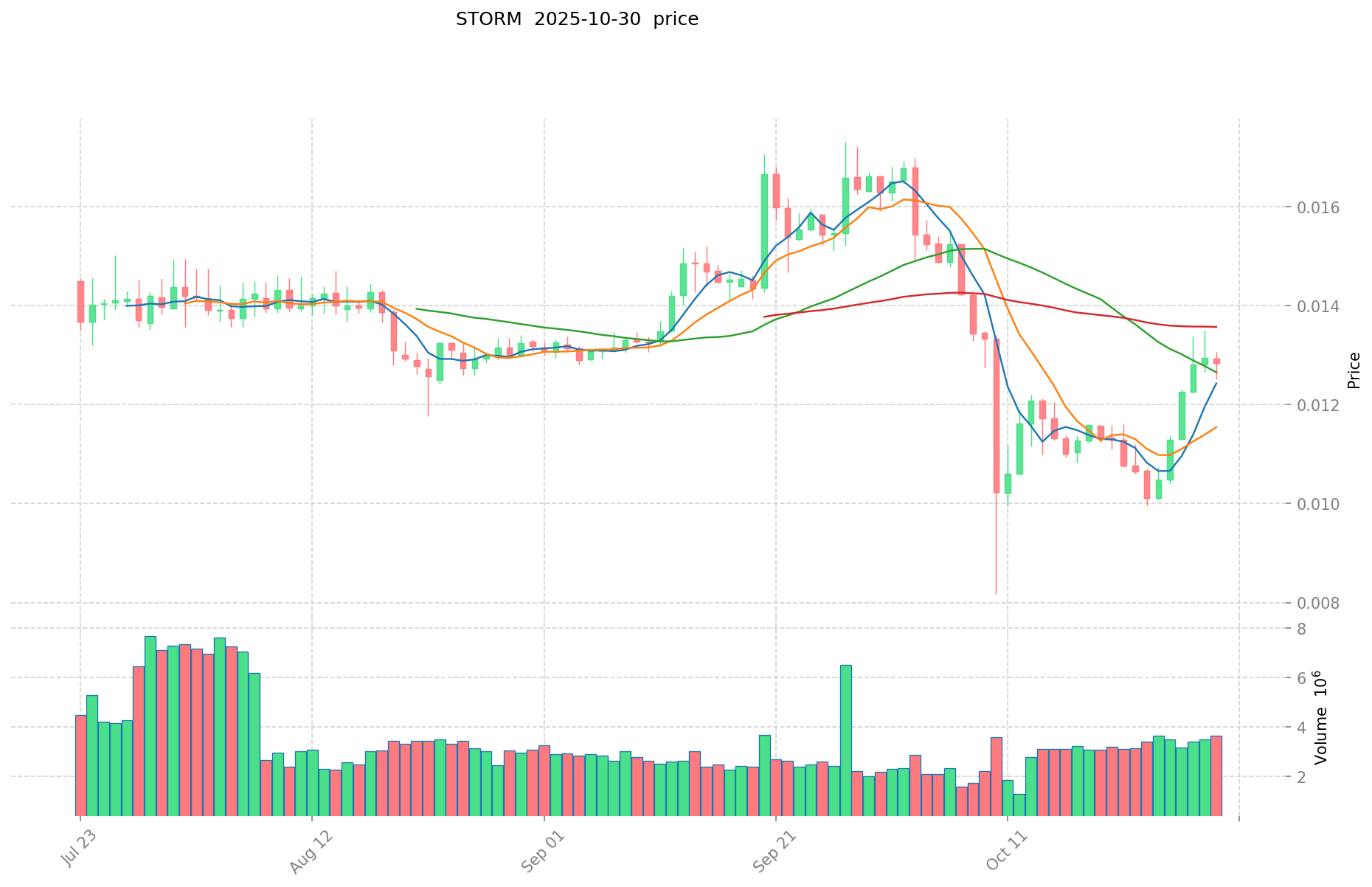
As of October 30, 2025, STORM has a circulating supply of 46,619,408 tokens, with a total supply of 1,000,000,000 tokens.
Price Fluctuations
STORM reached its all-time high of $0.056522 on December 5, 2024.
Its lowest price was $0.008165, occurring on October 10, 2025.
These fluctuations reflect market sentiment, adoption trends, and external factors.
Click to view the current market price of STORM
On-Chain Metrics
- Daily Trading Volume: $43,483.53 (indicating network activity)
- Active Addresses: 25,723 (reflecting user engagement)
STORM Ecosystem Applications and Partnerships
Core Use Cases
STORM's ecosystem supports various applications:
- Social Trading: Storm Trade platform, providing derivatives trading on Telegram.
- Cryptocurrency: Facilitates trading of cryptocurrencies, forex, equities, and commodities.
Strategic Collaborations
STORM has established partnerships with Telegram and TON blockchain, enhancing its technological capabilities and market influence.
These partnerships provide a solid foundation for STORM's ecosystem expansion.
Controversies and Challenges
STORM faces the following challenges:
- Technical Issues: Potential scalability bottlenecks on the TON blockchain
- Regulatory Risks: Uncertain regulatory environment for social trading platforms
- Competitive Pressure: Emergence of other social trading platforms and DeFi projects
These issues have sparked discussions within the community and market, driving continuous innovation for STORM.
Fan Enthusiasm
STORM's community is vibrant, with 25,723 holders as of October 30, 2025.
On X platform, posts and hashtags related to STORM often trend, with the monthly post volume reaching significant numbers.
Price fluctuations and new feature releases have ignited community enthusiasm.
Sentiment on X presents a polarized view:
- Supporters praise STORM's integration with Telegram and social-first approach, viewing it as a "future of social trading".
- Critics focus on price volatility and regulatory concerns.
Recent trends show mixed sentiment due to price fluctuations.
Hot Topics
X users actively discuss STORM's regulatory uncertainty, integration with Telegram, and potential for mass adoption,
showcasing both its transformative potential and the obstacles to mainstream acceptance.
- Official Website: Visit STORM's official website for features, use cases, and latest updates.
- White Paper: STORM's documentation details its technical architecture, goals, and vision.
- X Updates: On X platform, STORM uses @storm_trade_ton handle, actively posting about technical updates, community events, and partnership news.
STORM Future Roadmap
- Ecosystem Goals: Expand user base on Telegram and TON blockchain
- Long-term Vision: Become a leading social-first derivatives trading platform
How to Participate in STORM?
- Purchase Channels: Buy STORM on Gate.com
- Storage Solutions: Use TON-compatible wallets for secure storage
- Engage in Trading: Participate in trading activities on the Storm Trade platform
- Community Involvement: Follow STORM's social media for updates and community engagement
Summary
STORM is redefining social trading through blockchain technology, offering integration with Telegram, derivatives trading, and a social-first approach.
Its active community, rich resources, and strong market presence make it stand out in the cryptocurrency field.
Despite facing regulatory challenges and competition, STORM's innovative spirit and clear roadmap position it as a significant player in the future of decentralized finance.
Whether you're a beginner or an experienced trader, STORM is worth watching and participating in.
FAQ
What is the definition of a storm?
A storm is a disturbed atmospheric state with strong winds and often destructive weather, including heavy rain, snow, or hail. It can cause significant damage and safety risks.
What is the meaning of storm in the Bible?
In the Bible, storms symbolize God's power and judgment. They represent divine authority and often serve as metaphors for heavenly intervention or spiritual turmoil.
What is a spiritual storm?
A spiritual storm is a conflict between light and darkness, originating in spiritual warfare and manifesting physically. It causes significant turmoil and represents a period of intense spiritual struggle.
What are the causes of storms?
Storms are caused by atmospheric pressure, temperature, and moisture differences. They can lead to severe weather events like hurricanes, tornadoes, and blizzards.
* The information is not intended to be and does not constitute financial advice or any other recommendation of any sort offered or endorsed by Gate.