Square
Following
Hot
News
Profile

Kingbest

vip
Active for: 2y
Peak Tier 0
No content yet
0
Following
25
Followers
82
Liked
One of crypto’s biggest inefficiencies is having liquidity and applications that can’t interact without additional infrastructure.
Ethereum has established DeFi protocols. Solana has its own liquidity and native applications.
But developers shouldn’t have to rebuild everything just to access both.
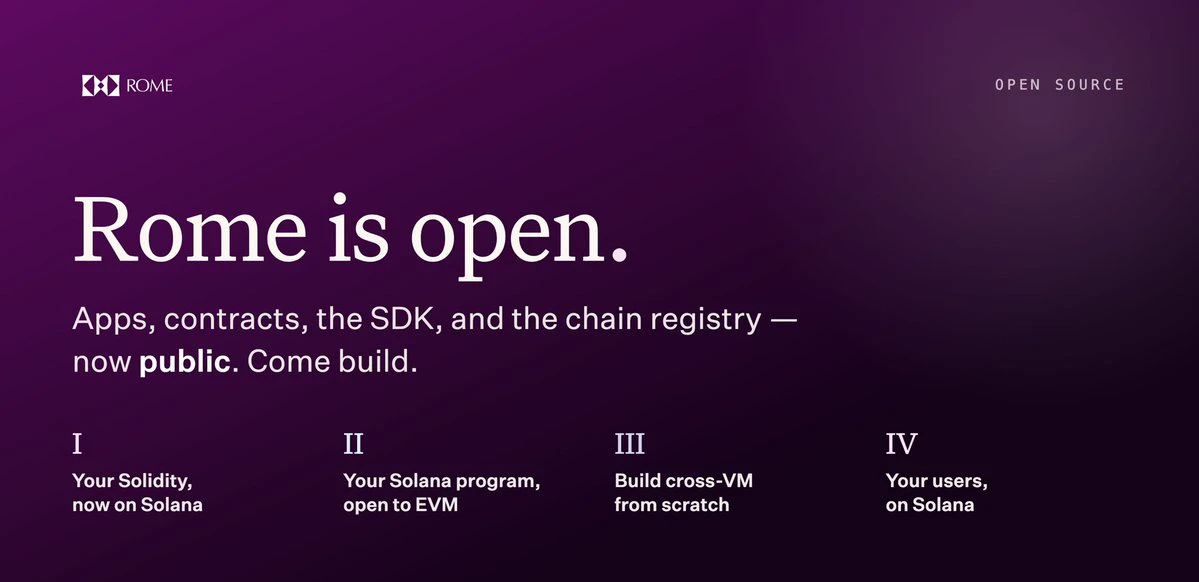
That’s the approach @RomeProtocol is taking.
Rome runs a real EVM inside Solana, allowing Ethereum-compatible applications and Solana programs to share liquidity and state.
> Solidity contracts can run using familiar Ethereum tooling.
> Solana-native programs can interact with EVM applications.
> Bot
post-image
ETH+2.90%
SOL+2.08%
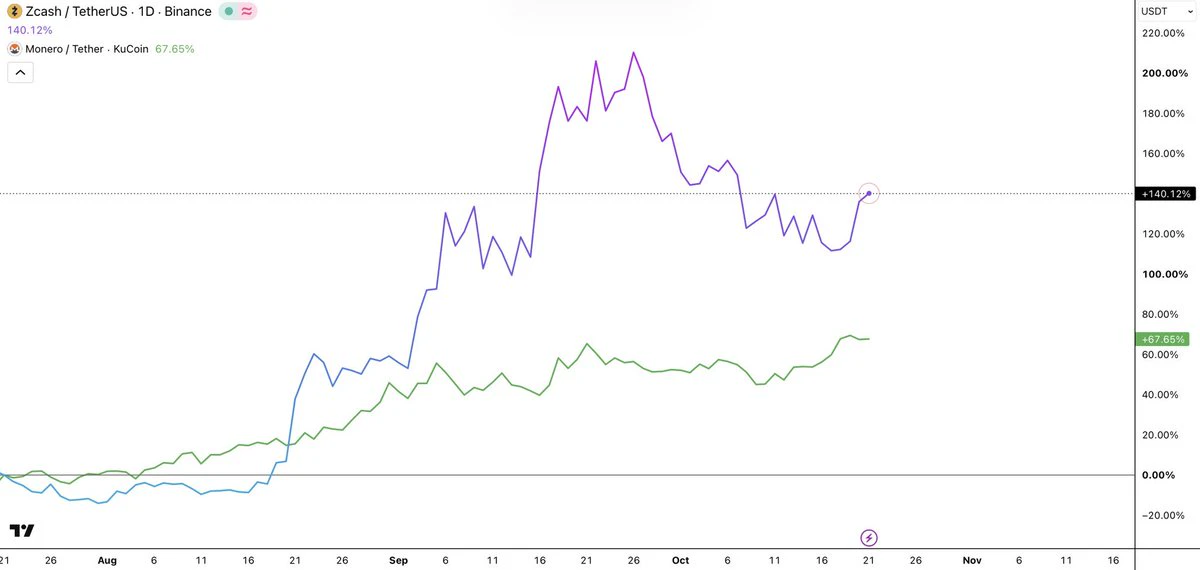
Privacy tokens are getting repriced a lot faster than the underlying usage.
Over the past 90 days:
> $ZEC : +140%
> $XMR : +67%
> @Zcash shielded holdings: +13%
> Shielded supply: 26.04% → 29.15%
Pretty significant divergence.
$ZEC has rallied more than 10x the percentage growth in its shielded holdings, although the two metrics aren’t directly comparable.
Doesn’t mean the rally is unjustified. Just means the market is pricing in considerably more than what’s currently visible in the adoption data.
There are two distinctions being overlooked here.
1. Shielded holdings aren’t the same as private
post-image
ZEC+11.01%
XMR+0.00%
STRK+9.80%
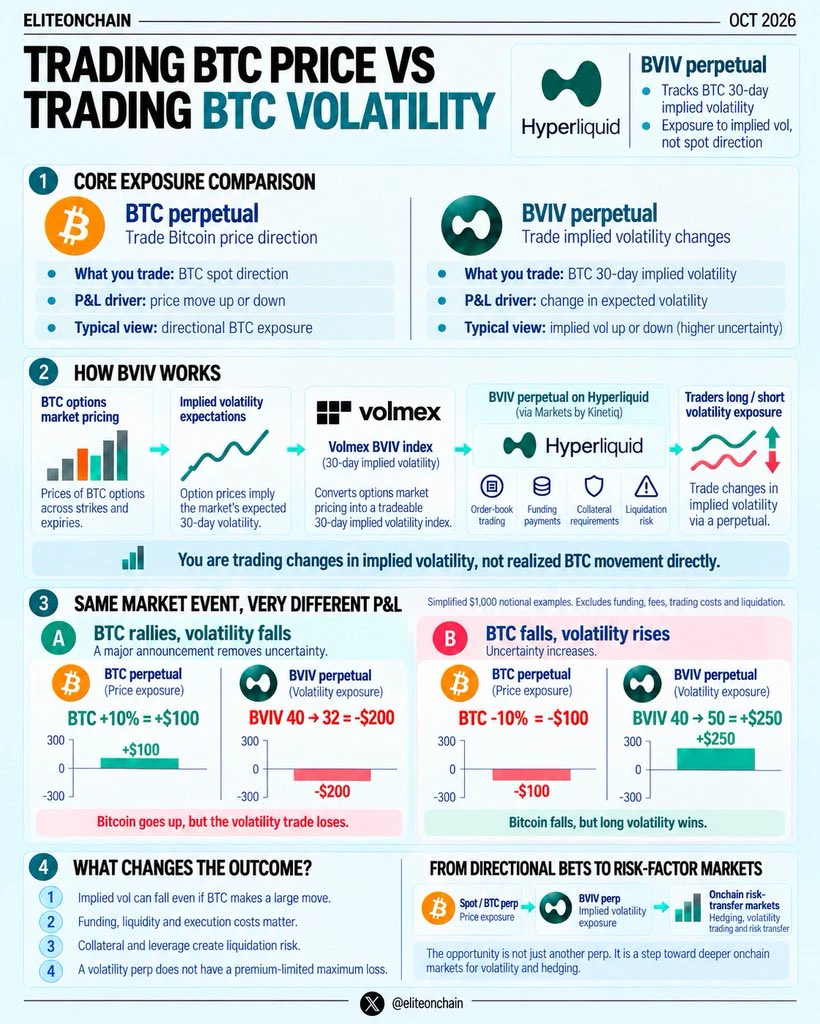
Bitcoin can rally 10%, and you can still lose money betting on Bitcoin volatility.
Sounds counterintuitive, but there’s a difference between betting on BTC’s price and betting on how much uncertainty the options market expects.
And @HyperliquidX now has a market for trading that second exposure directly.
@volmexfinance’s BVIV perpetual, deployed through @Markets_xyz by @Kinetiq_xyz, tracks Bitcoin’s 30-day implied volatility.
The concept is pretty straightforward:
> BTC perpetual: You’re trading Bitcoin’s price direction.
> BVIV perpetual: You’re trading changes in the market’s expectations of
post-image
BTC+2.31%
HYPE+1.95%
VOLX-3.99%
One of the biggest lending markets isn’t necessarily where the lending activity is most profitable.
@eulerfinance is a pretty good example of that right now.
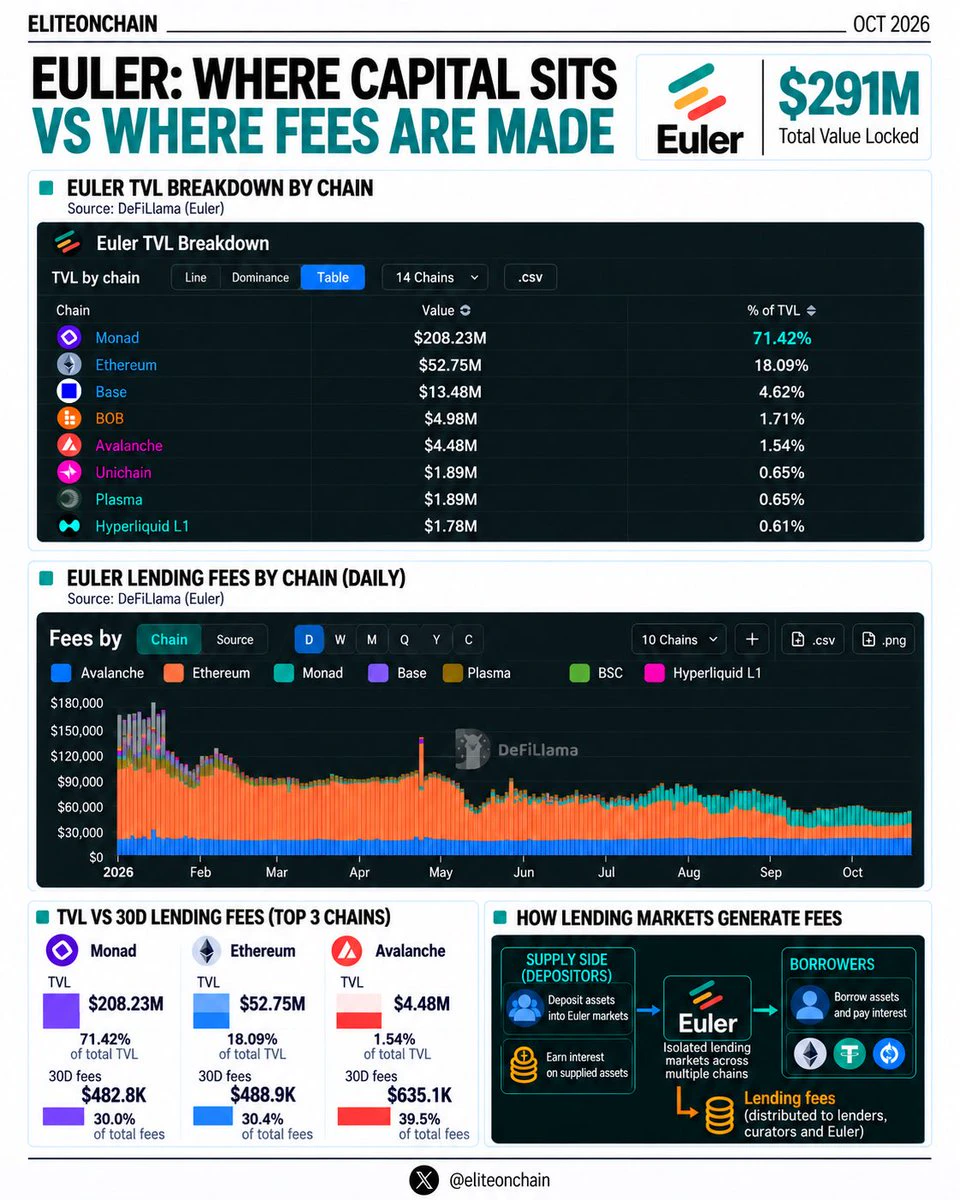
The protocol has around $291M in TVL, but the distribution of capital looks nothing like the distribution of fees.
Here’s the breakdown:
Monad
> $208M TVL
> $482.8K in 30-day fees
> 71.4% of total TVL
Ethereum
> $52.7M TVL
> $488.9K in 30-day fees
Avalanche
> $4.48M TVL
> $635.1K in 30-day fees
> Just 1.5% of TVL, but roughly 37% of fees
Avalanche is generating more lending fees than Monad despite holding around 46x less capital.
That’s a
post-image
MON+7.05%
ETH+2.90%
AVAX+2.65%
EUL+4.52%
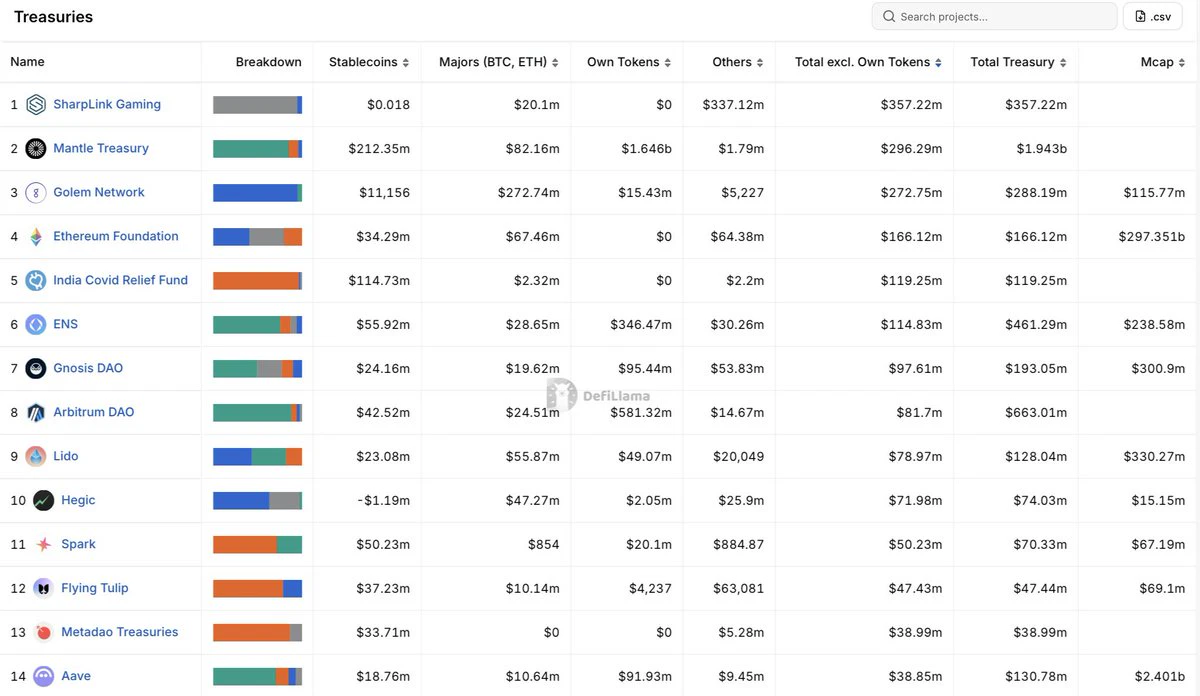
Some crypto treasuries look considerably smaller once you remove their own tokens.
Was looking through DefiLlama’s treasury data and noticed that Arbitrum holds $663M, while Golem holds $288M. You’d assume Arbitrum has the stronger treasury position, but excluding native tokens, Golem actually holds over 3x more in other assets.
Here’s how five treasuries compare:
> @Mantle_Official: $1.94B → $296.29M
> @Arbitrum: $663M → $81.70M
> @ensdomains: $461.29M → $114.83M
> @golemproject: $288.19M → $272.75M
> @gnosisdao: $193.05M → $97.61M
Across the 21 complete treasury entries, Arbitrum drops from
post-image
ARB+3.84%
GLM+2.58%
MNT+4.34%
A protocol can spend millions buying its own token and still leave holders worse off.
Because buying tokens is only half the equation. The other half is how much supply enters circulation, whether purchases are burned, and what investors paid for the token.
A tracker using DefiLlama data estimates $1.51B in buybacks across 23 programs over the year through October 15, 2026. The latest 30 days accounted for $155M.
Three protocols made up roughly 72%:
> @HyperliquidX: $71.4M (46.1%)
> @Pumpfun: $30.4M (19.6%)
> @Uniswap: $9.76M (6.3%)
> Other programs: $43.44M (28%)
But who actually benefits?
…
UNI+3.55%
HYPE+2.18%
PUMP+8.81%
Crypto is evolving from something you hold to something you can actually spend.
In 2026, crypto cards are making it easier to connect digital assets with everyday payments. One worth checking out is Cozy Card by @CwalletOfficial.
Security matters: Cozy Card is PCI DSS certified, demonstrating compliance with an industry standard for protecting payment card data.
Here’s what makes Cozy Card interesting 👇
Crypto top-ups: Fund your card with USDT, USDC, and other supported cryptocurrencies, with support for 17+ coins.
Everyday spending: Bridge the gap between crypto and real-world purchases with
post-image
USDC-0.04%
  • 1
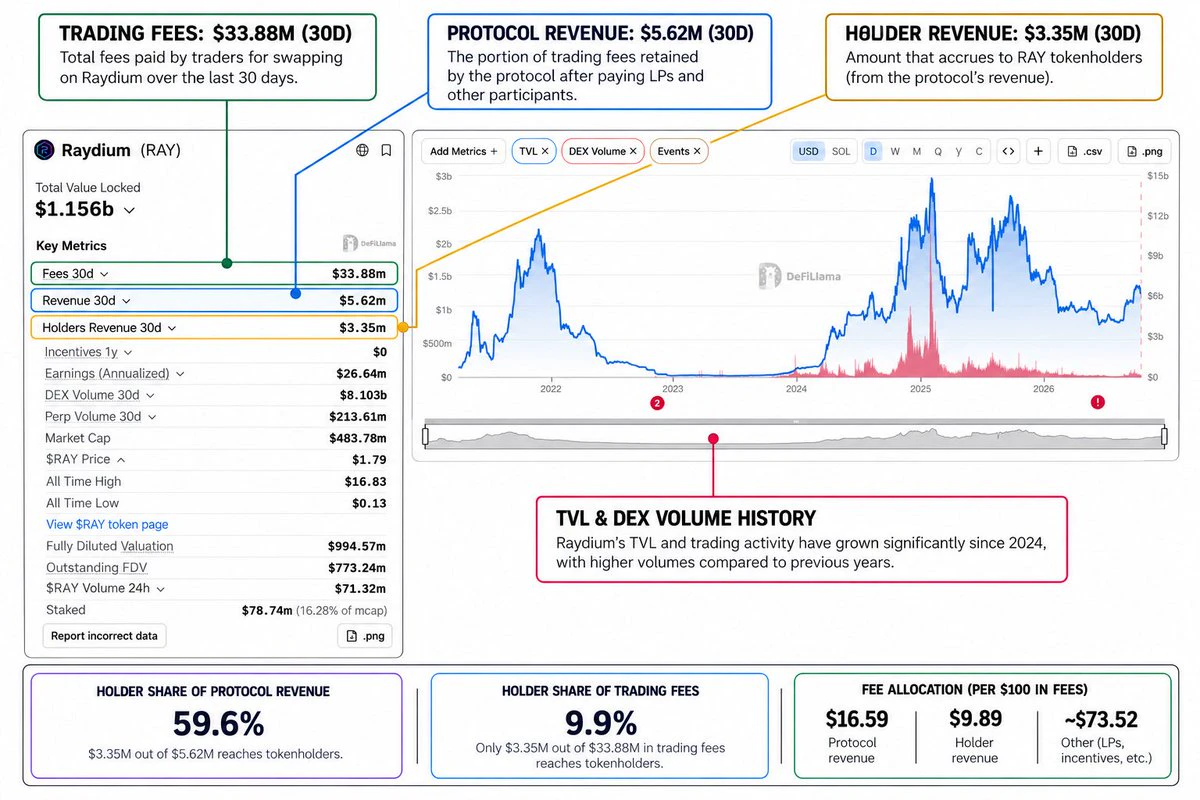
$33.88M in trading fees sounds like a pretty good business.
Until you realize only $3.35M of that reaches tokenholders.
That’s less than 10 cents for every dollar users pay in trading fees.
According to DeFiLlama’s 30-day snapshot, @Raydium generated:
> $33.88M in fees: What traders paid.
> $5.62M in revenue: What the protocol retained.
> $3.35M in holder revenue: What accrued to tokenholders.
Here’s where the numbers get revealing.
Raydium’s holder revenue represents approximately 59.6% of its protocol revenue.
That sounds like strong tokenholder capture.
But compare it against the original $
post-image
RAY-1.08%
The funny part about public Bitcoin treasury companies is that buying BTC is the easy part.
The harder business is convincing equity investors to keep paying a premium for it.
Here’s how the model works:
> mNAV measures market value relative to Bitcoin holdings.
> Above 1.0x, issuing shares to buy BTC can increase BTC per share.
> Below 1.0x, the same issuance becomes dilutive.
The premium is what makes the model work.
Strategy is the clearest example.
Its mNAV peaked near 3.4x in November 2024 and has since compressed toward parity.
Despite holding roughly 848,000 BTC, its October 5 purchase
BTC+2.48%
Abstract is shutting down on december 15.
It had 400K+ users, 144 apps and 325M transactions.
Igloo still lost tens of millions of dollars funding it over about 18 months.
I think this is a more useful L2 failure to study than Blast, because it’s a different failure.
Blast’s TVL fell 98% from $2.27B. Its daily revenue the day before the shutdown was $110.
Nobody was using it.
Abstract had users and still couldn’t pay for itself.
Here’s the mechanism.
An L2 earns its revenue from fees:
> Brand brings wallets
> Some wallets become active users
> Active users make transactions
> Transactions pay
post-image
BLAST-5.11%
PENGU+6.60%
TOKEN+5.00%
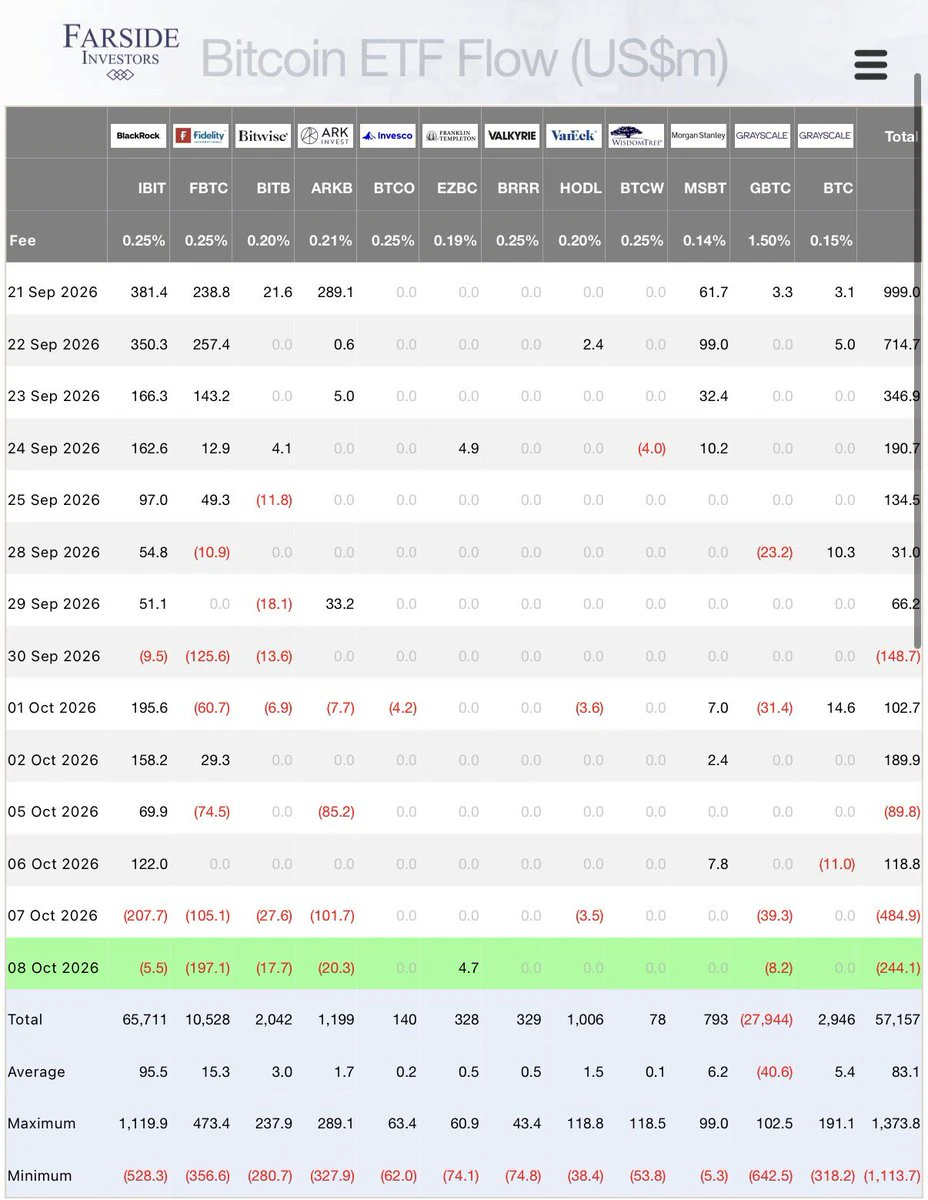
Bitcoin ETFs first four trading sessions:
+$321.6M
Next two:
➤ Oct. 7: -$484.9M
➤ Oct. 8: -$244.1M
Two-day outflow: -$729M
October went from +$321.6M to roughly -$407.4M in 48 hours of trading.
That’s the useful part.
It took four sessions to build the inflow.
Two sessions removed more than twice as much.
And this wasn’t just GBTC bleeding into the aggregate.
IBIT lost $207.7M on Oct. 7.
FBTC followed with $197.1M of outflows on Oct. 8.
So the demand deterioration was showing up across products that have previously been major sources of spot absorption.
ETF flows don’t tell you why somebody so
post-image
BTC+2.48%
GBTC+2.65%
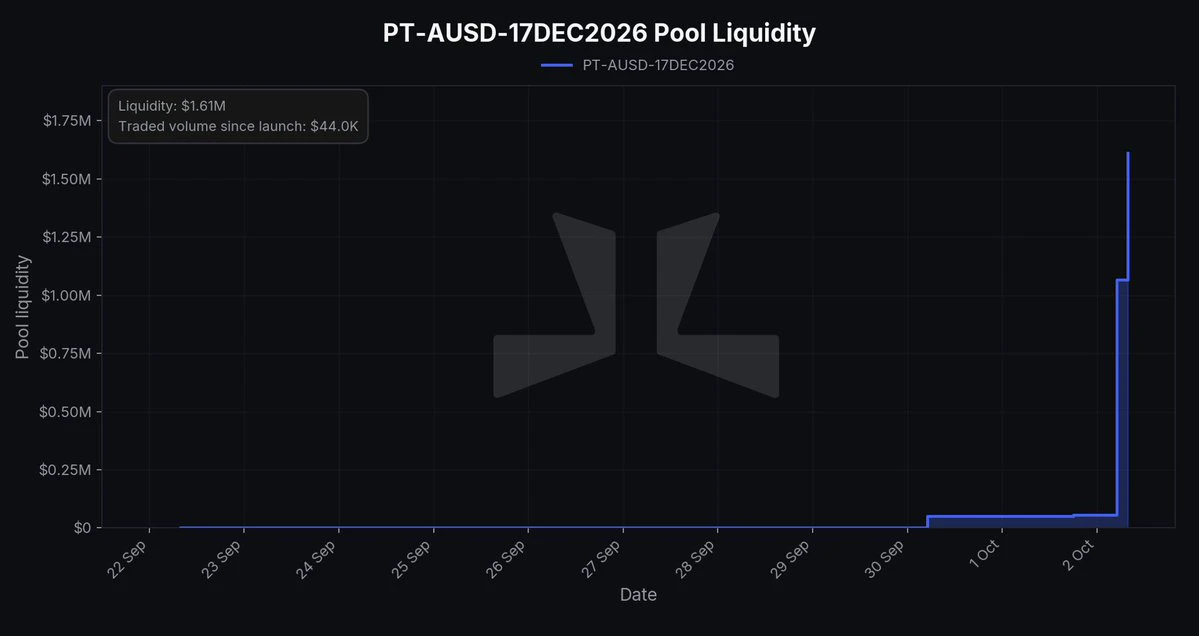
Around $67.4M of PT-AUSD collateral matures today inside @Aave on @Monad.
The maturity itself is straightforward.
The refinancing mechanics underneath it are the real story.
Users bought PT-AUSD through @pendle_fi to lock in fixed yield, deposited that PT into Aave as collateral, then borrowed stablecoins against it.
So the strategy became:
lock fixed yield → use PT as collateral → borrow → maturity arrives → refinance
Today is the refinance step.
Borrowers can:
> Repay the debt
> Replace the collateral
> Roll into the December maturity
> Exit the strategy entirely
The constraint is liquidity.
post-image
AAVE+4.69%
MON+7.05%
PENDLE+1.58%
Until this weekend, there was a small imbalance inside GHO’s economics.
Borrowers in @Aave’s Ethereum Core market could:
> Mint GHO at 4.25%
> Deposit it into sGHO earning 4.50%
That 25 bp gap was effectively being funded by the DAO.
With roughly $116M of Core GHO debt, 25 bps works out to about $290K annualized if balances stayed constant.
Not huge for Aave.
But the structure was backwards.
The system was paying savers more than it charged borrowers to create the stablecoin.
Aave has now raised the Core GHO borrow rate to 4.50%, matching the reported sGHO savings rate.
So the obvious subsidy
GHO+0.05%
AAVE+4.69%
USDC-0.04%
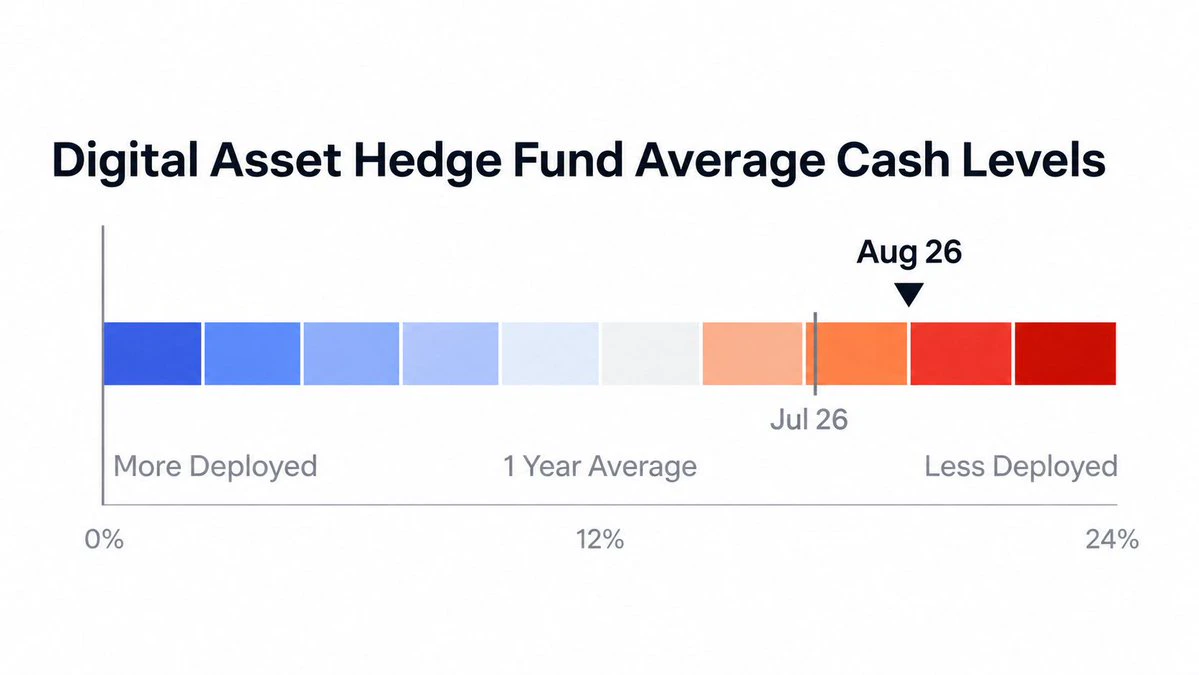
19.1% cash.
Second-highest reading in the series.
And somehow the obvious take is already “look at all that dry powder waiting to buy.”
Not so fast.
Glassnode’s latest Strategy Watch survey has crypto fund managers sitting at:
> 19.1% of portfolios in cash
> Nearly $1 in every $5 sitting out
> Only one reading in the series was higher
That’s pretty defensive positioning.
But cash doesn’t equal automatic future crypto demand.
Could be redemptions. Liquidity requirements. Mandates. Or managers simply deciding the current setup isn’t worth full exposure.
What stands out is the optionality.
Market
post-image
.@Circle already has $222M+ of tokenized stock exposure split across two different issuers.
> Circle on bStocks: $120.37M
> Circle on Ondo: $101.79M
Same underlying company. Different tokenized products. Almost the same amount of capital.
That’s the part I find more useful than just saying tokenized equities are growing.
The competition isn’t only between which stocks people want onchain anymore.
It’s also becoming a fight over who distributes the onchain version of the same stock.
Different issuers can have different legal rights, eligibility and redemption mechanics, so these aren’t necessar
CRCL+6.25%
ONDO+4.18%
  • 2
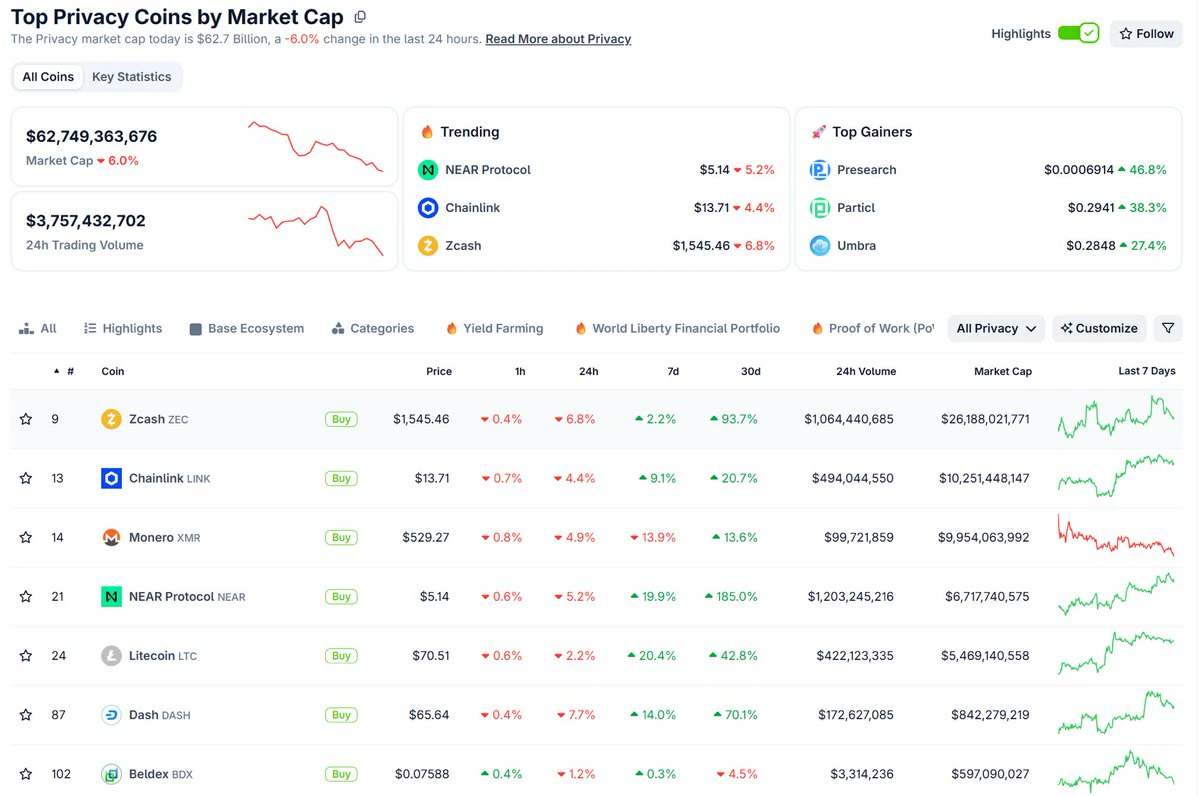
Privacy isn’t one trade anymore.
$ZEC , $XMR and privacy infrastructure are all being grouped under the same narrative, but they represent three very different bets.
$ZEC is the monetary privacy trade.
It’s around $1,546 with roughly $997.4M in daily volume. Nearly 5M $ZEC is sitting shielded, with around 23% of supply private.
Ironwood alone holds roughly 3.9M $ZEC, representing about 80% of shielded supply.
The thesis is increasingly:
private Bitcoin
$XMR is the actual private money trade.
Around $529, $99.4M in daily volume and a $10.2B market cap.
Less narrative optionality. More straightfo
post-image
ZEC+11.01%
XMR+0.00%
ZAMA+4.59%
AZTEC+4.34%
DeFi is increasingly splitting into two completely different businesses.
One monetizes capital sitting still.
The other monetizes capital moving.
@Aave alone currently holds ~$19.22B in TVL.
Meanwhile, DEXs are processing almost $9B in spot volume every day.
Obviously TVL and volume aren’t directly comparable.
But the contrast is useful.
Lending protocols want deep, sticky balance sheets.
More deposits → more borrowing capacity → more interest income.
DEXs want velocity.
The same $1 can trade multiple times, generating fees every time it changes hands.
So there are really two different games b
AAVE+4.69%