The Open Intents Framework may usher in an era of standardization of Cross-Chain Interaction intentions, addressing the long-standing issue of multi-chain fragmentation plaguing Ethereum
Authored by: Alex Liu, Foresight News
The dilemma of the intention paradigm and the Open Intents framework
In the process of Ethereum's journey towards a multi-chain future, users shuttle between Layer2 networks such as Arbitrum, Base, Mode, interacting with DeFi, social, AI, and other scenarios, but also suffer from the inconvenience of complex and inefficient Cross-Chain Interaction operations. This fragmented experience has led to the rise of the 'Intents' paradigm - users only need to declare their intentions (such as 'exchange 100 USDC on the Base chain for 100 USDT on the Arbitrum chain'), and professional solvers automatically complete complex processes such as path planning and transaction settlement. However, the high technical threshold for building intent systems, liquidity management challenges, weak ecosystem collaboration, and other issues have always constrained the scalability of this paradigm.
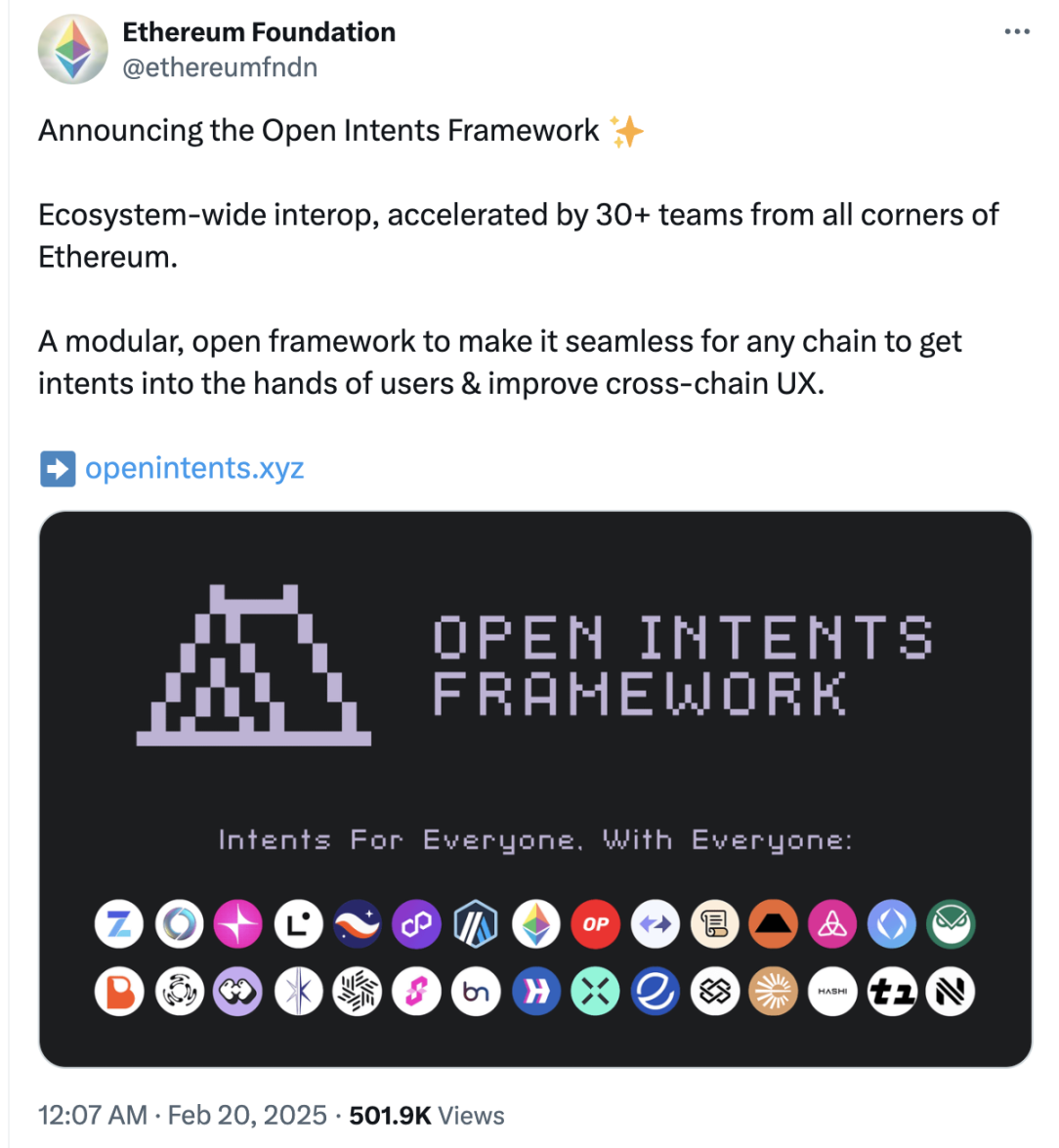
The birth of the Open Intents Framework is a collective response from the Ethereum community to this challenge. This open-source framework, jointly initiated by the Ethereum Foundation, Hyperlane, and Bootnode, aims to transform the intent infrastructure from a closed "island" to an open "Lego block" with "modularity" and "community co-construction" at its core.
Deconstruct Intent Stack: From Reinventing the Wheel to Plug and Play
Traditional intent protocols require building full-stack technologies such as smart contracts, solvers, settlement layers, etc. Developers often get stuck in the quagmire of repetitive development. The Open Intents Framework breaks the deadlock through three modular tools:
ERC-7683 Standard Reference Implementation
As a universal language for Cross-Chain Interaction intention, ERC-7683 defines standardized interfaces for intention creation, execution, and settlement, and has gained support from community leaders such as Vitalik Buterin. The framework not only provides open-source reference code for ERC-7683, but also complements the mainnet contract implementation of Across Protocol, ensuring that developers can innovate flexibly under a unified standard.
The 'programmability' of the solver
The built-in TypeScript solver in the framework provides cross-protocol universal indexing, transaction submission, and liquidity rebalancing functions. Developers can quickly customize exclusive solving logic based on this. For example, Eco Protocol is adapting it as the official solver for Eco Routes, while Everclear injects automatic rebalancing capabilities to reduce liquidity management costs.
'Building block' assembly of smart contracts
From basic limit order exchange to settlement mechanism supporting Hyperlane ISM, the framework's pre-built smart contract library allows developers to combine as needed. In the future, Arbitrum broadcasting standards, RRC-7755 storage proof, and other solutions can be accessed as modules to achieve diversified evolution of the intention settlement layer.
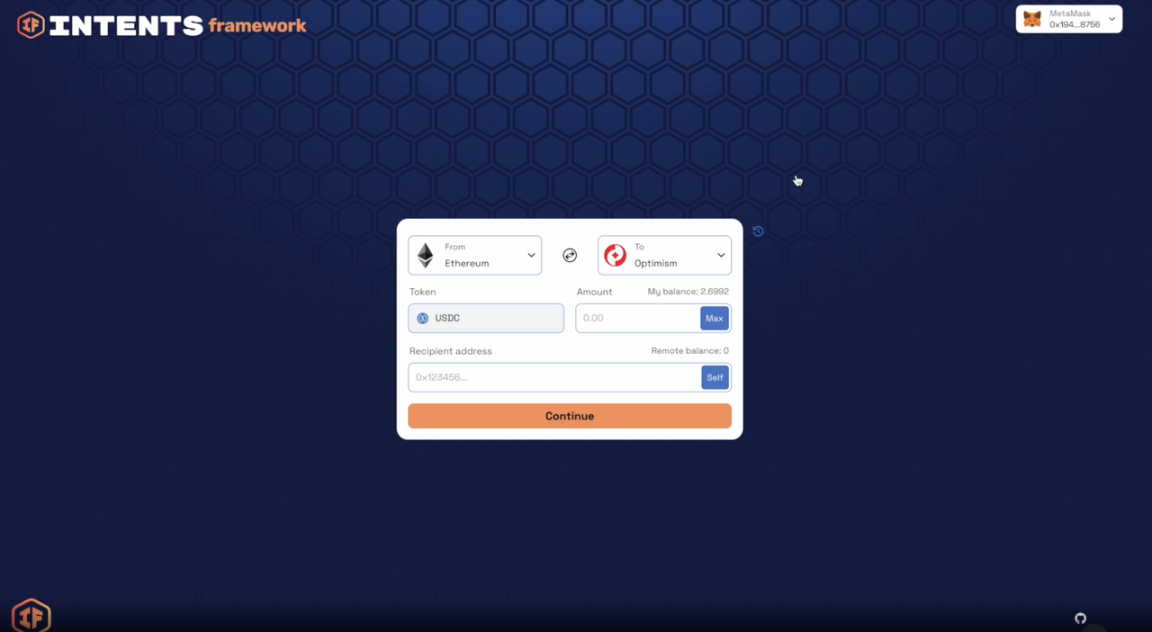
Intent Framework Frontend UI Example
Community resonance: Synergistic evolution from tools to ecosystem
The ambition of the Open Intents Framework goes beyond technical tools, it attempts to activate a collective experiment of "intent ecosystem".
Open Collaboration of Solver Network
Platforms like Khalani plan to connect dispersed solvers into a shared network, while Uniswap's The Compact protocol explores the combination of intent and resource locking, both of which can be quickly integrated through a framework to form a chain-wide solving capability.
Diversity Experiment of the Settlement Layer
Developers can freely choose Hashi's Oracle Aggregator, Espresso's Confirmation Layer, or Optimism's native interoperability solution as the settlement module, seeking the optimal solution between security and efficiency.
Seamless integration of user experience
Applications such as Superbridge have attempted to embed framework modules into the front-end interface. In the future, wallets and DApps only need to call standardized interfaces to provide users with a seamless 'One-Click Cross-Chain Interaction' experience.
Co-Builder Manifesto: Stitching Together a Multi-Chain World with Open Protocols
As Arbitrum launches a universal intent engine, the Base experimental RRC-7755 standard, and the Open Intents Framework open-source modular tool, the Ethereum community is responding to the biggest proposition of the multi-chain era with 'open collaboration': How to make users unaware of the existence of chains?
The answer to this question may lie in the underlying design of the framework, which does not attempt to define a single technology path, but rather reduces the cost of collaboration through standardized interfaces, allowing developers to focus on differentiated innovation. As its manifesto says, "If we build together, we win together."
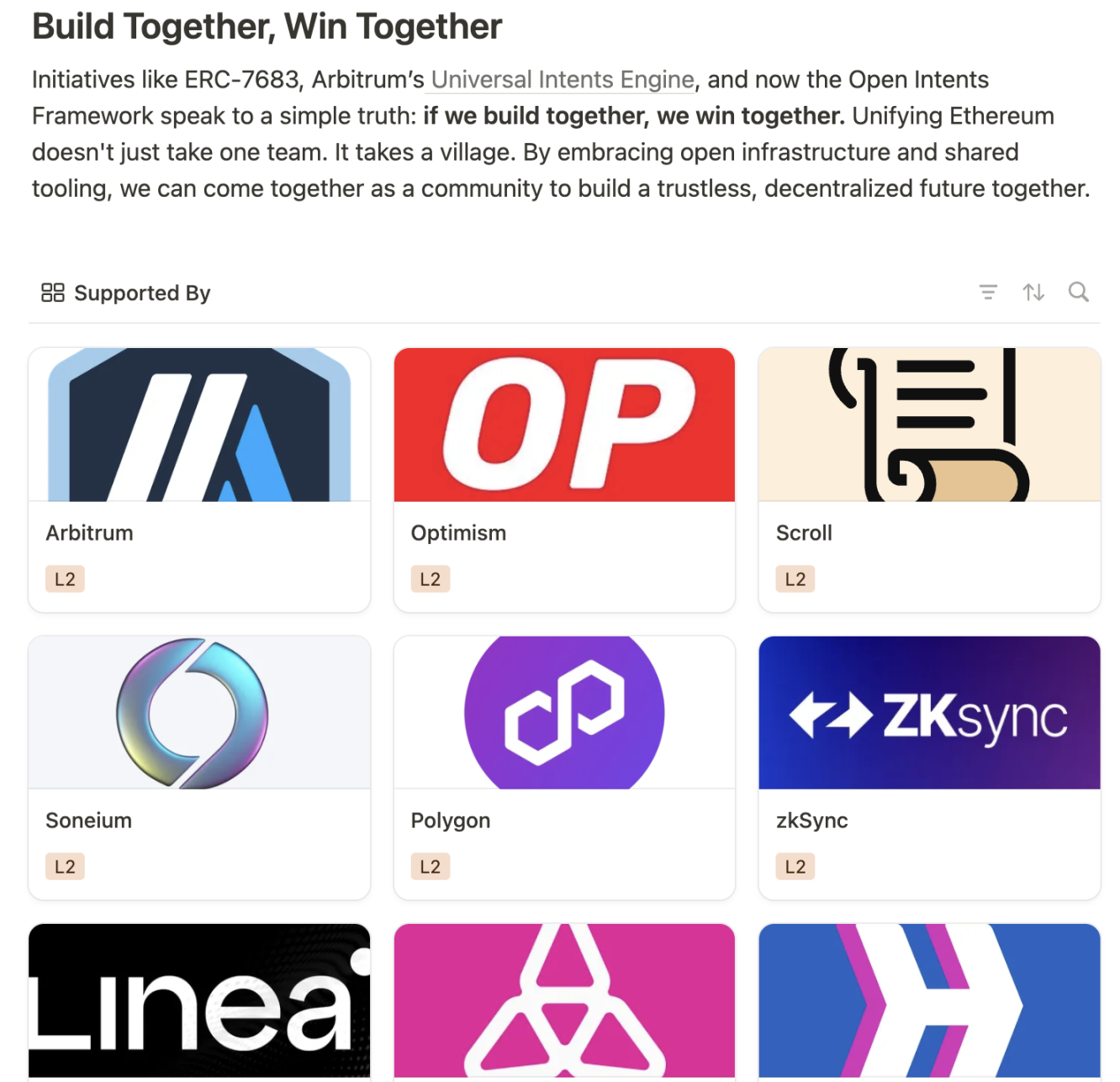
Currently, the codebase of the Open Intents Framework has been open-sourced on GitHub, and the audit work will be completed in the first quarter of 2025. Whether exploring new order logics (such as cross-chain interaction Dutch auctions), trying liquidity management solutions, or adding intent functionality to existing protocols, developers can join this open-source experiment and weave a seamless future for Ethereum with more than 30 ecosystem teams.
There are no lone heroes on the road to 'single-chain experience', but the power of open protocols will ultimately bring the multi-chain world together.


