
ETH Meme Wave Resurges: Liquidity Returns, Narrative-Driven Growth, and Risk Reassessment in the Ethereum Ecosystem
tag: Macro, TradFi
Title: Intel Stock Surge Analysis: Is the 2026 Rally Driven by Market Euphoria or Fundamental Revaluation?
Slug: intel-stock-surge-analysis-is-the-2026-rally-driven-by-market-euphoria-or-fundamental-revaluation
Meta Description (160-175 char):
Centered on Intel stock surge analysis, this article reviews the key catalysts behind Intel’s rapid stock price climb in April 2026, breaking down buybacks, partnership announcements, AI data center demand, 18A process and foundry progress, and assessing three core risks—valuation, profit realization, and competitive landscape—to help investors build an actionable tracking framework.
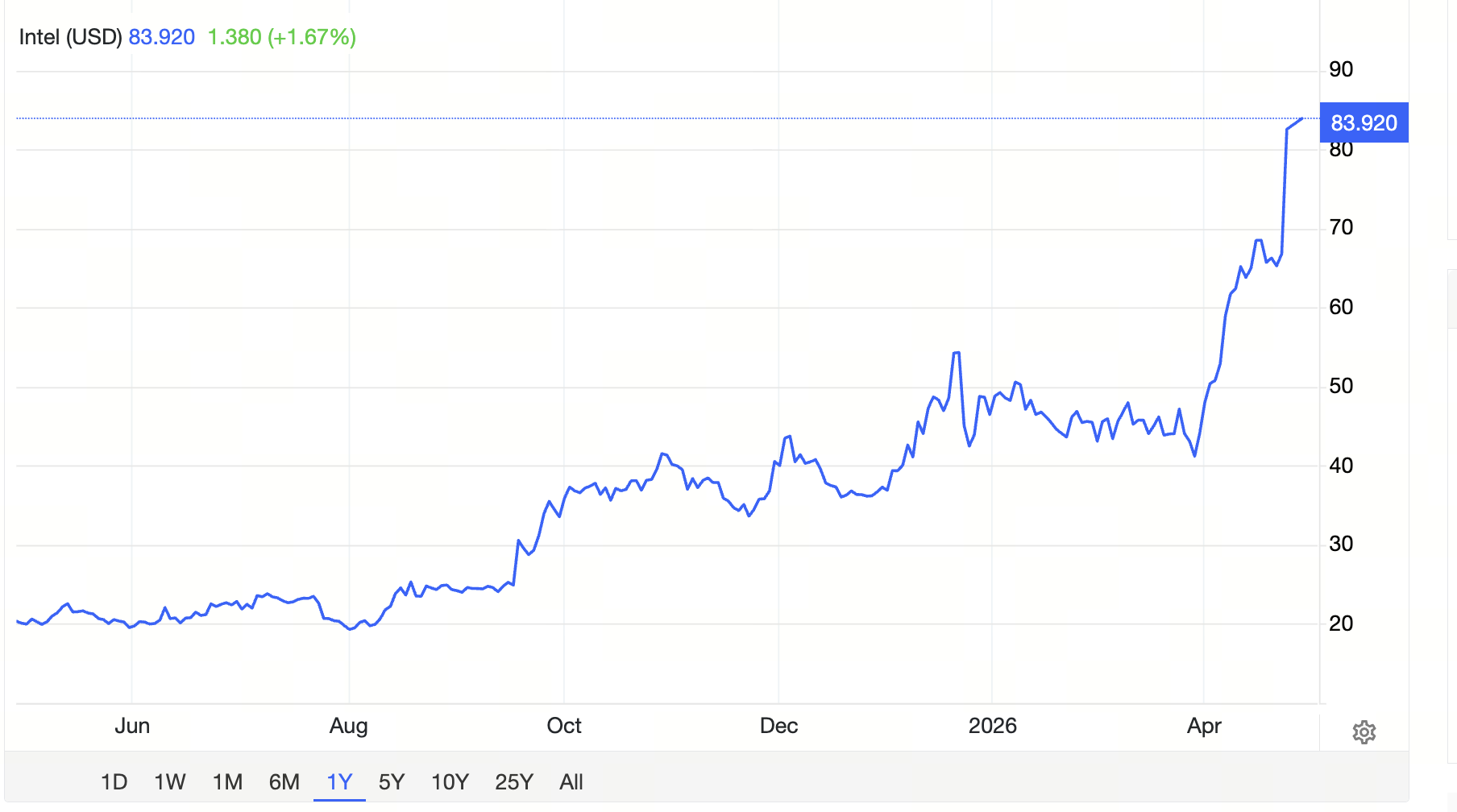
Image source: Tradingeconomics
In April 2026, the most hotly debated stock in the US tech sector wasn’t the usual market leader by rise %, but Intel (NASDAQ: INTC). Over several trading sessions, Intel’s price elasticity far exceeded its multi-year average volatility, with both its short-term rise % and market cap gains entering an “abnormal range.” The market’s tag was clear: Intel is back.
For professional investors, however, any “comeback” must be dissected on two fronts. The first is price: where are the bids coming from, and are the short-term drivers sustainable? The second is operations: can the company actually turn new expectations into real profits on its financial statements? Only when both layers hold does a stock’s revaluation shift from a “one-off move” to a “sustained trend.”
I. Market Focus: Why Did Intel Suddenly Become the Center of Attention in April 2026?
From a trading structure perspective, this Intel rally displays the classic signs of a “high-attention recovery trade”:
- A long-undervalued large-cap company suddenly receives multiple positive news catalysts;
- Capital rotates out of overcrowded sectors, seeking lower-valued, higher-beta alternatives;
- The narrative shifts from “Can it survive?” to “Can it deliver steady profits?”
Intel stands out by sitting at the intersection of three capital preferences:
AI infrastructure chain + US domestic manufacturing + large-cap value recovery.
When these three tags are repriced by the market in the same window, volatility jumps sharply.
Crucially, Intel is not a zero-to-one new story, but a heavily tracked, highly transparent, and deeply institutionalized company. In other words, the market isn’t “buying what it doesn’t understand”—it’s a shift from “understood but previously undervalued” to renewed optimism. When expectations reverse, the recovery is often faster than the climb of growth stocks.
II. Three Direct Catalysts: Capital Actions, Partnership Momentum, and Sector Rotation
Capital Actions: Buybacks and Asset Moves Signal Strong Intent
This cycle’s capital moves—buybacks, asset/equity adjustments, and capacity-related deals—were read as clear directional signals:
Management is proactively optimizing capital efficiency, not just passively riding out the cycle.
For the stock, these signals have two main effects:
- Raising the valuation floor: If the market believes management can actively optimize the balance sheet, downside risk decreases.
- Boosting profit recovery credibility: Capital actions may not immediately lift profits, but they improve the odds of profit improvement.
Partnership Momentum: From “Story” to “Order Pipeline”
Intel has secured a series of high-quality partnership expectations around data center CPUs, cloud deployments, and AI infrastructure. What matters most isn’t a single headline, but whether these signals show continuity:
Can the product roadmap, customer validation, and delivery cadence translate into real progress over the next two to three quarters?
In valuation models, partnership momentum mainly impacts:
- Future revenue growth trajectory;
- Capacity utilization and unit costs;
- Market confidence in management’s guidance.
Sector Rotation: Rebalancing After AI Crowding
In recent years, AI trades were crowded into a few mega-cap leaders. By 2026, capital is looking for “second-tier beneficiaries”—companies with both the concept and the capacity to capture real demand. Intel’s revaluation is closely tied to this style rotation.
It’s important to note: style rotation can drive the initial rally, but rarely sustains a full-year trend on its own. Operational data must take over, or the rally will revert to a high-volatility range.
III. Fundamentals: Intel’s Role in the AI Era
Some oversimplify the question: “Is only the GPU valuable in the AI era?” That’s incomplete. Data center architecture has always been about system synergy, not single-chip dominance. Even as AI workloads surge, CPUs remain critical for resource allocation, data preprocessing, inference pipelines, and virtualization management.
This is the foundation for Intel’s participation in the current revaluation:
AI growth doesn’t automatically mean CPUs lose relevance; in some scenarios, demand for high-performance general computing actually rises.
For Intel, the market’s focus isn’t on whether there’s an “AI story,” but on three quantifiable questions:
- Has the revenue percentage from data center businesses shown structural improvement?
- Can customer feedback on new-generation products—performance, efficiency, cost—translate into stable orders?
- Can gross margin hold its recovery trend amid price competition and product iteration?
If these three points are met, Intel’s revaluation is about profit potential—not just sentiment.
IV. 18A and Foundry: The Key Mid-Term Valuation Variables
Intel’s mid-term valuation hinges on process technology and foundry. The importance of 18A isn’t just technical jargon—it’s about the company’s most critical operational levers for the next few years:
Yield, cost, delivery capability, and customer stickiness.
Why 18A Is the Valuation Anchor
- It’s the key milestone for Intel to prove advanced process execution;
- It determines bargaining power in high-end products and foundry services;
- It directly impacts fixed cost absorption and gross margin flexibility.
Foundry: High Potential, High Execution Pressure
The foundry story has big upside, but realization will be slower than many expect. The reasons are straightforward:
- Long customer onboarding cycles and stringent validation;
- Yield ramp-up and cost optimization require several quarters of progress;
- Order quality matters more than quantity—low-quality orders can squeeze profits.
In short, foundry can raise Intel’s long-term ceiling, but also heightens execution risk during the ramp. For investors, the most effective tracking isn’t chasing every “deal announcement,” but consistently monitoring three metrics:
- Revenue: Are new customers generating sustainable revenue?
- Profit: Is gross margin improving in sync with utilization?
- Cash Flow: Are capex and operating cash flow in sustainable balance?
V. Market Divergence: The Overlooked Risks After a Rally
Every big rally brings high expectations. Expectations alone aren’t risky—it’s the failure to deliver that is. Intel’s key divergences fall into three categories:
Risk 1: Profit Delivery Lags Price Revaluation
Stocks can reprice in weeks, but operational improvements come quarterly. If, in the next one or two earnings cycles, revenue, gross margin, or cash flow miss expectations, drawdown risk rises sharply.
Risk 2: Competitive Intensity Remains High
In server and AI-related zones, Intel faces not just traditional rivals but also cloud providers’ in-house chips, architectural shifts, and supply chain restructuring. Total demand may grow, but not every player’s share will.
Risk 3: Liquidity Reflexivity After News-Driven Trading Fades
As trading shifts from “expectation-driven” to “verification-driven,” short-term funds can exit quickly. Shares accumulated during high turnover, if unsupported by results, tend to amplify volatility on negative or neutral news.
VI. Actionable Checklist: What to Track After the Intel Rally
If you’re using this Intel stock surge analysis for investment tracking—not just headline sentiment—prioritize as follows.
Quarterly Tracking
- Track quarterly data center revenue growth and management guidance updates.
- Compare gross margin, operating profit margin, and operating cash flow to assess recovery synchronization.
- Monitor 18A milestones for customer onboarding and mass production progress.
- Watch capital expenditure and buyback pace to evaluate the balance between shareholder returns and expansion.
- Benchmark peer valuations and profit forecasts to judge if Intel’s discount narrowing is fully priced in.
Event Tracking
- Are key customer partnerships moving from “release” to “delivery”?
- Is management language shifting from “vision statements” to “quantitative commitments”?
- Is industry demand broadly recovering or just restocking in pockets?
- Are there signs of crowded trades and high leverage in the market?
This checklist turns “surge” into verifiable variables—helping avoid emotional chasing or panic selling.
VII. Conclusion: Not the End, But the First Stage of Repricing
Back to the core question: What’s the real nature of this Intel rally?
A more objective view: it’s neither pure sentiment nor a fully realized bull run, but the first stage of repricing triggered by multiple catalysts.
- Short-term: News and capital flows still drive volatility.
- Mid-term: The trend depends on earnings consistency and execution.
- Long-term: Whether Intel truly reshapes its valuation depends on success in both technology roadmap and commercialization.
Ultimately, the real value in Intel stock surge analysis isn’t predicting “up or down tomorrow,” but continuously answering three questions:
Is demand real, is profit improving, and is execution stable? If two out of three keep strengthening, the valuation has room to rise; otherwise, any sharp rally may revert to the mean.
* The information is not intended to be and does not constitute financial advice or any other recommendation of any sort offered or endorsed by Gate.
* This article may not be reproduced, transmitted or copied without referencing Gate. Contravention is an infringement of Copyright Act and may be subject to legal action.
Share
Content


