From Dormant Code to Digital Currency: The Awakening of x402 and the AI Economy
Preface
In 1997, web engineers quietly embedded an unused status code in the HTTP standard — 402 Payment Required. It was meant for an internet that could one day handle native digital payments. But for nearly three decades, that idea lay dormant — a sleeping fragment of code waiting for its moment.
That moment arrived in 2025, when Coinbase, in partnership with Cloudflare, Google, and Visa, reignited the forgotten code and brought it back to life as the x402 protocol.
This revival is not just a technical update — it’s a foundational rewrite of how the internet transacts value, introducing a payment layer for AI, APIs, and the web itself.
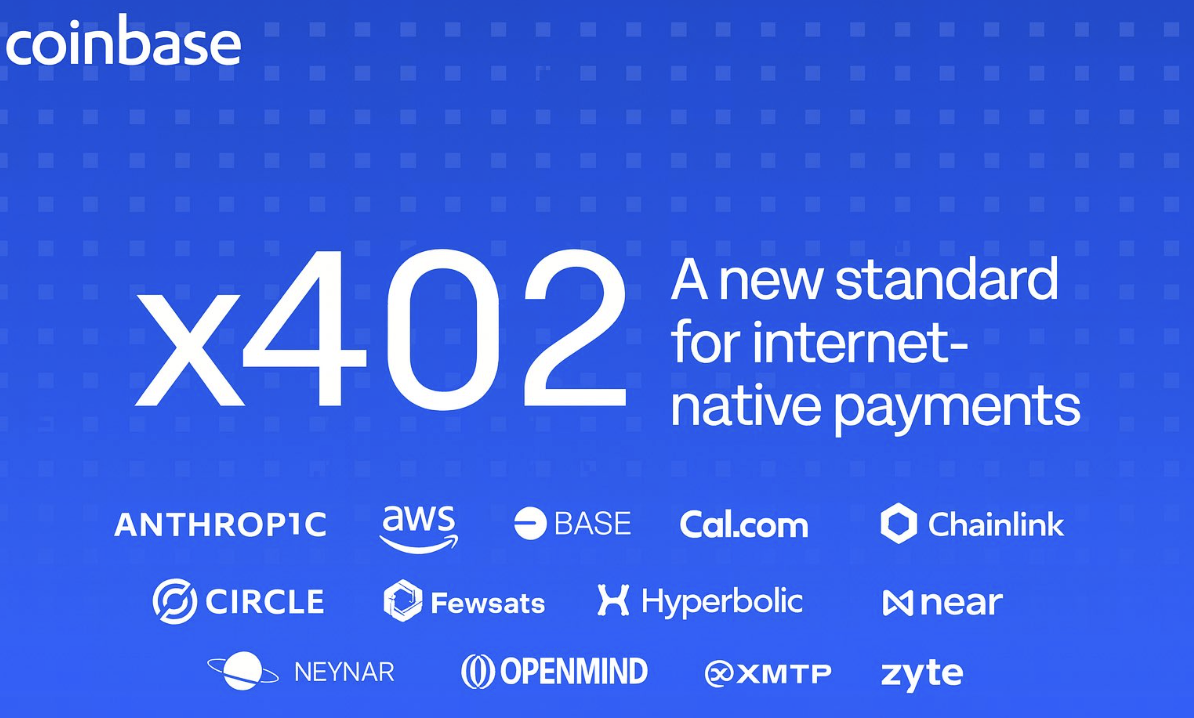
What Is x402?
(Image source: Coinbase)
At its core, x402 is an open protocol that enables automatic payments between AI agents, APIs, and websites.
It upgrades the traditional “request–response” web model into a “request–pay–response” loop — allowing intelligent entities to autonomously buy access, data, or services.
Here’s how a typical interaction works:
1.A server responds with a notice: “This service costs $0.05 (in USDC).”
2.The client or AI automatically completes the payment.
3.Once confirmed, the requested data or action is instantly delivered.
No accounts, no credit cards, no manual checkout. AI can now make its own financial decisions — marking the first step toward autonomous economic behavior.
How x402 Works: Building Payment into the Internet’s DNA
Rather than reinventing existing infrastructure, x402 elegantly connects three existing technological layers:
1.HTTP-Native Integration
x402 operates directly within the HTTP standard. Any website, API, or AI system that already uses HTTP can enable payments without altering its core architecture.
2.Payment Coordination Layer
This layer manages transaction validation, authorization, and settlement on-chain — simplifying integration for developers. No extra wallet setup or SDK installation is needed.
3.Blockchain Abstraction Layer
While currently running on the Base chain, x402 is designed to be multi-chain compatible, ensuring flexibility and scalability across blockchain environments.
Why x402 Redefines Digital Payments?
Traditional systems like credit cards come with significant friction:
- ~3% fees + $0.30 per transaction
- Multi-day settlement delays
- Chargeback risks lasting up to 120 days
By contrast, x402 executes transactions for as little as $0.0001, completes settlement in about 2 seconds, and offers final, irreversible confirmations — making fraud and reversals obsolete.
This efficiency makes it ideal for micropayments and AI-to-AI transactions, where agents exchange data or API access in real time.
x402: The Grammar of the AI Economy
Until now, AI systems could generate, analyze, and assist — but not spend.
With x402, they gain the missing economic syntax: the ability to transact.
Potential use cases include:
- An AI autonomously purchasing premium articles for research
- A digital assistant paying an API fee to complete a live task
- Two autonomous agents exchanging data and settling instantly
In each case, payment becomes a native function of the internet, no longer dependent on user wallets or third-party gateways.
Bridging the Gap in Web3’s Payment Layer
x402 fills one of Web3’s most critical missing pieces — a universal, programmable payment layer. It introduces a standardized mechanism for:
- Powering AI-driven token economies
- Enabling decentralized API marketplaces
- Monetizing data and digital content seamlessly
The collaboration among Coinbase, Cloudflare, and Visa signals a deeper convergence between traditional finance and blockchain-native systems, reshaping how value moves online.
A Return to the Internet’s Original Intent
The reawakening of the 402 status code represents more than a technical milestone — it’s a correction of history. Three decades ago, the web wasn’t ready for digital payment primitives. Today, through x402, that long-suspended vision has finally been realized.
In the near future, every AI, API, and digital agent will be capable of creating, trading, and rewarding value directly — without intermediaries.
x402 isn’t a token. It’s a language — one that allows the internet to finally understand how to charge, compensate, and sustain itself.
Disclaimer:
This is not investment advice. This information is provided for informational purposes only and should not be construed as a recommendation to buy, sell, or hold any asset. Cryptocurrency trading involves a risk of loss. Gate US services may be restricted in certain jurisdictions. For more information, please see our legal disclosures: https://us.gate.com/legal/disclosures
Share
Content


Related Articles

Bitcoin Halving Chart: Key Dates, Trends, and Future Predictions

Bitcoin Halving Chart:Understanding the Changes in Bitcoin Supply and Price Trends

US December Rate Cut Forecast: Will the Federal Reserve Finally Pivot?

Midnight Network Ignites Cardano’s Next Chapter with NIGHT Token Mining and Privacy Innovation

Federal Reserve Ends Quantitative Tightening — How the End of QT Could Reshape Global Markets in 2025