Five Strategic Directions Shaping the Crypto Landscape in 2026
Emerging Pillars of the 2026 Crypto Ecosystem
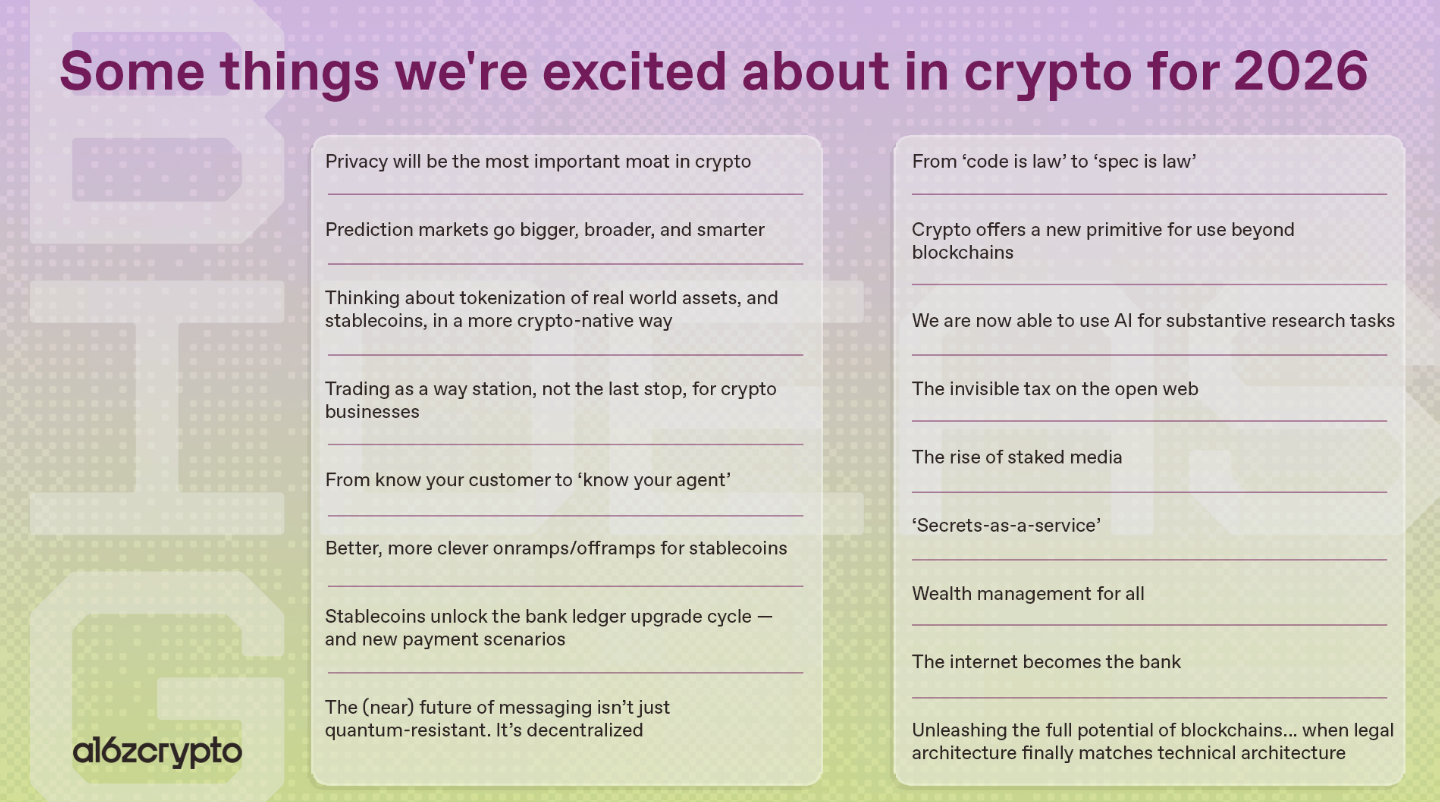
(Image source: a16zcrypto)
In its annual outlook, a16z highlights five major areas expected to define the coming year. These domains illustrate how blockchain innovation is expanding beyond experimentation and moving toward deeply integrated, real-world usage. Key areas of focus include on-chain native issuance for RWAs, upgraded global stablecoin payment systems, the rise of autonomous AI agents, advancements in privacy technologies, and new application layers such as prediction markets and “Staked Media.” Collectively, these innovations outline the next stage of open finance and open networks.
A New Model for Global Value Transfer
The report emphasizes that today’s financial architecture faces structural limitations—limitations that blockchain technology is uniquely positioned to solve. Several key observations shape this viewpoint:
- Stablecoins and tokenized assets are becoming the most practical path toward financial modernization.
- Value transfer is evolving to resemble data flow—instant, global, and programmable.
- AI agents will open new pathways for automated payments and transaction execution.
- The idea of the “internet as a bank” is transforming from metaphor to reality.
As AI systems interact with on-chain assets and global payment networks, financial activities could increasingly be executed through automated logic, enabling seamless and low-cost movement of value across platforms and borders.
Tokenization Meets AI: The Next Phase of Personal Wealth Management
a16z suggests that full-scale asset tokenization could fundamentally expand access to financial tools. As investment instruments transition onto blockchains, users may experience a shift in how wealth is managed:
- Personal finances may no longer depend on exclusive services designed for high-net-worth individuals.
- AI-driven strategies could empower everyday users with professional-grade portfolio management.
- DeFi mechanisms and on-chain financial strategies will become more modular and automated.
This combination of tokenized assets and AI-enabled intelligence may pave the way for widespread adoption of customizable, automated financial assistants.
Privacy Infrastructure: The Next Major Competitive Frontier
With the expansion of cross-chain applications, privacy is emerging as a critical battleground. a16z believes privacy-focused solutions will play a defining role in the next generation of blockchain infrastructure:
- Chains with strong privacy guarantees may experience network-effect consolidation.
- If privacy protections become inherently composable, they could become a standard feature of cross-chain financial systems.
- A new wave of privacy protocols may reshape how data ownership and security are defined.
A future version of open finance will require both transparency and personal data protection—a balance that determines how broadly these systems can scale.
New Application Layers: AI Identity, Verifiable Media, and Prediction Markets
The outlook also highlights emerging use cases that could gain significant traction:
- Identity frameworks for AI agents, enabling “Know Your Agent (KYA)” verification.
- Embedded payment logic integrated directly into smart contracts.
- On-chain verifiable content systems and models like “Staked Media.”
- Continued development and mainstream participation in prediction markets.
These innovations expand the concept of verifiable computation and user-controlled data, creating a network environment where rules become self-enforcing through programmable logic.
A Convergence of Traditional Finance and Open Networks
As regulatory clarity and technical capabilities advance, crypto systems are positioned to integrate more deeply with global economic infrastructure. In this transition, blockchain networks could:
- Redefine the settlement layer for financial transactions
- Provide verifiable identities, content, and financial instructions
- Enable synchronized flows of information and value
- Support the next foundational layer of the internet
According to a16z, this convergence marks not just technological evolution, but a large-scale restructuring of the global digital economy.
Conclusion
The a16z annual outlook signals that 2026 represents a turning point where crypto evolves from experimental tools into essential infrastructure. Key domains—RWA issuance, AI-driven systems, privacy technologies, global stablecoin payments, and next-generation applications—are beginning to interconnect and form a unified framework for programmable, verifiable value transfer. As finance, identity, and digital content move onto transparent and trust-minimized systems, the architecture of the open internet is on track to be fundamentally redesigned.
Share
Content
Emerging Pillars of the 2026 Crypto Ecosystem
A New Model for Global Value Transfer
Tokenization Meets AI: The Next Phase of Personal Wealth Management
Privacy Infrastructure: The Next Major Competitive Frontier
New Application Layers: AI Identity, Verifiable Media, and Prediction Markets
A Convergence of Traditional Finance and Open Networks
Conclusion


Related Articles

Bitcoin Halving Chart: Key Dates, Trends, and Future Predictions

Bitcoin Halving Chart:Understanding the Changes in Bitcoin Supply and Price Trends

US December Rate Cut Forecast: Will the Federal Reserve Finally Pivot?

Federal Reserve Ends Quantitative Tightening — How the End of QT Could Reshape Global Markets in 2025

Midnight Network Ignites Cardano’s Next Chapter with NIGHT Token Mining and Privacy Innovation