Cardano’s Next Leap: AI-Powered Payments and Network Expansion Redefine the Future of ADA
Cardano’s Next Leap: AI-Powered Payments and Network Expansion Redefine the Future of ADA
Cardano (ADA) is once again in the spotlight as it embraces a series of technological breakthroughs that could reshape its position in the blockchain ecosystem. Patrick Tobler, founder of NMKR and creator of the Masumi Network, recently announced that the x402 protocol—a next-generation payment layer—will officially launch within the Cardano ecosystem. Integrated directly with Masumi, this innovation is designed to power the AI Agent economy, opening new possibilities for decentralized automation.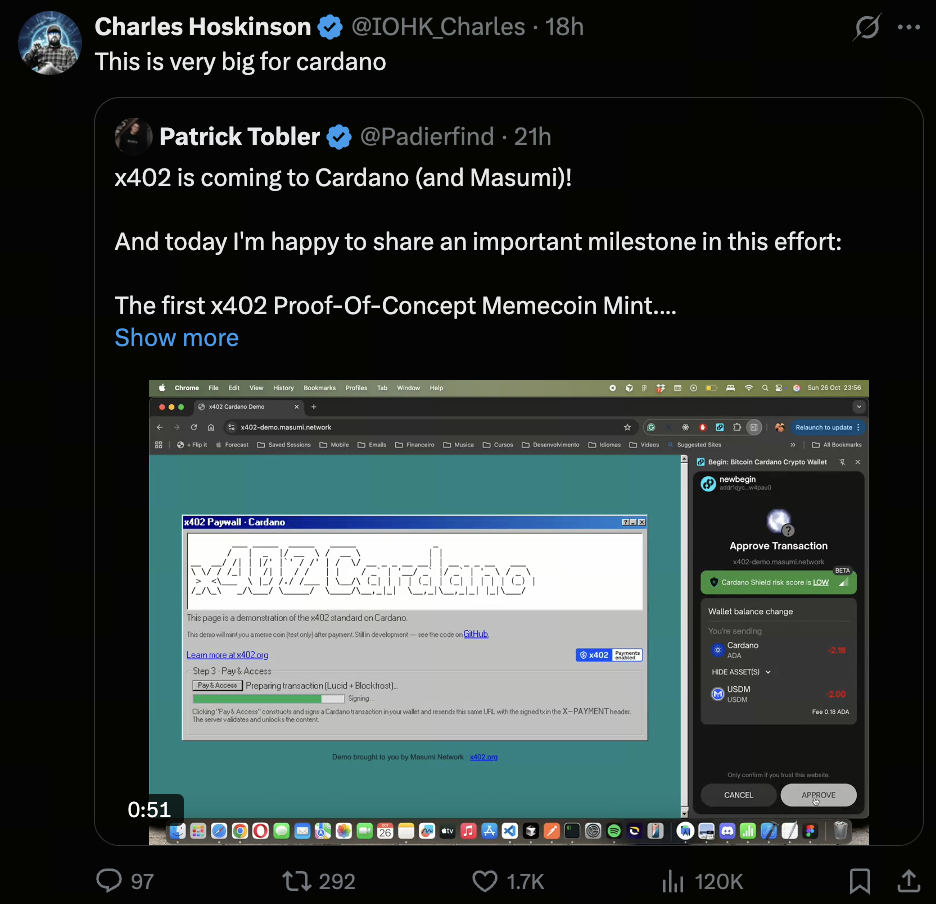
(Image source: IOHK_Charles)
Cardano founder Charles Hoskinson celebrated the milestone on X (formerly Twitter), calling it “a major step forward for Cardano.”
x402: Redefining On-Chain Payments
Inspired by the HTTP 402 status code, the x402 protocol reinvents digital payments by removing traditional barriers such as sign-ups, email verification, and OAuth. Instead, it enables users to make direct, decentralized API payments for digital assets.
Initially developed by Coinbase and integrated with Google’s Agent-Payment Protocol (AP2), x402 represents a critical evolution in blockchain payments. According to Tobler, its integration with Cardano introduces a native, verifiable, and automated payment layer, positioning Cardano as a potential financial backbone for the AI and Web3 economy.
Masumi: The AI Layer of Cardano
Masumi Network serves as Cardano’s foundational AI protocol, built to enable AI Agents to trade, verify, and execute tasks autonomously. With the inclusion of x402, these agents gain the ability to perform trustless payments and resource exchanges, creating a fully automated and decentralized AI-driven economy.
This shift marks Cardano’s evolution from a general-purpose blockchain into a collaborative infrastructure for intelligent economic systems, integrating AI’s decision-making with blockchain’s transparency and security.
Leios Consensus: Cardano’s Scalability Milestone
Beyond payments and AI integration, Cardano’s core consensus mechanism is undergoing a pivotal upgrade.
Input Output Global (IOG) confirmed that the Ouroboros Leios protocol has transitioned from research to full-scale engineering development. As a major enhancement to the existing Ouroboros framework, Leios aims to significantly boost transaction throughput and network scalability.
A recent internal handover from Input Output Research (IOR) to Input Output Engineering (IOE) marks the project’s progression toward mainnet readiness—a signal that Cardano’s scalability ambitions are becoming tangible.
ADA Enters the Mainstream: ETF Inclusion
Cardano’s growing technological maturity is mirrored by its increasing visibility in traditional finance.
Last week, Grayscale and CoinDesk launched the Crypto 5 ETF (GDLC) on the New York Stock Exchange (NYSE)—the first multi-asset crypto ETF in the U.S. market.
This ETF tracks the five most valuable and liquid digital assets: Bitcoin, Ethereum, Solana, XRP, and Cardano (ADA).
By offering investors exposure to more than 90% of the total crypto market cap through a single product, GDLC paves the way for greater institutional access to ADA.
Conclusion
Cardano is no longer just a smart contract platform—it’s evolving into a next-generation intelligent economy network.
With x402 bringing automation to payments and Leios driving scalability, ADA stands poised to become the core transaction layer for decentralized AI and finance.
In this new era, Cardano isn’t competing to be “another blockchain”—it’s building the infrastructure for a connected world where AI, finance, and collaboration coexist seamlessly.
Disclaimer:
This is not investment advice. This information is provided for informational purposes only and should not be construed as a recommendation to buy, sell, or hold any asset. Cryptocurrency trading involves a risk of loss. Gate US services may be restricted in certain jurisdictions. For more information, please see our legal disclosures: https://us.gate.com/legal/disclosures
Share
Content


Related Articles

Bitcoin Halving Chart: Key Dates, Trends, and Future Predictions

Bitcoin Halving Chart:Understanding the Changes in Bitcoin Supply and Price Trends

US December Rate Cut Forecast: Will the Federal Reserve Finally Pivot?

Federal Reserve Ends Quantitative Tightening — How the End of QT Could Reshape Global Markets in 2025

Midnight Network Ignites Cardano’s Next Chapter with NIGHT Token Mining and Privacy Innovation