Arc: Building the Economic Operating System for a Global On-Chain Future
A New Kind of Blockchain: From Speed to Real-World Finance

(Image source: arc)
In today’s Web3 landscape, most chains compete on speed, scalability, or transaction cost — yet few succeed in linking blockchain innovation with real-world financial systems.
Arc aims to close that gap. More than just another Layer-1, Arc is a financial infrastructure protocol designed to function as an Economic Operating System (Economic OS) for the global digital economy.
By combining programmable liquidity with on-chain financial frameworks, Arc enables developers, institutions, and issuers to build applications for lending, FX, capital markets, and payments — forming a unified foundation for decentralized finance and traditional finance alike.
Core Principles of Arc
Arc’s architecture is built upon four guiding principles:
- Stable Cost Model: Transactions use USDC as gas, providing predictable, low-volatility fees.
- Instant Finality: Every transaction reaches irreversible confirmation within one second.
- Opt-in Privacy: Supports confidentiality while maintaining compliance readiness.
- Enterprise Integration: Through Circle APIs, institutions can easily plug in stablecoin liquidity.
This makes Arc not just a DeFi chain — but a bridge between Web2 and Web3 finance.
Predictable Fees through USDC
Traditional blockchains often suffer from volatile gas prices tied to native tokens. Arc eliminates this problem by using USDC as the transaction currency, stabilizing costs at roughly one cent per transaction.
Key benefits include:
- Predictable cost planning for users and enterprises
- Accounting and settlements in USD terms
- Simplified development — no need for complex gas logic
Arc’s fee-smoothing system, inspired by EIP-1559 and powered by an EWMA (Exponentially Weighted Moving Average) algorithm, ensures transaction fees remain steady even during network congestion.
One-Second Finality: Financial-Grade Settlement
Arc’s proprietary Malachite BFT consensus engine delivers sub-second finality — eliminating block reorganization risk and enabling real-time settlement.
For industries like cross-border payments, capital markets, and retail transactions, this means trades and transfers are finalized the moment they’re confirmed — no delays, no rollbacks, no uncertainty.
Opt-In Privacy: Balancing Transparency and Compliance
Arc introduces a two-phase privacy framework that merges discretion with accountability:
- Confidential Transfers: Encrypts transaction amounts while keeping addresses visible.
- View Keys: Grants authorized parties (e.g., auditors, regulators) selective data access.
In the long term, Arc will expand this model using TEE, MPC, FHE, and ZK technologies — layering performance, confidentiality, and regulatory compliance within one unified privacy system.
Architecture and Compatibility
Arc adopts a dual-layer design for performance and modularity:
- Consensus Layer (Malachite BFT): A PoA-based system providing enterprise-level fault tolerance and sub-second confirmation.
- Execution Layer (Reth): A Rust-implemented EVM runtime supporting modules like the Fee Manager and Privacy Module.
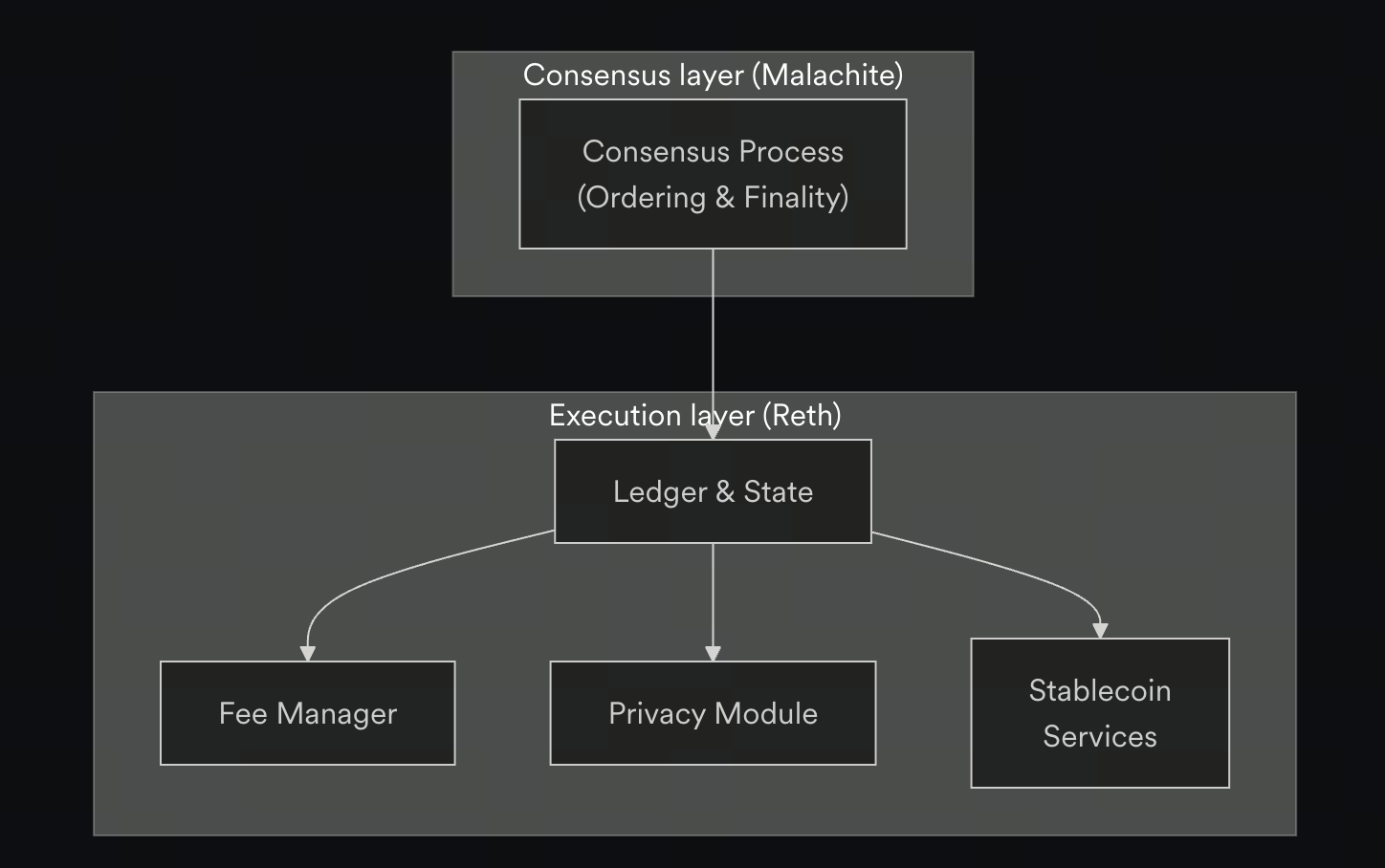
(Image source: docs.arc.network)
Arc is fully EVM-compatible, allowing developers to deploy with Solidity, Foundry, or Hardhat, and use USDC as gas to launch DApps or integrate APIs seamlessly.
The Vision: Structuring the On-Chain Economy
Arc isn’t aiming to be the fastest chain — it’s aiming to be the most economically relevant.
By introducing stable fees, instant settlement, and privacy-conscious compliance, Arc is shaping a financial foundation where enterprises, banks, and developers can engage with blockchain under familiar economic frameworks.
Its long-term goal: to digitize the world’s capital markets and payment networks through a unified, regulation-ready infrastructure.
Conclusion
Arc redefines what blockchain means for finance. It’s not just a chain — it’s an open financial operating system that unites stability, privacy, compliance, and performance into a single architecture.
As the multi-chain world expands, Arc is poised to serve as the core infrastructure linking digital assets, global payments, and institutional finance — setting a new standard for what on-chain economics can achieve.
Disclaimer:
This is not investment advice. This information is provided for informational purposes only and should not be construed as a recommendation to buy, sell, or hold any asset. Cryptocurrency trading involves a risk of loss. Gate US services may be restricted in certain jurisdictions. For more information, please see our legal disclosures: https://us.gate.com/legal/disclosures
Share
Content


Related Articles

Bitcoin Halving Chart: Key Dates, Trends, and Future Predictions

Bitcoin Halving Chart:Understanding the Changes in Bitcoin Supply and Price Trends

US December Rate Cut Forecast: Will the Federal Reserve Finally Pivot?

Midnight Network Ignites Cardano’s Next Chapter with NIGHT Token Mining and Privacy Innovation

DeFi TVL Hits $237 Billion: What the 2025 Surge Means for Crypto Investor