ADA is Cardano’s native token. It is used to pay network transaction fees and supports protocol functions related to staking delegation, governance, and applications within the Cardano ecosystem. Cardano combines the Extended Unspent Transaction Output (EUTXO) ledger model with native multi-asset support and smart contract functionality.
Cardano provides infrastructure for a range of blockchain applications, including decentralized finance (DeFi), digital identity, credential management, and supply chain traceability. The capabilities and risks of these applications depend on the network’s transaction model, smart contract functionality, and the implementation of individual projects.
Key Takeaways
- Cardano is a Layer 1 blockchain that supports smart contracts and decentralized applications, with an emphasis on research-driven development and formal methods.
- Cardano uses the Ouroboros Proof-of-Stake consensus protocol, which organizes network time into epochs and slots and coordinates block production through stake pools.
- Its architecture separates ledger-related functions from computation-related functions, allowing these components to be developed and optimized independently.
- ADA is Cardano’s native token, used for transaction fees and various protocol functions, including staking delegation and governance participation.
- Cardano uses an Extended Unspent Transaction Output (EUTXO) ledger model to structure transaction validation and smart contract execution.
- Stake pools participate in Cardano’s consensus process. ADA delegation allows holders to support stake-based network participation without transferring ownership of their ADA to a pool operator.

What Is Cardano (ADA)?
Cardano is a public blockchain project founded with the involvement of Charles Hoskinson, a co-founder of Ethereum. Its development approach emphasizes research, formal methods, and peer review. Protocol designs and technical proposals may be evaluated through academic research and formal analysis before implementation.
The network supports ADA transfers, native digital assets, smart contracts, and decentralized applications. Its architecture combines consensus rules, ledger design, and protocol governance to support the operation and evolution of the network.
Cardano uses the Ouroboros Proof-of-Stake consensus protocol. Unlike Proof-of-Work networks, which rely on computational work for block production, Ouroboros coordinates block production through stake-based participation and cryptographic procedures.
Cardano’s core software uses Haskell, a functional programming language. The network does not natively use the Ethereum Virtual Machine (EVM) as its primary smart contract execution environment. Instead, it has its own ledger and execution model. The name ADA refers to Ada Lovelace, the nineteenth-century mathematician, and the token serves functions within Cardano’s transaction and protocol systems.
How Does Cardano Work? Its Layered Architecture and Ouroboros Protocol
Cardano’s design separates ledger-related functions from computation-related functions to support modularity and independent development.
Its architecture is commonly described using two logical layers: the Cardano Settlement Layer (CSL), associated with transaction and asset accounting, and the Cardano Computation Layer (CCL), associated with smart contract and computation functionality. These labels describe the separation between recording transactions and assets and executing application logic.
For consensus, Ouroboros divides blockchain time into epochs and slots. Stake pools participate in block production, and slot leaders are selected through a protocol-defined process that uses cryptographic randomness.
Network operation can be summarized in several steps:
- A user creates and signs a transaction or smart contract interaction using the appropriate key.
- The transaction is broadcast across the peer-to-peer network, where nodes perform validation checks involving transaction inputs, scripts, and fees.
- The Ouroboros protocol determines the eligible slot leader through a stake-based selection process involving a verifiable random function (VRF).
- The selected slot leader assembles valid transactions into a block and broadcasts it with the required cryptographic information.
- Other nodes verify the block, including its signatures, VRF proof, UTXO changes, and script execution, before updating their local chain state according to the protocol’s rules.
This process coordinates block production and transaction validation. The architecture organizes ledger and computation functions, while Ouroboros provides the consensus mechanism for maintaining agreement across the network.
ADA Tokenomics and Core Use Cases
ADA is the native token of the Cardano network. It is used to pay transaction fees and supports protocol functions associated with staking delegation, governance, and interactions with applications that accept ADA or Cardano native assets.
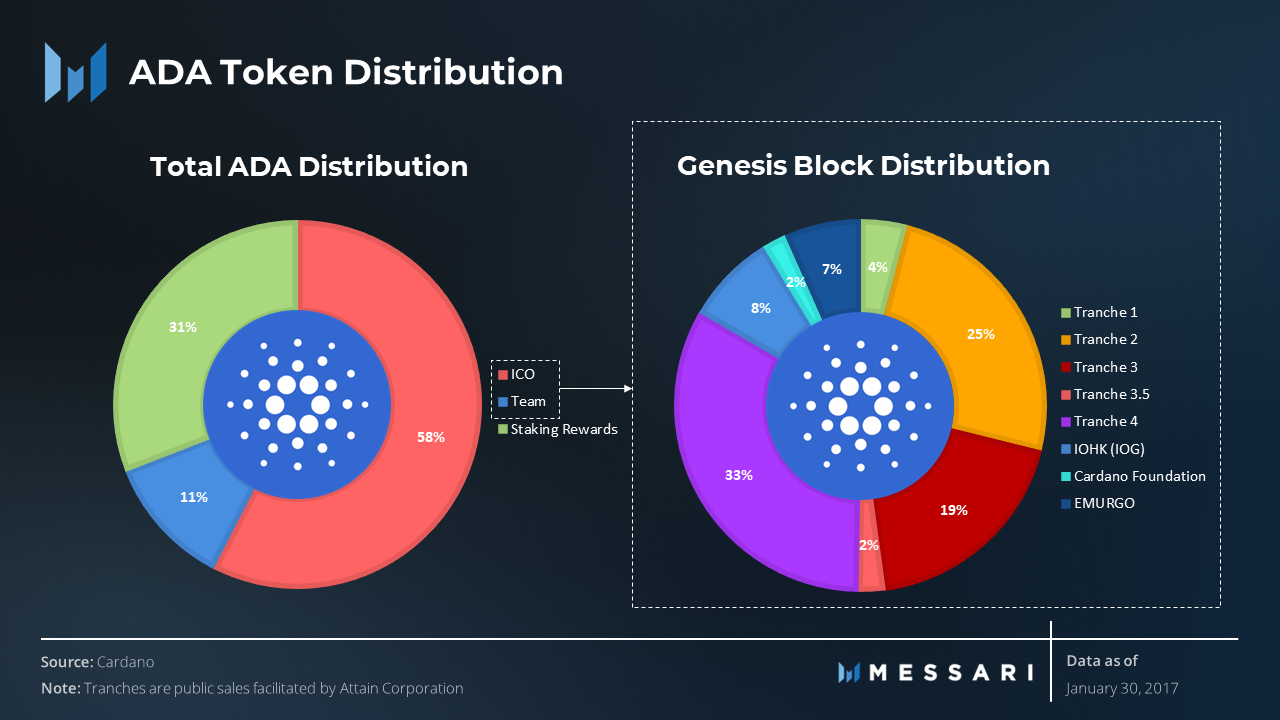
Sources: Messari
ADA Supply and Treasury Mechanism
Token supply
ADA has a protocol-defined maximum supply. Its supply rules form part of Cardano’s monetary design and should be distinguished from the token’s technical functions on the network.
Protocol parameters
Cardano’s protocol includes rules governing network operation and resource allocation. These rules are distinct from any claim about a guaranteed financial outcome for an individual token holder. This guide focuses on the protocol’s technical design and does not provide staking yield estimates or projections.
Treasury mechanism
Cardano includes an on-chain treasury intended to support ecosystem development and community-directed decisions. The treasury and governance framework define processes through which network resources may be allocated, subject to the applicable protocol rules.
Core Use Cases of ADA
Network fees
ADA is used to pay transaction fees when users send transactions or interact with smart contracts on Cardano. The applicable fee depends on network rules and transaction characteristics.
Staking and delegation
ADA staking is part of Cardano’s Proof-of-Stake consensus model. Stake pools provide infrastructure for block production, while delegation allows ADA holders to designate stake to a pool under the protocol’s rules. Delegated ADA remains under the holder’s control rather than being transferred to the pool operator.
Governance
Cardano’s governance framework provides mechanisms for participation in protocol decisions. Governance processes may cover proposals and network changes, subject to eligibility requirements and the rules applicable to each process.
Settlement and application interactions
ADA can be used for transactions and may be supported as an asset in applications built on Cardano, including certain DeFi services. The functionality and risks of these applications depend on their individual designs and implementations.
Cardano’s protocol does not impose a mandatory lock-up period for delegated ADA. However, the practical ability to change a delegation choice or transfer assets may depend on wallet functionality, transaction processing, and the relevant protocol rules.
Core Features and Technical Standards of Cardano
Cardano’s technical design is characterized by its ledger model, formal methods, layered architecture, and native multi-asset support.
The EUTXO Ledger Model
Cardano extends the Unspent Transaction Output (UTXO) model used by Bitcoin to support smart contracts. Under the Extended UTXO model, transaction outputs can contain data and be governed by scripts. Transactions consume existing outputs and create new ones, providing a structured way to represent asset ownership and application state.
This model can make transaction validation more deterministic because execution depends on specified inputs and the relevant script conditions. Transactions that do not compete for the same outputs may also be processed independently, although practical parallelism depends on application design and resource constraints.
Formal Methods and Peer-Reviewed Development
Cardano emphasizes research and formal methods in protocol and software development. Formal modeling and verification can help developers reason about system behavior and identify certain classes of errors. However, these methods do not eliminate every possible implementation, operational, or application-level risk.
Smart contract development on Cardano uses its own tools and execution environment, including Plutus. Developers must account for the EUTXO model and the way transaction inputs, outputs, and script execution are structured.
Layered Architecture and Modularity
The separation of settlement and computation functions helps distinguish asset accounting from application execution. This modular approach can support the development and optimization of different network components without requiring every function to be handled by a single execution model.
Native Assets and Multi-Asset Support
Cardano supports the creation and transfer of native assets at the ledger level. These assets use Cardano’s transaction rules rather than requiring a separate smart contract solely to define each token. Additional application logic may still be needed for more complex asset functions.
The Stake Pool Ecosystem
Stake pools are an important part of Cardano’s consensus architecture. They provide infrastructure for participating in block production and support distributed participation across network operators.
ADA holders can delegate stake to a pool without transferring ownership of their assets to the pool operator. Stake pools differ in their technical operation, infrastructure, reliability, and operational configuration. Their role in consensus should be distinguished from any assumptions about financial outcomes associated with delegation.
Cardano vs. Ethereum: Key Differences
Cardano and Ethereum both support smart contracts and decentralized applications, but they differ in their ledger models, execution environments, consensus protocols, staking systems, and governance structures.
Account Model and EUTXO
Cardano uses the UTXO and EUTXO model, in which blockchain state is represented through unspent transaction outputs. Transactions consume existing outputs and create new ones. Smart contract state can be represented through outputs containing relevant data and script conditions.
Ethereum uses an account-based model, in which addresses can maintain balances and contract storage. Transactions update the shared state according to Ethereum’s execution rules.
These differences affect how developers design, execute, and validate transactions.
Transaction Parallelism
Under EUTXO, transactions that do not depend on or consume the same outputs may be processed independently. This can support parallel processing when applications are designed accordingly.
In account-based systems, transactions that modify shared state may require coordination. Scaling approaches such as rollups can process activity through separate execution environments, depending on their architecture.
Fee Predictability and Execution
Cardano’s EUTXO model allows developers to reason about transaction inputs and script conditions in a structured way. This can make some execution outcomes easier to determine in advance.
Actual fees and transaction success still depend on transaction size, script execution, network parameters, and other conditions.
Differences in Staking Mechanisms
Cardano and Ethereum both use Proof of Stake, but their participation models differ.
Cardano’s delegation model
Cardano supports stake delegation, allowing ADA holders to designate stake to a stake pool without transferring ownership of their ADA to the pool operator. The protocol does not impose a mandatory lock-up period for delegated ADA.
Stake pool participation
Cardano’s network includes stake pools operated by different participants. Pool operators are responsible for the infrastructure and operations needed for their role in consensus. Delegation provides a way for ADA holders to participate in the network’s stake-based system without running a pool themselves.
Ethereum validator participation
Ethereum’s native staking system involves validator requirements and protocol-defined duties. Participants may operate validators directly or use third-party arrangements, each of which has its own technical and operational considerations.
The two networks therefore use different approaches to staking participation. Their requirements and risks should be evaluated according to the relevant protocol and participation method.
Governance Model Comparison
Cardano’s governance framework includes on-chain mechanisms and a treasury intended to support community-directed decisions and ecosystem development. Certain protocol parameters and network changes can be addressed through defined governance processes.
Ethereum governance relies more heavily on social coordination among developers, client teams, researchers, and community participants. Technical proposals and protocol upgrades are implemented through client software and broader community agreement rather than a single unified on-chain voting mechanism.
Both models depend on participation, coordination, and technical implementation. Their differences reflect distinct approaches to protocol evolution and community decision-making.
Participating in the Cardano Ecosystem
Cardano supports different forms of network interaction, including ADA transfers, smart contract execution, decentralized applications, and governance participation. The functions available to users depend on the relevant wallet, application, network rules, and eligibility requirements.
ADA Transfers and Wallets
Wallets compatible with Cardano allow users to manage ADA and supported native assets, sign transactions, and interact with applications. Transactions are processed according to the network’s rules. Address accuracy, private-key security, and wallet integrity are important considerations when managing digital assets.
Staking Delegation as a Network Mechanism
Delegation is a component of Cardano’s Proof-of-Stake model. It allows ADA holders to assign stake to a pool for consensus participation without transferring ownership of the underlying ADA to the pool operator.
Stake pool operation and delegation are distinct roles: pool operators maintain the infrastructure required for pool participation, while delegators designate stake under the protocol’s rules. This description concerns network structure and consensus participation, not a recommendation to use a particular pool or pursue a financial outcome.
Using Decentralized Applications
Cardano supports decentralized applications across areas such as lending, decentralized exchanges, digital collectibles, identity-related services, and supply chain solutions. Applications may use ADA to pay transaction fees when interacting with the network.
Application-level risks can differ from those associated with the underlying blockchain. Smart contract errors, interface issues, asset liquidity, and project-specific dependencies may affect individual applications.
Governance and Community Participation
Cardano participants can follow governance discussions and, where eligible under the relevant rules, participate in proposal and voting processes. Developers and other community members can also contribute through software development, research, testing, documentation, and security reviews.
As with other public blockchain networks, Cardano has technical and ecosystem risks. Network functionality can be affected by software defects, infrastructure issues, and protocol changes. Applications built on Cardano may also face adoption, security, or operational challenges. ADA is a digital asset whose market price can fluctuate, and network utility does not eliminate the risks associated with digital assets.
Conclusion
Cardano is a Layer 1 blockchain that combines the Ouroboros Proof-of-Stake consensus protocol, a layered architecture, and the EUTXO ledger model. These design choices shape how the network coordinates block production, validates transactions, and supports smart contracts and native assets.
ADA is used for transaction fees and supports protocol functions related to staking delegation, governance, and interactions across the Cardano ecosystem. Stake pools provide infrastructure for consensus participation, while delegation allows ADA holders to designate stake without transferring ownership of their assets to pool operators.
Cardano’s technical approach differs from that of account-based smart contract networks such as Ethereum. Understanding its ledger model, consensus protocol, governance framework, and application-level risks provides a foundation for evaluating how Cardano operates and how its ecosystem is structured.
FAQs
What is the biggest technical difference between Cardano and Bitcoin?
Bitcoin uses Proof of Work and a UTXO ledger model primarily designed for digital asset transfers. Cardano uses Proof of Stake and extends the UTXO model through EUTXO to support smart contracts and native assets.
Is ADA locked when delegated to a Cardano stake pool?
Cardano’s protocol does not impose a mandatory lock-up period for delegated ADA. The assets remain under the holder’s control, and users can generally change their delegation choice or transfer their ADA, subject to wallet functionality and network processing.
How is Ouroboros different from other Proof-of-Stake designs?
Ouroboros organizes network time into epochs and slots and uses a protocol-defined process involving stake and cryptographic randomness to select slot leaders. Its design has been studied through formal security analysis, although no protocol design eliminates every possible risk.
What does the EUTXO model mean for developers?
Developers represent transaction and application state through UTXOs and must account for how transactions consume and create outputs. This model can support deterministic validation and parallel processing when transactions do not compete for the same outputs, but application design remains important.
How does Cardano approach scalability?
Cardano’s development approach includes changes to protocol parameters, transaction processing, smart contract execution, and complementary scaling approaches. Actual performance depends on network conditions, implementation, and application requirements.