:
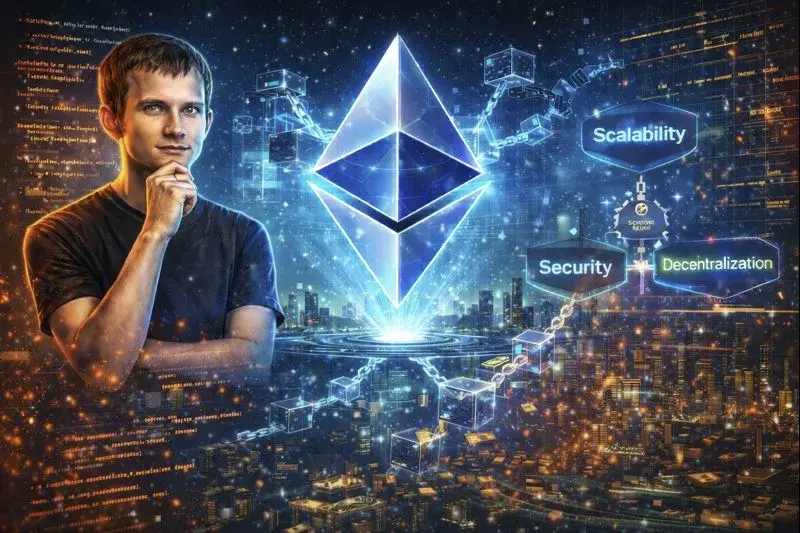
:#Gate广场创作者新春激励 Ethereum co-founder Vitalik Buterin dropped a bombshell in early January 2026. He officially announced that the long-standing "Blockchain Trilemma"—the contradiction that decentralization, security, and scalability cannot be achieved simultaneously—has moved from a theoretical obstacle to a solved problem through "live running code" that is already online and operational. This declaration marks Ethereum's evolution from a simple smart contract platform into a "fundamentally new" and more powerful decentralized network.
Core Technology Analysis:
The Double-Edged Sword of PeerDAS and zkEVM
The core of V神's announcement lies in two major technological breakthroughs. First is the introduction of PeerDAS, a peer-to-peer data availability sampling technology, which was officially integrated with the "Fusaka" upgrade at the end of 2025. This technology addresses scalability issues at the data layer by allowing Ethereum nodes to verify data integrity through probabilistic sampling without downloading the entire data set. This not only increases Layer 2 data storage capacity (Blobs) by eight times but also significantly reduces bandwidth requirements for individual nodes, ensuring that ordinary hardware can still participate in validation as the network expands—upholding the core value of decentralization. Second, the development of zero-knowledge Ethereum Virtual Machine (zkEVM) has reached "production-level efficiency."
Traditionally, each validator must re-execute every transaction in a block to confirm its validity, which puts enormous pressure on hardware. zkEVM allows a single participant to generate cryptographic proofs, which other nodes can verify to confirm the correctness of a batch of transactions.
Vitalik pointed out that while zkEVM is currently in Alpha stage, its performance is sufficient for large-scale applications. The remaining work mainly focuses on system security reinforcement. The combination of these two technologies enables Ethereum to achieve high bandwidth and low costs comparable to centralized systems without sacrificing security and decentralization.
From 2026 to 2030: Ethereum’s Long-term "Anti-Centralization" Blueprint
Although V神 announced that the Blockchain Trilemma has been addressed at the architectural level, he also emphasized that "solving it does not mean completion." This is a decade-long transformation journey, and the current progress is more of a declaration than a simple roadmap.
2026 will be the transitional year for Ethereum’s transformation. Developers will begin early opportunities to run zkEVM nodes and will moderately raise Gas limits without relying on zkEVM to alleviate short-term network pressure. According to V神's published plan, from 2026 to 2028, Ethereum will undergo a series of detailed adjustments, including re-evaluating Gas prices and optimizing state structures, to ensure network stability under higher transaction throughput. The ultimate goal is to make zkEVM the primary method for validating Ethereum blocks between 2027 and 2030. By then, Ethereum will have completely broken free from the fate of high-performance blockchains relying on expensive servers or a few nodes, achieving true "collective sovereignty" and fighting against centralized hegemony that seeks to control data and power.
Expert Analysis: The Challenge of Decoupling Technological Progress from Market Confidence
From a market perspective, V神's statement comes amid skepticism towards Ethereum. Despite frequent technical developments and strong institutional interest in 2025, the native token ETH's price performance lagged behind some competitors. Critics argue that Ethereum's reliance on Layer 2 networks dilutes value capture.
However, Vitalik's latest remarks reshape the discussion: Ethereum's pursuit is not short-term price volatility but whether it can build an infrastructure capable of supporting a global scale that is uncensorable and unstoppable. Compared to emerging public chains like Solana that compromise decentralization for throughput, Ethereum’s "trilemma solution" offers a more challenging but resilient path. If Ethereum successfully integrates Layer 1 security with Layer 2 efficiency, it will challenge industry assumptions.
Analyst Daniel Tschinkel pointed out that users will ultimately trust systems that operate consistently and predictably. Ethereum’s architectural breakthroughs are not only for engineers’ self-fulfillment but also to provide a truly permissionless and fair environment in the future digital economy.
Conclusion: Ethereum Has Entered the Implementation Stage of Architectural Finalization
Overall, V神's declaration on solving the blockchain trilemma symbolizes that Ethereum has completed its most challenging design phase and has entered a multi-year phase of execution and solidification. PeerDAS addresses data scalability bottlenecks, while zkEVM redefines transaction verification efficiency. The combination of these two heralds the arrival of a high-performance, decentralized network era. Although fully realizing these improvements will take years, Ethereum’s technological performance in 2026 undoubtedly boosts confidence for long-term investors and developers. In today’s context of tightening global regulations and increasing demands to counteract centralized censorship, a foundational protocol that balances security, decentralization, and scalability will have a value far beyond short-term market fluctuations. Investors should closely monitor the adoption of zkEVM nodes over the next two years and whether these underlying architecture upgrades can ultimately translate into improved transaction experiences for end users.
Core Technology Analysis:
The Double-Edged Sword of PeerDAS and zkEVM
The core of V神's announcement lies in two major technological breakthroughs. First is the introduction of PeerDAS, a peer-to-peer data availability sampling technology, which was officially integrated with the "Fusaka" upgrade at the end of 2025. This technology addresses scalability issues at the data layer by allowing Ethereum nodes to verify data integrity through probabilistic sampling without downloading the entire data set. This not only increases Layer 2 data storage capacity (Blobs) by eight times but also significantly reduces bandwidth requirements for individual nodes, ensuring that ordinary hardware can still participate in validation as the network expands—upholding the core value of decentralization. Second, the development of zero-knowledge Ethereum Virtual Machine (zkEVM) has reached "production-level efficiency."
Traditionally, each validator must re-execute every transaction in a block to confirm its validity, which puts enormous pressure on hardware. zkEVM allows a single participant to generate cryptographic proofs, which other nodes can verify to confirm the correctness of a batch of transactions.
Vitalik pointed out that while zkEVM is currently in Alpha stage, its performance is sufficient for large-scale applications. The remaining work mainly focuses on system security reinforcement. The combination of these two technologies enables Ethereum to achieve high bandwidth and low costs comparable to centralized systems without sacrificing security and decentralization.
From 2026 to 2030: Ethereum’s Long-term "Anti-Centralization" Blueprint
Although V神 announced that the Blockchain Trilemma has been addressed at the architectural level, he also emphasized that "solving it does not mean completion." This is a decade-long transformation journey, and the current progress is more of a declaration than a simple roadmap.
2026 will be the transitional year for Ethereum’s transformation. Developers will begin early opportunities to run zkEVM nodes and will moderately raise Gas limits without relying on zkEVM to alleviate short-term network pressure. According to V神's published plan, from 2026 to 2028, Ethereum will undergo a series of detailed adjustments, including re-evaluating Gas prices and optimizing state structures, to ensure network stability under higher transaction throughput. The ultimate goal is to make zkEVM the primary method for validating Ethereum blocks between 2027 and 2030. By then, Ethereum will have completely broken free from the fate of high-performance blockchains relying on expensive servers or a few nodes, achieving true "collective sovereignty" and fighting against centralized hegemony that seeks to control data and power.
Expert Analysis: The Challenge of Decoupling Technological Progress from Market Confidence
From a market perspective, V神's statement comes amid skepticism towards Ethereum. Despite frequent technical developments and strong institutional interest in 2025, the native token ETH's price performance lagged behind some competitors. Critics argue that Ethereum's reliance on Layer 2 networks dilutes value capture.
However, Vitalik's latest remarks reshape the discussion: Ethereum's pursuit is not short-term price volatility but whether it can build an infrastructure capable of supporting a global scale that is uncensorable and unstoppable. Compared to emerging public chains like Solana that compromise decentralization for throughput, Ethereum’s "trilemma solution" offers a more challenging but resilient path. If Ethereum successfully integrates Layer 1 security with Layer 2 efficiency, it will challenge industry assumptions.
Analyst Daniel Tschinkel pointed out that users will ultimately trust systems that operate consistently and predictably. Ethereum’s architectural breakthroughs are not only for engineers’ self-fulfillment but also to provide a truly permissionless and fair environment in the future digital economy.
Conclusion: Ethereum Has Entered the Implementation Stage of Architectural Finalization
Overall, V神's declaration on solving the blockchain trilemma symbolizes that Ethereum has completed its most challenging design phase and has entered a multi-year phase of execution and solidification. PeerDAS addresses data scalability bottlenecks, while zkEVM redefines transaction verification efficiency. The combination of these two heralds the arrival of a high-performance, decentralized network era. Although fully realizing these improvements will take years, Ethereum’s technological performance in 2026 undoubtedly boosts confidence for long-term investors and developers. In today’s context of tightening global regulations and increasing demands to counteract centralized censorship, a foundational protocol that balances security, decentralization, and scalability will have a value far beyond short-term market fluctuations. Investors should closely monitor the adoption of zkEVM nodes over the next two years and whether these underlying architecture upgrades can ultimately translate into improved transaction experiences for end users.