What Is Quantitative Trading? Understanding Data-Driven Trading Systems
Introduction to Quantitative Trading
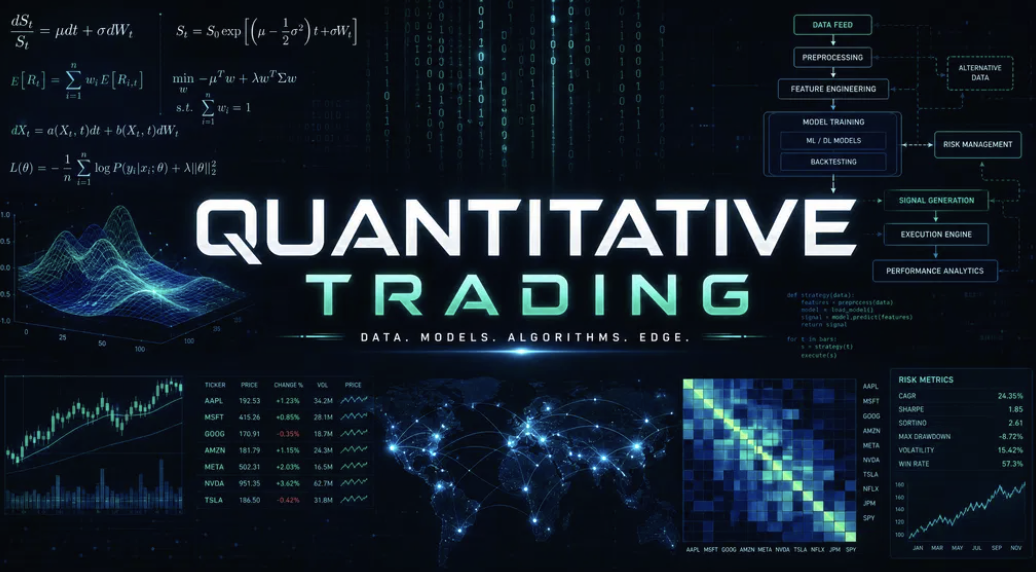
Quantitative trading refers to a systematic approach to financial trading that relies on mathematical models, computational algorithms, and data analysis rather than discretionary human judgment. By combining statistics, programming, and market research, traders develop rule-based systems capable of identifying trading opportunities and executing transactions automatically.
Originally associated with institutional finance and Wall Street firms, quantitative trading has gradually expanded into broader financial sectors, including cryptocurrency markets, foreign exchange, commodities, and digital asset ecosystems.
Data-Driven Decision Making
A defining characteristic of quantitative trading is its dependence on historical and real-time market data. Instead of relying primarily on intuition or subjective interpretation, quantitative systems evaluate measurable variables such as price movements, trading volume, volatility, or correlations between assets.
These data inputs are processed through predefined models to generate trading signals. Because the rules are explicitly programmed, strategies can often be tested repeatedly under different market conditions before deployment.
Strategy Development and Model Construction
One of the central components of quantitative trading involves strategy construction. Traders and researchers design models intended to capture recurring market behaviors or inefficiencies. Common examples include trend-following systems, moving average crossover models, momentum strategies, and arbitrage-based approaches.
Historical backtesting is typically used to evaluate how a strategy would have performed under previous market conditions. Although past performance does not guarantee future results, this process helps assess the consistency and limitations of a trading model.
Risk Management Frameworks
Risk control is another essential element of quantitative trading systems. Because automated strategies can execute trades rapidly and continuously, predefined safeguards are often implemented to manage exposure.
These controls may include stop-loss mechanisms, profit-taking conditions, position-sizing rules, and portfolio allocation limits. The objective is to reduce the probability of excessive losses during periods of unfavorable market behavior or unexpected volatility.
Automation and Trade Execution
Once a trading strategy and risk framework are established, execution is commonly handled through automated infrastructure. Trading bots, APIs, and algorithmic execution systems allow orders to be submitted and managed with minimal human intervention.
Automation offers several practical advantages, including faster execution speed and reduced emotional bias. By removing many discretionary decisions from the trading process, quantitative systems aim to maintain consistency in strategy implementation.
Conclusion
In summary, quantitative trading represents a structured and technology-driven approach to market participation. Through the integration of mathematical modeling, statistical analysis, and automated execution, it seeks to transform trading into a repeatable and data-oriented process. As computational tools and financial data continue to evolve, quantitative methods are likely to remain an increasingly important part of modern financial markets.
* The information is not intended to be and does not constitute financial advice or any other recommendation of any sort offered or endorsed by Gate Australia.
* This article may not be reproduced, transmitted or copied without referencing Gate Australia. Contravention is an infringement of Copyright Act and may be subject to legal action.


Related Articles

ERC-721 Explained in 2026: How the NFT Standard Powers Digital Ownership and What Risks Investors Should Know

TradFi Meets Blockchain in 2026: Institutional Adoption, Tokenization, and Market Risks

Zero-Knowledge Proof (ZKP) in 2026: Technology Breakthroughs, Market Trends, and Risk Analysis

Bless: Building a Decentralized Edge Computing Network for the AI Era

Understanding Creditlink ($CDL): On‑Chain Credit Infrastructure & RootData Airdrop Explained