What Is 2FA? Understanding Two-Factor Authentication in Digital Security
Introduction to Two-Factor Authentication
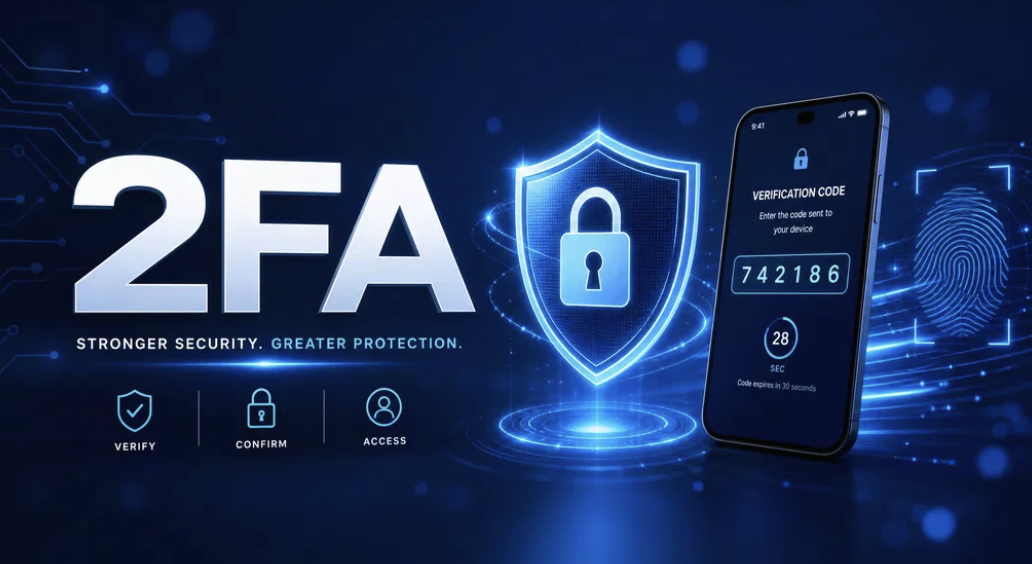
Two-factor authentication, commonly abbreviated as 2FA, is a security mechanism designed to strengthen account protection by requiring more than a password alone. When users log in to an account or perform sensitive operations, they must provide a second form of verification in addition to their primary credentials.
The underlying principle is based on layered security. Even if a password is compromised, unauthorized access becomes significantly more difficult if a second authentication factor is still required.
Why Additional Authentication Is Necessary
Passwords have long served as the primary method of digital authentication, yet they remain vulnerable to phishing attacks, data breaches, malware, and credential reuse. As online financial systems and digital assets have become more valuable, the risks associated with password-only security have increased substantially.
2FA addresses this issue by separating authentication into multiple factors, thereby reducing the likelihood that a single point of failure can compromise an account.
Common Forms of 2FA
Several forms of two-factor authentication are widely used across digital platforms. One common method involves time-based one-time passwords (TOTP), which are generated through applications such as Google Authenticator or Authy. These codes refresh periodically and are typically generated locally on the user’s device.
Another approach uses SMS verification, where a temporary authentication code is sent to the user’s mobile phone via text message. While convenient, this method is generally considered less secure due to risks such as SIM-swapping attacks.
Hardware security keys, including physical authentication devices like YubiKey, represent another form of 2FA. These devices require direct physical interaction and are often regarded as one of the strongest authentication methods available for individual users.
The Role of TOTP in Cryptocurrency and Web3
Within cryptocurrency exchanges and Web3 applications, TOTP-based authentication has become one of the most commonly adopted forms of 2FA. Unlike SMS verification, TOTP systems do not rely on mobile carrier infrastructure, which reduces exposure to telecommunication-related attacks.
Because authentication codes are generated offline and stored locally on the user’s device, TOTP is generally considered more suitable for environments involving digital asset management and blockchain-related services.
Security Benefits and Practical Limitations
Although 2FA significantly improves account security, it does not eliminate all risks. Users must still protect recovery codes, authentication devices, and backup methods. Losing access to the second authentication factor without proper recovery preparation may result in account lockout.
Nevertheless, when combined with strong password practices and careful device management, two-factor authentication remains one of the most effective measures for reducing unauthorized account access.
Conclusion
In summary, two-factor authentication enhances digital security by requiring multiple forms of identity verification. By adding an additional protective layer beyond passwords, 2FA reduces the probability of unauthorized access and has become an important standard across financial platforms, cryptocurrency services, and online applications. As cyber threats continue to evolve, multi-factor authentication mechanisms are likely to remain central to modern account security practices.
* The information is not intended to be and does not constitute financial advice or any other recommendation of any sort offered or endorsed by Gate Australia.
* This article may not be reproduced, transmitted or copied without referencing Gate Australia. Contravention is an infringement of Copyright Act and may be subject to legal action.


Related Articles

ERC-721 Explained in 2026: How the NFT Standard Powers Digital Ownership and What Risks Investors Should Know

TradFi Meets Blockchain in 2026: Institutional Adoption, Tokenization, and Market Risks

Zero-Knowledge Proof (ZKP) in 2026: Technology Breakthroughs, Market Trends, and Risk Analysis

Bless: Building a Decentralized Edge Computing Network for the AI Era

Understanding Creditlink ($CDL): On‑Chain Credit Infrastructure & RootData Airdrop Explained