














#KalshiFacesNevadaRegulatoryClash
The clash between Kalshi and Nevada is not just a regulatory dispute; it is a structural stress test for how modern economies classify uncertainty, risk, and speculation.
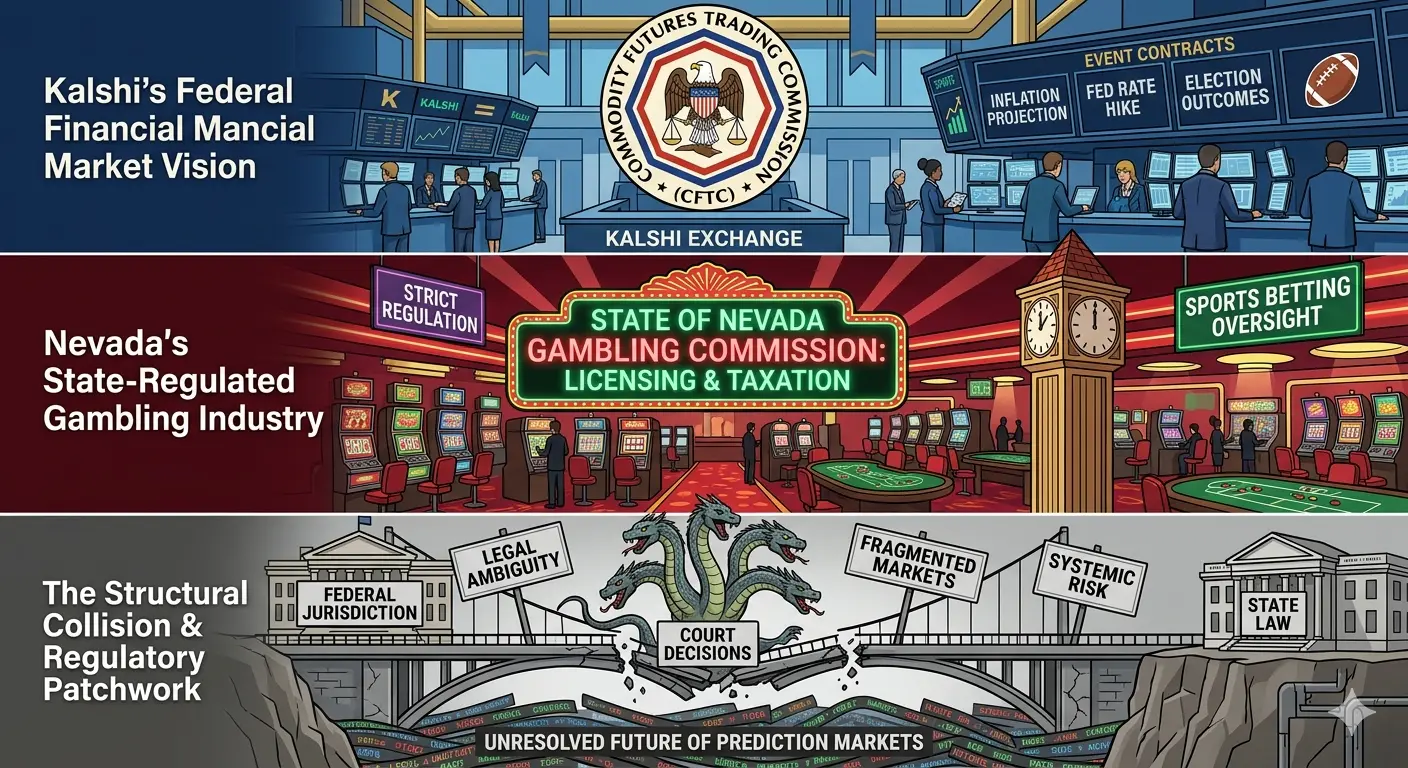
At the center of the conflict is a legal contradiction that current frameworks were never designed to handle. Kalshi operates as a federally approved exchange offering “event contracts,” arguing these are financial derivatives under the jurisdiction of the Commodity Futures Trading Commission. Nevada regulators, however, view the exact same instruments as indistinguishable from sports betting, requiring state licensing and oversight. Courts are now being forced to decide whether identical economic behavior changes meaning based solely on legal classification.
This tension exposes a deeper flaw in regulatory design. Financial markets are traditionally defined by their connection to underlying economic activity, while gambling is defined by outcome-based wagering. Prediction markets sit directly between these categories. A contract on inflation clearly resembles a derivative, but a contract on a football game outcome looks functionally identical to a bet. The law was not built for instruments that can seamlessly span both domains.
Nevada’s response is not just about legal interpretation; it is about preserving jurisdictional authority and economic control. The state has one of the most mature and tightly regulated gambling ecosystems in the world. Allowing a federally regulated platform to offer similar products without a state license would effectively bypass its entire regulatory and taxation structure. From Nevada’s perspective, this is not innovation—it is regulatory arbitrage at scale.
Kalshi’s position, however, is equally strategic. By anchoring itself in federal derivatives law, it is attempting to establish prediction markets as a new asset class rather than a subset of gambling. If successful, this would allow nationwide scaling without the friction of state-by-state licensing. The implications are enormous: a unified, federally governed market for trading probabilities on everything from elections to economic indicators to sports.
What makes the situation unstable is that the legal system is producing inconsistent outcomes. Some courts and jurisdictions have sided with Kalshi’s federal argument, while others—like Nevada—have enforced state gambling laws and blocked operations. This fragmentation creates a patchwork regulatory environment where the same product is simultaneously legal and illegal depending on geography.
The scale of the industry is accelerating the urgency of resolution. Prediction markets have grown from niche experiments into high-volume platforms handling billions in trades, with activity heavily concentrated in sports-related contracts. This growth is precisely what is triggering regulatory backlash. As long as these platforms remained small, ambiguity was tolerable. At scale, ambiguity becomes systemic risk.
There is also a policy concern that goes beyond classification. Prediction markets challenge traditional safeguards around gambling, including age restrictions, addiction controls, and consumer protections. Regulators argue that by framing bets as financial trades, platforms may be bypassing protections designed for behavioral risk. At the same time, proponents argue that these markets improve information discovery and price real-world probabilities more efficiently than polls or forecasts.
Another layer of complexity comes from federal intent. Key architects of derivatives regulation have argued that applying swap frameworks to sports-style contracts stretches the original purpose of the law. This suggests that even if Kalshi’s interpretation is legally defensible, it may not align with the policy objectives those laws were meant to serve.
What is emerging is not just a legal dispute, but a three-way power struggle: federal regulators asserting exclusive authority over financial instruments, state governments defending control over gambling within their borders, and private platforms exploiting the gap between the two.
The outcome will define more than Kalshi’s future. If federal authority prevails, prediction markets could become a standardized financial layer integrated into trading platforms, brokerage apps, and institutional portfolios. If state authority dominates, the industry will fragment into localized, licensed markets with slower growth and tighter controls.
The most likely trajectory is escalation. With conflicting rulings, increasing economic stakes, and multiple states involved, the issue is moving toward higher courts and potentially a definitive national ruling. Until then, the market operates in a state of legal limbo where innovation is advancing faster than the rules that govern it.
At its core, this conflict is about whether probability itself becomes a tradable financial primitive or remains confined within the boundaries of regulated gambling. The system has not yet decided, but the decision will reshape both industries.
The clash between Kalshi and Nevada is not just a regulatory dispute; it is a structural stress test for how modern economies classify uncertainty, risk, and speculation.
At the center of the conflict is a legal contradiction that current frameworks were never designed to handle. Kalshi operates as a federally approved exchange offering “event contracts,” arguing these are financial derivatives under the jurisdiction of the Commodity Futures Trading Commission. Nevada regulators, however, view the exact same instruments as indistinguishable from sports betting, requiring state licensing and oversight. Courts are now being forced to decide whether identical economic behavior changes meaning based solely on legal classification.
This tension exposes a deeper flaw in regulatory design. Financial markets are traditionally defined by their connection to underlying economic activity, while gambling is defined by outcome-based wagering. Prediction markets sit directly between these categories. A contract on inflation clearly resembles a derivative, but a contract on a football game outcome looks functionally identical to a bet. The law was not built for instruments that can seamlessly span both domains.
Nevada’s response is not just about legal interpretation; it is about preserving jurisdictional authority and economic control. The state has one of the most mature and tightly regulated gambling ecosystems in the world. Allowing a federally regulated platform to offer similar products without a state license would effectively bypass its entire regulatory and taxation structure. From Nevada’s perspective, this is not innovation—it is regulatory arbitrage at scale.
Kalshi’s position, however, is equally strategic. By anchoring itself in federal derivatives law, it is attempting to establish prediction markets as a new asset class rather than a subset of gambling. If successful, this would allow nationwide scaling without the friction of state-by-state licensing. The implications are enormous: a unified, federally governed market for trading probabilities on everything from elections to economic indicators to sports.
What makes the situation unstable is that the legal system is producing inconsistent outcomes. Some courts and jurisdictions have sided with Kalshi’s federal argument, while others—like Nevada—have enforced state gambling laws and blocked operations. This fragmentation creates a patchwork regulatory environment where the same product is simultaneously legal and illegal depending on geography.
The scale of the industry is accelerating the urgency of resolution. Prediction markets have grown from niche experiments into high-volume platforms handling billions in trades, with activity heavily concentrated in sports-related contracts. This growth is precisely what is triggering regulatory backlash. As long as these platforms remained small, ambiguity was tolerable. At scale, ambiguity becomes systemic risk.
There is also a policy concern that goes beyond classification. Prediction markets challenge traditional safeguards around gambling, including age restrictions, addiction controls, and consumer protections. Regulators argue that by framing bets as financial trades, platforms may be bypassing protections designed for behavioral risk. At the same time, proponents argue that these markets improve information discovery and price real-world probabilities more efficiently than polls or forecasts.
Another layer of complexity comes from federal intent. Key architects of derivatives regulation have argued that applying swap frameworks to sports-style contracts stretches the original purpose of the law. This suggests that even if Kalshi’s interpretation is legally defensible, it may not align with the policy objectives those laws were meant to serve.
What is emerging is not just a legal dispute, but a three-way power struggle: federal regulators asserting exclusive authority over financial instruments, state governments defending control over gambling within their borders, and private platforms exploiting the gap between the two.
The outcome will define more than Kalshi’s future. If federal authority prevails, prediction markets could become a standardized financial layer integrated into trading platforms, brokerage apps, and institutional portfolios. If state authority dominates, the industry will fragment into localized, licensed markets with slower growth and tighter controls.
The most likely trajectory is escalation. With conflicting rulings, increasing economic stakes, and multiple states involved, the issue is moving toward higher courts and potentially a definitive national ruling. Until then, the market operates in a state of legal limbo where innovation is advancing faster than the rules that govern it.
At its core, this conflict is about whether probability itself becomes a tradable financial primitive or remains confined within the boundaries of regulated gambling. The system has not yet decided, but the decision will reshape both industries.