

















Middle East Situation Tracking and In-Depth Analysis | April 13
The US-Iran Islamabad Marathon negotiations announced failure on April 12, immediately followed by Trump ordering the blockade of Iranian ports, sharply escalating the Strait of Hormuz standoff. Oil prices surged over 8% in response, ground clashes in Lebanon continue, Houthi forces issued a new round of threats, and the "Axis of Resistance" risk increases. The two-week ceasefire lasted only a few days, and the Middle East is sliding into a larger conflict vortex.
Quick Overview
· Negotiation Breakdown: US and Iran failed to reach an agreement in Islamabad; Iran announced three "unreasonable demands" from the US, with core disagreements on Strait control and uranium enrichment rights.
· Strait Confrontation: Trump announced the blockade of the Strait of Hormuz, the Revolutionary Guard claimed full control of the strait, US warships attempted to pass but were forced back.
· Israel-Lebanon Clashes: Israeli military and Hezbollah engaged in fierce firefights in southern Lebanon at Bint Jbeil, Netanyahu personally visited the "buffer zone."
· Energy Markets: Brent crude surged about 8% intraday, European natural gas jumped 18%, the effects of the Hormuz blockade quickly transmitted.
I. Negotiation Breakdown: 21-Hour Marathon Fails
The US-Iran Islamabad talks ended on April 12 without any agreement. US Vice President Vance announced the breakdown in a press conference lasting just over three minutes, accusing Iran of refusing to promise to give up nuclear weapons development, claiming the US had offered a "final best offer." Iran blamed the failure on US "excessive demands and greed," stating the negotiations were in an "atmosphere of mistrust and suspicion," with disagreements on two or three key issues.
Sources familiar with the matter revealed that "both sides' emotions fluctuated during the negotiations, sometimes tense, sometimes easing." Iranian Foreign Minister Araghchi issued a statement after the talks, saying "just one step away from reaching the Islamabad Memorandum of Understanding, we encountered maximum pressure, constantly changing goals, and obstruction. Goodwill should be met with goodwill; hostility will only invite hostility."
Iranian official Nabavi disclosed three major US demands:
1. Equal sharing of benefits and management in the Strait of Hormuz;
2. All 60% enriched uranium to be shipped abroad;
3. Deprive Iran of all uranium enrichment rights for the next 20 years.
In addition to these demands, senior US officials also revealed that Iran rejected the US proposal to stop funding Hamas, Hezbollah, and Houthi forces, and to fully open the Strait of Hormuz.
II. Strait Confrontation Escalates: Dual Narratives Under the Blockade
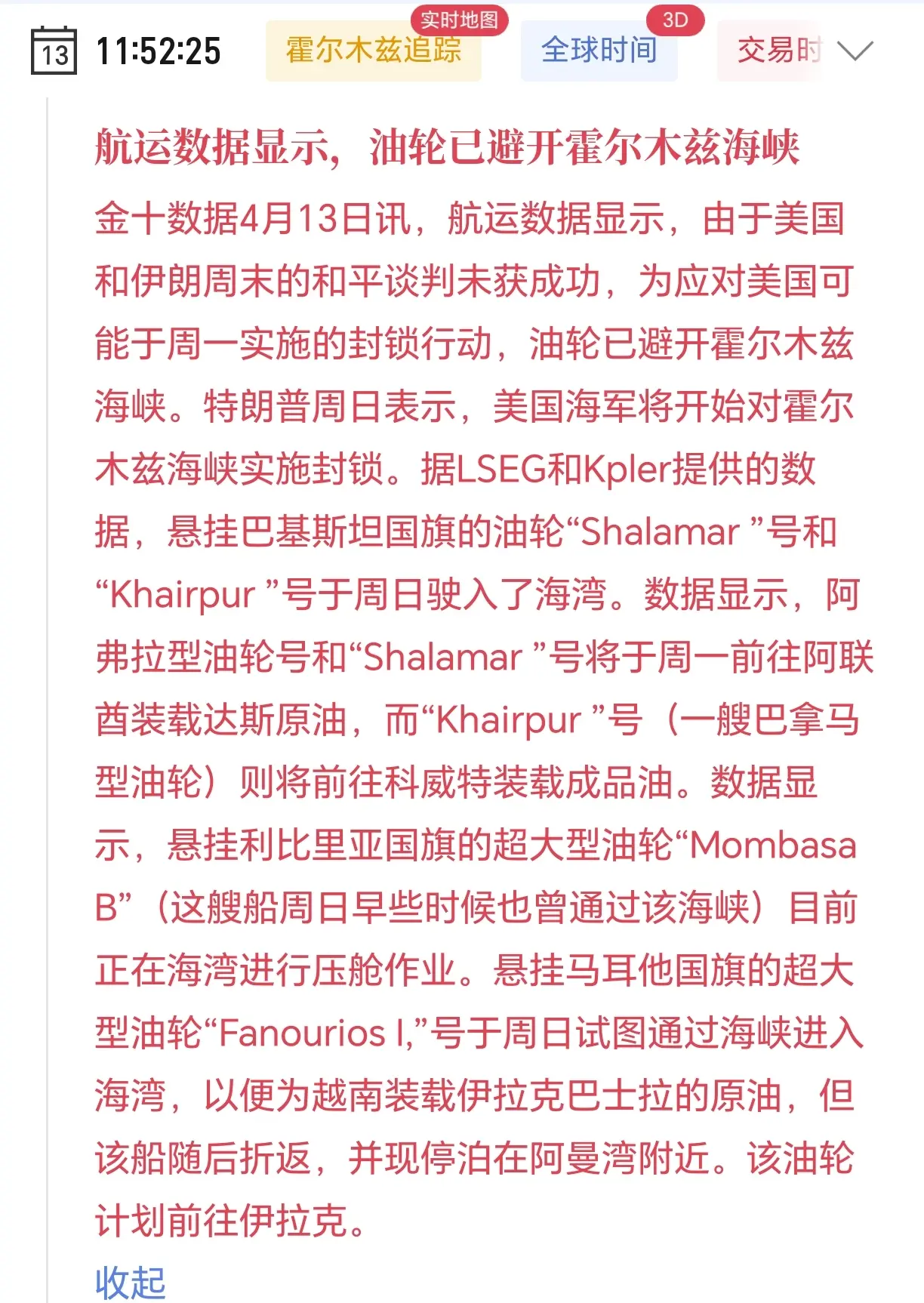
Hours after the negotiations failed, Trump posted on social media that the US Navy would immediately begin blocking all ships attempting to enter or exit the Strait of Hormuz, intercept and verify all ships paying tolls to Iran in international waters, and clear mines laid by Iran in the strait. He also indicated possible strikes on Iran’s desalination plants and power plants. According to The Wall Street Journal, sources said Trump and his aides are considering limited military strikes against Iran while maintaining the blockade.
US Central Command then announced that from 10 a.m. Eastern Time on April 13, all maritime traffic entering or leaving Iranian ports would be blocked, but ships traveling to non-Iranian ports would still be allowed through the Strait of Hormuz. This scope is narrower than Trump’s initial statement of "any ship."
Iran responded strongly. The Revolutionary Guard issued a statement saying the Strait of Hormuz is under control, open to non-military ships under certain conditions, warning that any military vessels approaching the strait would be considered violations of the ceasefire and met with tough responses. They also released drone surveillance footage of the strait, warning "any wrong move will plunge the enemy into a deadly whirlpool in the strait."
Regarding the US and Iranian naval standoff, both sides have different accounts. Trump claimed two US ships successfully passed through the Strait of Hormuz on April 11, but Iran said that when two US destroyers attempted to enter the Persian Gulf, the Revolutionary Guard completed cruise missile lock-on and deployed attack drones, giving the US ships a 30-minute retreat deadline. The US ultimately withdrew, just minutes from destruction. Iran’s state broadcaster called this a "failed propaganda operation."
The UK has made clear it will not participate in the blockade. A government spokesperson said the UK is working with France and others to form a coalition to protect navigation freedom.
III. Israel-Lebanon Clashes Continue: Netanyahu Visits "Buffer Zone"
While the Hormuz Strait crisis escalates, ground conflicts in Lebanon persist. On April 12, Israeli military and Hezbollah engaged in fierce firefights in southern Lebanon at Bint Jbeil, with Hezbollah firing rockets at Israeli Defense Forces headquarters in northern Israel that night.
Netanyahu personally visited the so-called "buffer zone" controlled by Israel in southern Lebanon, stating "the war continues, including within the buffer zone in Lebanon," and that the IDF has more work to do. Israel agreed to hold formal peace talks with Lebanon in Washington on April 14 but refused to discuss a ceasefire with Hezbollah.
Meanwhile, Houthi forces issued a statement on April 12, warning that if the US and Israel attack Iran and the "Resistance Front" again, they will participate with greater intensity. The four simultaneous fronts—nuclear negotiations, Hormuz Strait confrontation, Israel-Lebanon ground clashes, and Houthi threats—show Iran and its proxy system are capable of "full-scale counterattacks."
IV. Energy Markets React Sharply
Affected by the blockade news, international oil prices surged at Asian market open on Monday, with Brent and WTI crude both rising about 8%. More notably, spot market distortions are extreme—Brent Forties spot prices approached $147 per barrel, far above futures prices, signaling severe shortages. European natural gas also jumped 18%.
Trump rarely admits that oil prices might stay high before the midterm elections, saying "they might go down, stay the same, or maybe go a bit higher, but should be roughly at current levels." Iranian Parliament Speaker Kalibaf posted a map of oil prices around the White House on social media, writing "As the so-called blockade continues, you’ll soon miss $4–$5 per gallon gasoline."
V. In-Depth Analysis
(1) The Essence of the Negotiation Breakdown: From "Military Stop-loss" to "Political Showdown"
The root cause of the US-Iran negotiation failure lies in fundamentally different underlying logics of "ceasefire." For Iran, the war has lasted over a month, with more than 3,300 deaths, domestic economic pressure, and damaged refineries. Accepting a ceasefire and seeking negotiations is essentially a stop-loss move—using diplomacy to consolidate battlefield gains, seek sanctions relief and asset thawing, and gain breathing room. Foreign Minister Araghchi explicitly said Iran "never expects to reach an agreement in a single round," revealing a strategic view of negotiations as a long-term game.
For the US, a ceasefire is an extension of military pressure through diplomacy. The three core US demands in Islamabad—"benefit sharing" in the strait, all 60% enriched uranium shipped out, and depriving Iran of uranium enrichment rights for 20 years—each touch Iran’s core interests. These "red lines" show the Trump administration’s goal is not primarily to reach an agreement but to exert maximum pressure for Iran to fully concede.
The immediate root of the negotiation failure is this strategic goal mismatch.
(2) The Strait of Hormuz: Geographical Leverage and Nuclear Bargaining
The New York Times analysis suggests both sides see themselves as "winners of the first round": the US by military strikes, Iran by survival; neither willing to compromise. Former US State Department Middle East negotiator Miller pointed out Iran "still possesses high-enriched uranium, demonstrating it can use geographic advantage to control and manage the Strait of Hormuz, and the regime remains standing—these are their chips."
Iran’s two key chips—geographical leverage (the Strait of Hormuz) and nuclear (60% enriched uranium)—are linked in this game. The US demands Iran give up both, but Iran believes "the day it drops its weapons is the day it gets beaten."
(3) Political Constraints and Red Lines for US and Iran
Iran’s dilemma: Despite domestic calls for peace and economic recovery, Supreme Leader Khamenei prioritizes national dignity. Accepting the US demand to deprive Iran of 20 years of uranium enrichment is tantamount to self-destruction. Iran reportedly "is not in a hurry to renegotiate," and as long as the US refuses a reasonable deal, the Hormuz situation will not change. Parliament Speaker Kalibaf said, "If war is necessary, we will fight; if rational negotiations are possible, we will respond rationally."
US dilemma: Trump faces core political constraints from the November midterms. Currently, US regular gasoline prices exceed $4 per gallon, up from below $3 in February. The New York Times notes Trump’s "biggest leverage is threatening to escalate military action," but this is not a particularly feasible political choice for him, and Iran is well aware of this.
(4) Multi-Front War Risks
Iran is currently engaged simultaneously on three fronts: direct confrontation with the US in the Strait of Hormuz, fierce clashes with Israeli forces in southern Lebanon, and ongoing pressure via Houthi forces in the Red Sea. This "multi-pronged, multi-point" deployment enables Iran to exert pressure on the US and Israel if negotiations break down.
The most severe risk is a two-front squeeze: if the Strait of Hormuz is fully blocked, the Bab el-Mandeb Strait could also close, disrupting about 20% of global oil transport and 12% of trade, causing unprecedented energy price shocks.
Iranian political analyst Haratian proposed two possible future scenarios: one, the US avoids escalation into another war and instead intensifies economic and shipping sanctions; two, the situation escalates into military action and war, with Iran continuing economic and energy price pressure on the US, and swiftly taking action against Israel to pave the way for new negotiations.
Key Variables
The future trajectory depends on several key variables:
1. Whether the US will implement limited military strikes—Trump is weighing whether to resume airstrikes while maintaining the blockade; if implemented, the situation will escalate.
2. Duration and enforcement of the Hormuz blockade—Britain has made clear it will not participate, and the scale of the US "alliance" remains to be seen.
3. The intensity of Israeli military actions against Lebanon—Israel will start negotiations with Lebanon in Washington on April 14 but refuses to discuss a ceasefire with Hezbollah, which could trigger new conflicts.
4. Whether diplomatic windows remain open—despite US claims of "final and best offer," Iran says "the ball is in the US court," and Pakistan continues to call for "all parties to continue honoring ceasefire commitments." China played a key role in the ceasefire, and whether it can again mediate amid escalation remains to be seen.
With all sides’ bottom lines unchanged, the confrontation in the Strait of Hormuz has become the core "pressure valve" of Middle East tensions. In the short term, the outlook can be summarized as: diplomatic doors remain open, but the risk of conflict is rising at an unprecedented pace. Trump’s midterm election countdown is underway, while Tehran’s strategic patience and military resilience are also under heavy test.
This report is compiled from open sources and is for reference only as of April 13, 2026, and does not represent any position.
#Gate廣場四月發帖挑戰
The US-Iran Islamabad Marathon negotiations announced failure on April 12, immediately followed by Trump ordering the blockade of Iranian ports, sharply escalating the Strait of Hormuz standoff. Oil prices surged over 8% in response, ground clashes in Lebanon continue, Houthi forces issued a new round of threats, and the "Axis of Resistance" risk increases. The two-week ceasefire lasted only a few days, and the Middle East is sliding into a larger conflict vortex.
Quick Overview
· Negotiation Breakdown: US and Iran failed to reach an agreement in Islamabad; Iran announced three "unreasonable demands" from the US, with core disagreements on Strait control and uranium enrichment rights.
· Strait Confrontation: Trump announced the blockade of the Strait of Hormuz, the Revolutionary Guard claimed full control of the strait, US warships attempted to pass but were forced back.
· Israel-Lebanon Clashes: Israeli military and Hezbollah engaged in fierce firefights in southern Lebanon at Bint Jbeil, Netanyahu personally visited the "buffer zone."
· Energy Markets: Brent crude surged about 8% intraday, European natural gas jumped 18%, the effects of the Hormuz blockade quickly transmitted.
I. Negotiation Breakdown: 21-Hour Marathon Fails
The US-Iran Islamabad talks ended on April 12 without any agreement. US Vice President Vance announced the breakdown in a press conference lasting just over three minutes, accusing Iran of refusing to promise to give up nuclear weapons development, claiming the US had offered a "final best offer." Iran blamed the failure on US "excessive demands and greed," stating the negotiations were in an "atmosphere of mistrust and suspicion," with disagreements on two or three key issues.
Sources familiar with the matter revealed that "both sides' emotions fluctuated during the negotiations, sometimes tense, sometimes easing." Iranian Foreign Minister Araghchi issued a statement after the talks, saying "just one step away from reaching the Islamabad Memorandum of Understanding, we encountered maximum pressure, constantly changing goals, and obstruction. Goodwill should be met with goodwill; hostility will only invite hostility."
Iranian official Nabavi disclosed three major US demands:
1. Equal sharing of benefits and management in the Strait of Hormuz;
2. All 60% enriched uranium to be shipped abroad;
3. Deprive Iran of all uranium enrichment rights for the next 20 years.
In addition to these demands, senior US officials also revealed that Iran rejected the US proposal to stop funding Hamas, Hezbollah, and Houthi forces, and to fully open the Strait of Hormuz.
II. Strait Confrontation Escalates: Dual Narratives Under the Blockade
Hours after the negotiations failed, Trump posted on social media that the US Navy would immediately begin blocking all ships attempting to enter or exit the Strait of Hormuz, intercept and verify all ships paying tolls to Iran in international waters, and clear mines laid by Iran in the strait. He also indicated possible strikes on Iran’s desalination plants and power plants. According to The Wall Street Journal, sources said Trump and his aides are considering limited military strikes against Iran while maintaining the blockade.
US Central Command then announced that from 10 a.m. Eastern Time on April 13, all maritime traffic entering or leaving Iranian ports would be blocked, but ships traveling to non-Iranian ports would still be allowed through the Strait of Hormuz. This scope is narrower than Trump’s initial statement of "any ship."
Iran responded strongly. The Revolutionary Guard issued a statement saying the Strait of Hormuz is under control, open to non-military ships under certain conditions, warning that any military vessels approaching the strait would be considered violations of the ceasefire and met with tough responses. They also released drone surveillance footage of the strait, warning "any wrong move will plunge the enemy into a deadly whirlpool in the strait."
Regarding the US and Iranian naval standoff, both sides have different accounts. Trump claimed two US ships successfully passed through the Strait of Hormuz on April 11, but Iran said that when two US destroyers attempted to enter the Persian Gulf, the Revolutionary Guard completed cruise missile lock-on and deployed attack drones, giving the US ships a 30-minute retreat deadline. The US ultimately withdrew, just minutes from destruction. Iran’s state broadcaster called this a "failed propaganda operation."
The UK has made clear it will not participate in the blockade. A government spokesperson said the UK is working with France and others to form a coalition to protect navigation freedom.
III. Israel-Lebanon Clashes Continue: Netanyahu Visits "Buffer Zone"
While the Hormuz Strait crisis escalates, ground conflicts in Lebanon persist. On April 12, Israeli military and Hezbollah engaged in fierce firefights in southern Lebanon at Bint Jbeil, with Hezbollah firing rockets at Israeli Defense Forces headquarters in northern Israel that night.
Netanyahu personally visited the so-called "buffer zone" controlled by Israel in southern Lebanon, stating "the war continues, including within the buffer zone in Lebanon," and that the IDF has more work to do. Israel agreed to hold formal peace talks with Lebanon in Washington on April 14 but refused to discuss a ceasefire with Hezbollah.
Meanwhile, Houthi forces issued a statement on April 12, warning that if the US and Israel attack Iran and the "Resistance Front" again, they will participate with greater intensity. The four simultaneous fronts—nuclear negotiations, Hormuz Strait confrontation, Israel-Lebanon ground clashes, and Houthi threats—show Iran and its proxy system are capable of "full-scale counterattacks."
IV. Energy Markets React Sharply
Affected by the blockade news, international oil prices surged at Asian market open on Monday, with Brent and WTI crude both rising about 8%. More notably, spot market distortions are extreme—Brent Forties spot prices approached $147 per barrel, far above futures prices, signaling severe shortages. European natural gas also jumped 18%.
Trump rarely admits that oil prices might stay high before the midterm elections, saying "they might go down, stay the same, or maybe go a bit higher, but should be roughly at current levels." Iranian Parliament Speaker Kalibaf posted a map of oil prices around the White House on social media, writing "As the so-called blockade continues, you’ll soon miss $4–$5 per gallon gasoline."
V. In-Depth Analysis
(1) The Essence of the Negotiation Breakdown: From "Military Stop-loss" to "Political Showdown"
The root cause of the US-Iran negotiation failure lies in fundamentally different underlying logics of "ceasefire." For Iran, the war has lasted over a month, with more than 3,300 deaths, domestic economic pressure, and damaged refineries. Accepting a ceasefire and seeking negotiations is essentially a stop-loss move—using diplomacy to consolidate battlefield gains, seek sanctions relief and asset thawing, and gain breathing room. Foreign Minister Araghchi explicitly said Iran "never expects to reach an agreement in a single round," revealing a strategic view of negotiations as a long-term game.
For the US, a ceasefire is an extension of military pressure through diplomacy. The three core US demands in Islamabad—"benefit sharing" in the strait, all 60% enriched uranium shipped out, and depriving Iran of uranium enrichment rights for 20 years—each touch Iran’s core interests. These "red lines" show the Trump administration’s goal is not primarily to reach an agreement but to exert maximum pressure for Iran to fully concede.
The immediate root of the negotiation failure is this strategic goal mismatch.
(2) The Strait of Hormuz: Geographical Leverage and Nuclear Bargaining
The New York Times analysis suggests both sides see themselves as "winners of the first round": the US by military strikes, Iran by survival; neither willing to compromise. Former US State Department Middle East negotiator Miller pointed out Iran "still possesses high-enriched uranium, demonstrating it can use geographic advantage to control and manage the Strait of Hormuz, and the regime remains standing—these are their chips."
Iran’s two key chips—geographical leverage (the Strait of Hormuz) and nuclear (60% enriched uranium)—are linked in this game. The US demands Iran give up both, but Iran believes "the day it drops its weapons is the day it gets beaten."
(3) Political Constraints and Red Lines for US and Iran
Iran’s dilemma: Despite domestic calls for peace and economic recovery, Supreme Leader Khamenei prioritizes national dignity. Accepting the US demand to deprive Iran of 20 years of uranium enrichment is tantamount to self-destruction. Iran reportedly "is not in a hurry to renegotiate," and as long as the US refuses a reasonable deal, the Hormuz situation will not change. Parliament Speaker Kalibaf said, "If war is necessary, we will fight; if rational negotiations are possible, we will respond rationally."
US dilemma: Trump faces core political constraints from the November midterms. Currently, US regular gasoline prices exceed $4 per gallon, up from below $3 in February. The New York Times notes Trump’s "biggest leverage is threatening to escalate military action," but this is not a particularly feasible political choice for him, and Iran is well aware of this.
(4) Multi-Front War Risks
Iran is currently engaged simultaneously on three fronts: direct confrontation with the US in the Strait of Hormuz, fierce clashes with Israeli forces in southern Lebanon, and ongoing pressure via Houthi forces in the Red Sea. This "multi-pronged, multi-point" deployment enables Iran to exert pressure on the US and Israel if negotiations break down.
The most severe risk is a two-front squeeze: if the Strait of Hormuz is fully blocked, the Bab el-Mandeb Strait could also close, disrupting about 20% of global oil transport and 12% of trade, causing unprecedented energy price shocks.
Iranian political analyst Haratian proposed two possible future scenarios: one, the US avoids escalation into another war and instead intensifies economic and shipping sanctions; two, the situation escalates into military action and war, with Iran continuing economic and energy price pressure on the US, and swiftly taking action against Israel to pave the way for new negotiations.
Key Variables
The future trajectory depends on several key variables:
1. Whether the US will implement limited military strikes—Trump is weighing whether to resume airstrikes while maintaining the blockade; if implemented, the situation will escalate.
2. Duration and enforcement of the Hormuz blockade—Britain has made clear it will not participate, and the scale of the US "alliance" remains to be seen.
3. The intensity of Israeli military actions against Lebanon—Israel will start negotiations with Lebanon in Washington on April 14 but refuses to discuss a ceasefire with Hezbollah, which could trigger new conflicts.
4. Whether diplomatic windows remain open—despite US claims of "final and best offer," Iran says "the ball is in the US court," and Pakistan continues to call for "all parties to continue honoring ceasefire commitments." China played a key role in the ceasefire, and whether it can again mediate amid escalation remains to be seen.
With all sides’ bottom lines unchanged, the confrontation in the Strait of Hormuz has become the core "pressure valve" of Middle East tensions. In the short term, the outlook can be summarized as: diplomatic doors remain open, but the risk of conflict is rising at an unprecedented pace. Trump’s midterm election countdown is underway, while Tehran’s strategic patience and military resilience are also under heavy test.
This report is compiled from open sources and is for reference only as of April 13, 2026, and does not represent any position.
#Gate廣場四月發帖挑戰