
Futures
Access hundreds of perpetual contracts
TradFi
Gold
One platform for global traditional assets
Options
Hot
Trade European-style vanilla options
Unified Account
Maximize your capital efficiency
Demo Trading
Introduction to Futures Trading
Learn the basics of futures trading
Futures Events
Join events to earn rewards
Demo Trading
Use virtual funds to practice risk-free trading
Launch
CandyDrop
Collect candies to earn airdrops
Launchpool
Quick staking, earn potential new tokens
HODLer Airdrop
Hold GT and get massive airdrops for free
Launchpad
Be early to the next big token project
Alpha Points
Trade on-chain assets and earn airdrops
Futures Points
Earn futures points and claim airdrop rewards


More






From annual shareholder letters, see how Fosun navigates cycles and achieves new momentum transformation
Ask AI · How Do Shareholder Letters Reveal Fosun’s Strategic Resolve Through the Cycle?
Introduction: With the exit from non-core businesses and the resolution of historical legacy risks, Fosun, which has been “lightened” and become more strategically focused, will inevitably generate stronger compounding effects in globalization and technological innovation in the future—transforming into a truly global household-consumption industry group.
Lu Yan / Author Lishi Business Review / Produced by
1
“Yes” Votes Cast for the Capital Market
After decades of commercial ups and downs following China’s reform and opening up, people are increasingly aware of how difficult it is to become a perpetually thriving company. This is because, as the times change, the external macro environment, consumer demand, and technology trends are all evolving rapidly, causing many companies to be unable to keep up with the pace of development. To become a company with lasting foundations, it must continuously iterate its business as the times change in order to adapt to new competitive environments.
Recently, Hong Kong-listed company Fosun International (hereinafter “Fosun”) released its 2025 financial report. Due to changes in the industrial environment brought about by shifts in the times, some real estate projects and non-core business developments Fosun formed during its historical growth did not meet expectations. In that year’s financial statements, Fosun made non-cash impairment provisions and value remeasurements for goodwill and intangible assets related to these businesses, resulting in an accounting loss of RMB 23.4 billion. What is worth noting, however, is that the loss resulting from this impairment did not have a negative impact on Fosun in the capital market. The day after the performance pre-announcement was released, Fosun’s share price surged by 6.69%; the day after the annual financial report was formally published, the share price rose again by 2.48%.
Behind this, on the one hand, the impairment provisions are non-cash, so they have no impact on Fosun’s overall operations and cash flow. On the other hand, it is because the annual report shows Fosun’s fundamentals are solid—Fosun has demonstrated a steady upward development trend in core business areas such as pharmaceuticals and insurance.
For example, in the pharmaceutical sector, Fosun’s core listed company Fosun Pharma reported full-year revenue of RMB 41.662 billion in 2025 and net profit of RMB 3.371 billion; Fosun Chorison reported full-year revenue of RMB 6.667 billion and net profit of RMB 0.827 billion; Fosun Charged Medical Technology reported full-year revenue of USD 365 million, with adjusted net profit of USD 31 million.
In the insurance sector, Fosun’s core subsidiary, Portugal Insurance, recorded full-year premium income of EUR 6.529 billion, up 5.8% year over year; net profit of EUR 201 million, up 15.8% year over year, and total market share in terms of premiums reached 28.1%. Both domestic insurance companies have entered a harvest period after years of cultivation. Among them, Fosun United Health Insurance’s business income reached RMB 7.84 billion, up 50% year over year, with full-year net profit of RMB 130 million; Fosun Prudential Life Insurance’s full-year insurance business income was RMB 12.598 billion, up 36.17% year over year, delivering net profit of RMB 647 million, up sharply by over 450% year over year.
Overall, Fosun International’s total revenue in 2025 reached RMB 173.43 billion, and adjusted industry operating profit reached RMB 4.0 billion. This provides highly certain expectations for Fosun’s performance recovery going forward. Fosun founder Guo Guangchang, in his 2026 “Letter to Shareholders,” said that over the medium term, it will strive to recover to the target of “100 billion in profit.” The controlling shareholder and management will also plan to increase their holdings of the company’s shares and push forward share repurchases. In addition, at the performance interpretation meeting, Fosun management also committed to raising the 2026 fiscal year’s performance dividend ratio to 35%, with a total amount not less than RMB 1.5 billion. Based on this, the profit Fosun International will generate in the 2026 fiscal year corresponds to Fosun International’s current market capitalization, with a trailing P/E of only around 7.5x—indicating enormous upside potential for the stock price.
Readers familiar with Fosun will know that it began in 1992 with a single-story bungalow near Fudan University. After more than 30 years of development, it has evolved into a global household-consumption industry group with multiple high-quality core businesses. So how did Fosun continuously evolve with the times, successfully switch business momentum, and continue to show vitality in a new cycle?
2
Plant Causes and Reap Results: Fosun’s Business Transformation Into a Butterfly
Starting from its 2014 annual financial report, Fosun founder Guo Guangchang has published a “Letter to Shareholders” every year—giving a detailed summary of the company’s business over the past year and outlining plans for the business in the new year.
As of this year, Fosun has cumulatively published 12 “Letters to Shareholders.” After reading these letters in detail, I found that Fosun’s eventual evolution into a vibrant form of global household-consumption group was not accidental. Rather, it was the “cause” it planted—consistent adherence to its core philosophy and core strategy—that naturally produced the “result.”
Among them, what impressed me most was Fosun’s坚持 in its corporate culture philosophy. In nearly every “Letter to Shareholders,” Guo Guangchang emphasizes the company’s core values of “Cultivate oneself, Harmonize the family, Build one’s career, and Help the world,” and highlights the operating principle of “Do the right things, do the difficult things, and do the things that require time and accumulation.”
The well-known ancient Greek philosopher Aristotle has a quote: “Business is the vivid unity of ideas and practice.” In Fosun’s specific operations, it achieves unity between its own strategy, its business, and the core philosophy mentioned above.
First, over these 12 years, Fosun has consistently adhered to ‘industry operation + industry investment’ around household consumption.
After studying Fosun’s 12 “Letters to Shareholders,” I found that in different stages it described different positioning for the company. At the beginning, it was positioned as a “global financial enterprise driven by insurance + investment.” Later, it was adjusted to “industry + investment” dual-engine driving, and then further adjusted to “deep industry operation + industry investment,” until its latest positioning as “a global household-consumption industry group.” Regardless of the stage, “household consumption” has always been a key direction Fosun has focused on.
For example, in 2014, when the outside world often described Fosun’s “insurance + investment” business model as “China’s Berkshire Hathaway,” they overlooked an important background: Fosun had built industry capabilities from scratch across multiple industry areas within household consumption. It also had the ability to identify who were the strongest and best performers in the industry—so its investments are made from an industry perspective.
Based on its deep understanding of industry, Fosun early on recognized the enormous potential and anti-cyclical nature of household-consumption industries. This belongs to “the right things—things that can form accumulation.” Therefore, the vast majority of its investments are based on users’ real needs and experiences, focusing on the “three major household-consumption needs—health, happiness, and sufficiency—that all humankind likes.” In early shareholder letters, Guo Guangchang also repeatedly said that the fundamental source of happiness for Fosun is to be able to launch more great products that satisfy user needs and serve more families.
Second, over these 12 years, Fosun has consistently and firmly advanced globalization.
Globalization has always been relatively unfamiliar to Chinese companies and also one of the most challenging topics. But Fosun recognized the value of globalization early on, and from the moment it started trading on the Hong Kong Stock Exchange in 2007, it firmly committed to advancing this difficult yet correct endeavor.
In the “Letters to Shareholders” from 2014 to 2025, globalization has been the most constant strategic theme every year. Moreover, as time progresses, Fosun’s understanding of globalization has continued to evolve—from “Chinese expertise plus global capabilities” at the beginning, to “Chinese momentum integrating global resources,” and now to “global resources integrating Chinese capabilities.”
The above evolution is not just a change in concepts—it is closely related to changes in the external environment and improvements in Fosun’s globalization capabilities. In Fosun’s early globalization stage, China’s domestic economy was developing strongly and consumer demand was robust, but it lacked high-quality brands, products, and services. Therefore, Fosun focused on industrial layout globally, using investment to bring certain outstanding overseas companies’ assets into Fosun’s ecosystem and introducing them into the China market. Later, Fosun gradually accumulated many great brands, products, and services that are also highly attractive to global consumers. Then it began to push these businesses to “go global,” entering global markets to “compete on a level playing field.”
For example, Fosun Portugal Insurance is a typical case. In its 2026 “Letter to Shareholders,” Guo Guangchang said: “Portugal Insurance is no longer simply about buying it. Instead, while deeply cultivating the local market, it also empowers and drives the expansion of its business into regions outside Portugal’s local territory, such as Europe, Latin America, and Africa. These international businesses already account for more than 30% of the combined total business scale.”
In the pharmaceuticals sector, Fosun Pharma has also built a global operating network covering markets including China, the United States, Europe, Africa, India, and Southeast Asia. In terms of BD, the total upfront payments from external licensing and co-development in 2025 exceeded USD 260 million, and the total value of potential milestones exceeded USD 4.0 billion. Among them, the global licensing project for the GLP-1 target YP05002 with Pfizer includes an upfront payment of USD 150 million, with potential total consideration of USD 2.085 billion.
In the consumer sector, in the UK, the catering brand Songhe Lou under Yu Garden Co. opened its first overseas outlet in London, and the jewelry brand Lao Miao opened its first overseas store in Kuala Lumpur, Malaysia. Fosun Tourism Culture Club Med carries out sales and marketing activities across over 40 countries and regions on six continents, operating 67 resorts. These business changes all reflect Fosun’s evolution from “buying globally” to “earning globally.”
Third, over these 12 years, Fosun International has consistently and firmly advanced technological innovation.
Fosun has always had a keen sense of emerging technology trends. For instance, in 2016, Guo Guangchang in its “Letter to Shareholders” made a forward-looking remark: “The impact brought by artificial intelligence may be far deeper than all other technologies, including mobile internet.” Therefore, when the era of large models arrived, Fosun actively integrated large-model technology into real business scenarios at Fosun. For example, PharmAID, an intelligent pharmaceutical platform built by Fosun Pharma, can improve the intelligent extraction efficiency of drug R&D and industry intelligence data by about 50%, and provides systematic support for areas such as assessments of the commercial value of drugs and R&D decision-making. AI G.O built by Fosun Tourism Culture can provide customers with intelligent services covering the entire journey—from before the trip, during the trip, to after the trip—and has been successfully rolled out in Sanya · Atlantis and multiple Club Med resorts in China.
This image is suspected to be AI-generated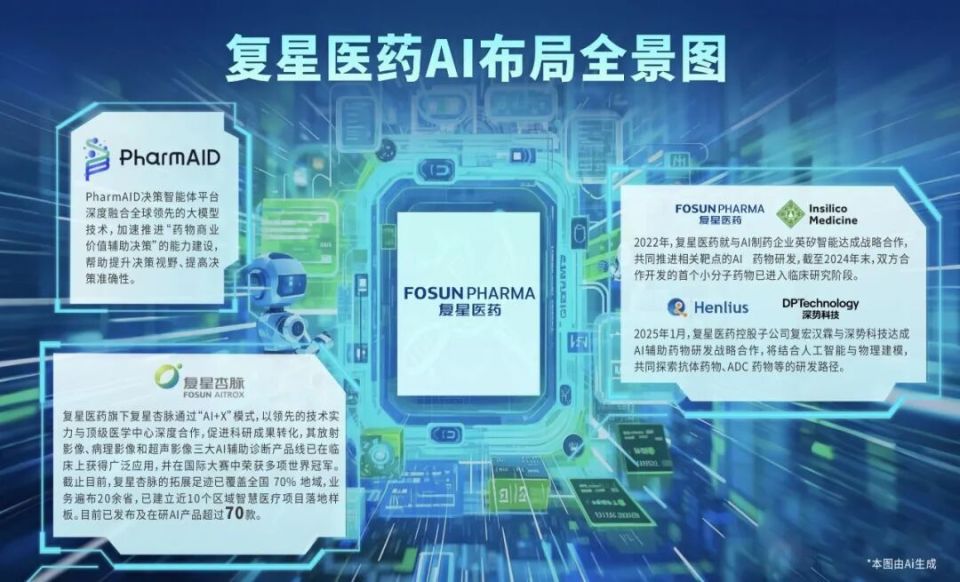
Fosun’s biggest business carrier for technological innovation is, in particular, Fosun Pharma. Starting from high-value generic drugs, it has evolved step by step into a science-and-technology-driven health platform led by innovative drugs, and in recent years it has been entering a period of concentrated breakthroughs in innovative drugs.
Among the star products attracting the most attention from the outside world is H drug Hansus® (H药汉斯状®), developed by Fosun Pharma’s subsidiary Fosun Chorison. As the world’s first PD-1 monoclonal antibody approved for first-line treatment of small cell lung cancer, it continues to release its differentiated clinical value and global commercialization potential. It is expected to become the next domestically developed innovative drug to break through RMB 10 billion in annual sales. PD-L1 ADC HLX43 and the new epitope HER2 antibody HLX22, which are comprehensively advancing global pivotal clinical studies, are the most valuable future innovative assets; both have enormous market potential.
In corporate strategic management theory, there is an important view: “A company’s strategy depends on the advantages formed by effective tactics.” As Fosun continues to develop and iterate, competitive advantages in household-consumption industries such as health, consumption, insurance, and tourism culture have become increasingly prominent. The compounding effects generated by two core engines—globalization and technological innovation—have grown stronger and stronger, gradually becoming the core drivers supporting Fosun’s sustainable development. Under these circumstances, Fosun refocusing on core industries, eliminating non-core businesses “branch by branch” within the ecosystem, and focusing on building an “innovation-driven global household-consumption industry group” has become the most correct choice.
The outbreak of the three-year COVID-19 pandemic in 2020, together with external crises such as the U.S.-China trade war and downturns in the real estate cycle, caused Fosun’s external environment to change dramatically. This further accelerated Fosun’s transformation process, prompting it to clearly propose the strategic policy of “Shed weight and strengthen the body, focus on the main business.”
Under the new strategic policy, Fosun International insists on “balance between offense and defense, with the ability to move forward and retreat where needed.” On the one hand, it has gradually exited non-core assets such as Nanjing Nangang Steel and Long Steel Co. and continued to compress debt, strengthening its capital safety cushion. On the other hand, it has continued to enhance refined management and operating efficiency, improving product strength and brand strength across various businesses, promoting ecosystem synergy among household-consumption businesses, and strengthening control-oriented investments that have strategic value to reinforce the main household-consumption business. For example, after 2020, in the consumption sector, Fosun completed a controlling stake in Shuide Liquor. In the health sector, Fosun Pharma increased its stake in Fosun Carely to 100%.
It is precisely these strategic focusing actions that have enabled Fosun to achieve increasingly strong compounding effects in the fields of “main household-consumption business, globalization, and technological innovation.” Taking 2025 as an example, Fosun’s four main core companies—Fosun Pharma, Yu Garden, Portugal Insurance, and Fosun Tourism Culture—recorded total revenue of RMB 128.2 billion, and their share of the group’s total revenue rose to 74%. Industry operating profit reached RMB 4.0 billion. Fosun’s overseas revenue for the full year reached RMB 94.86 billion, representing a year-on-year increase of 5.4 percentage points as a share of total revenue, reaching 54.7%.
The excellent performance in the household-consumption industry ultimately gave Fosun the confidence to “repair the roof on a sunny day,” prompting it in its 2025 annual financial report to make a one-time non-cash impairment provision on some real estate projects and non-core business segments, making it even more focused on deep operation of core industries.
3
Lighten the Load and Get Back on the Road Again: Fosun Sets Off Anew
Jim Collins’ book Built to Last is arguably one of the most influential works for China’s business community. In this book, Jim Collins distilled an important characteristic of built-to-last companies: “Preserve the core, stimulate progress.”
“Preserve the core” means that a company must stick to its own operating philosophy and core values—such as its mission, vision, values, humanism, and a belief in technology. “Stimulate progress” means that while adhering to the company’s core理念, specific businesses can change flexibly with changes in the times, enabling continuous iteration.
Fosun’s development embodies “preserve the core” through its culture philosophy of “do the right things, do the difficult things, and do the things that require time to accumulate,” as well as its commitment to the two strategic engines of “globalization and technological innovation.” Adjusting the strategic weight between industry and investment under different historical backgrounds, iterating and evolving different globalization paths across stages, and making decisions about when to enter or exit for different business segments—these all reflect preserving business flexibility to “stimulate progress.”
What impressed me most is that at this year’s performance interpretation meeting, Fosun proposed that “going forward, at the group level, it will basically no longer conduct large-scale mergers and acquisitions.” On one side, this fully demonstrates its determination to “focus on the main business and shed weight to strengthen the body.” On the other, it proves its strong confidence that its current core strategies in innovation and globalization can support long-term growth.
Compared with complex conglomerates, the capital market tends to grant greater recognition to vertically structured companies that have a prominent main business and clear strategic focus. With the exit of non-core main businesses and the clearance of historical risks, Fosun—now lightened and more focused on its core strengths and core main business—will inevitably generate stronger compounding effects in globalization and technological innovation in the future, accelerating its transformation into a truly world-class household-consumption industry group. By then, Fosun will likely see a major reappraisal of its value in the capital market.