

Trade
Basic
Futures
Futures
Hundreds of contracts settled in USDT or BTC
Options
HOT
Trade European-style vanilla options
Unified Account
Maximize your capital efficiency
Demo Trading
Futures Kickoff
Get prepared for your futures trading
Futures Events
Participate in events to win generous rewards
Demo Trading
Use virtual funds to experience risk-free trading
Earn
Launch
CandyDrop
Collect candies to earn airdrops
Launchpool
Quick staking, earn potential new tokens
HODLer Airdrop
Hold GT and get massive airdrops for free
Launchpad
Be early to the next big token project
Alpha Points
NEW
Trade on-chain assets and enjoy airdrop rewards!
Futures Points
NEW
Earn futures points and claim airdrop rewards
Investment
Simple Earn
Earn interests with idle tokens
Auto-Invest
Auto-invest on a regular basis
Dual Investment
Buy low and sell high to take profits from price fluctuations
Soft Staking
Earn rewards with flexible staking
Crypto Loan
0 Fees
Pledge one crypto to borrow another
Lending Center
One-stop lending hub
VIP Wealth Hub
Customized wealth management empowers your assets growth
Private Wealth Management
Customized asset management to grow your digital assets
Quant Fund
Top asset management team helps you profit without hassle
Staking
Stake cryptos to earn in PoS products
Smart Leverage
NEW
No forced liquidation before maturity, worry-free leveraged gains
GUSD Minting
Use USDT/USDC to mint GUSD for treasury-level yields

More

Trending Topics
View More1.69K Popularity
23.56K Popularity
2.58K Popularity
3.48K Popularity
18.96K Popularity





Pin
History of Silver: What 100 Years of Turbulence Reveal About Today's Market
Source: Coindoo Original Title: History of Silver: What 100 Years of Turbulence Reveal About Today’s Market Original Link: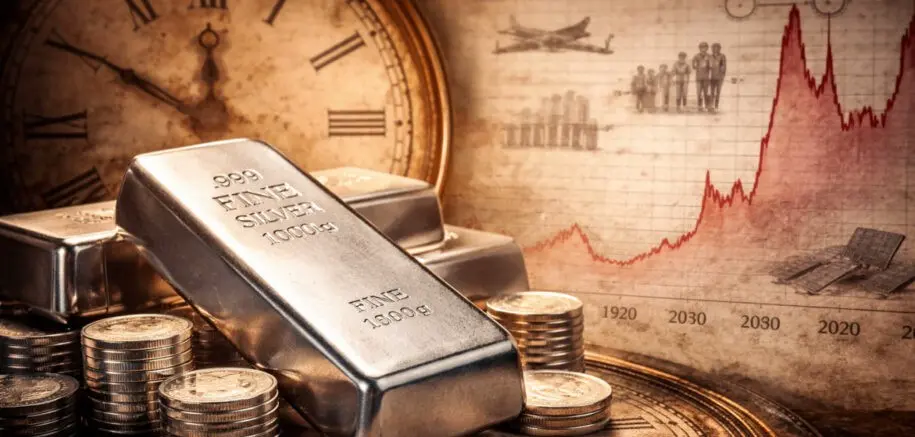
Silver’s price history over the past century looks chaotic at first glance, marked by violent spikes, deep crashes, and long periods of stagnation.
But behind the volatility sits a deeper story. Silver has spent the last 100 years drifting between two identities – a form of money and a critical industrial input. That unresolved tension explains why its price reacts so sharply to major economic, political, and technological turning points.
Key Takeaways
From monetary metal to economic casualty
Silver entered the 20th century as a monetary anchor. That status became a liability during the Great Depression, when global deflation crushed commodity prices. By 1932, silver fell to levels that effectively erased its monetary premium. Governments stepped in, treating silver less as a market asset and more as a policy tool, buying supplies to stabilize prices rather than letting demand decide value.
This era set a pattern. When silver functioned as money, it was controlled. When that control loosened, volatility followed.
War and the birth of silver’s industrial role
The Second World War quietly altered silver’s long-term trajectory. Copper shortages forced the U.S. government to tap silver reserves for military engineering, including critical electrical components tied to nuclear research. For the first time, silver was consumed not for coins or savings, but for performance.
That shift never fully reversed. Silver emerged from the war with a new identity – not just a store of value, but a strategic material.
The 1965 break that changed everything
The real structural break came in the mid-1960s. When the U.S. removed silver from circulating coinage, the metal was effectively released from price controls tied to face value. The move did not weaken silver. It freed it.
Once detached from fixed monetary pegs, silver began trading as a scarce commodity with finite above-ground supply. Volatility increased, but so did long-term upside.
Speculation versus fundamentals
The most famous spike arrived in 1980, driven by the Hunt Brothers’ attempt to dominate supply. That episode ended badly and left lasting scars on investor psychology. For decades, silver rallies were dismissed as speculative excess.
Yet a quieter accumulation phase followed in the late 1990s, when investors like Warren Buffett focused not on inflation panic, but on falling inventories and rising industrial usage. That period marked the beginning of the modern supply deficit narrative.
A different kind of bull market
The post-2011 cycle looked familiar on the surface, but its foundation was different. Monetary stimulus played a role, yet industrial demand steadily grew in the background. Solar energy, electrification, and advanced manufacturing turned silver into a consumption-driven metal.
By the early 2020s, silver demand consistently exceeded new supply. Unlike past spikes, prices found support not in speculation, but in usage.
Why 2025 looks structurally different
Today’s silver market lacks the frenzy of previous peaks. Instead, it reflects tight inventories, expanding industrial reliance, and recognition of silver as a strategic resource. Its designation as a critical mineral underscores a reality that has been building for decades.
Silver is no longer debating what it is. The market has decided for it.