
Futures
Access hundreds of perpetual contracts
TradFi
Gold
One platform for global traditional assets
Options
Hot
Trade European-style vanilla options
Unified Account
Maximize your capital efficiency
Demo Trading
Introduction to Futures Trading
Learn the basics of futures trading
Futures Events
Join events to earn rewards
Demo Trading
Use virtual funds to practice risk-free trading
Launch
CandyDrop
Collect candies to earn airdrops
Launchpool
Quick staking, earn potential new tokens
HODLer Airdrop
Hold GT and get massive airdrops for free
Launchpad
Be early to the next big token project
Alpha Points
Trade on-chain assets and earn airdrops
Futures Points
Earn futures points and claim airdrop rewards


More






Xianyu, a better OpenClaw for Chinese babies
Original|Odaily Planet Daily (@OdailyChina)
Author|Wenser (@wenser2010)
The “lobster craze” sparked by OpenClaw has somewhat cooled off on major social media platforms. Just a couple of days ago, Anthropic—the developer of Claude—posted to directly ban “OpenClaw’s subscription-based free-riding.” As a result, some people are asking, “Is OpenClaw already dead?”
In my view, against the backdrop that even more than 90% of the world’s 8 billion people have yet to use an AI application, OpenClaw is already a phenomenon-level AI product—its popularity lasting a full 3 months is proof of its massive buzz. On the other hand, for most people in China, compared with OpenClaw—which consumes a lot of Tokens, has a complicated configuration process, updates too frequently, and has unclear security risks—Xianyu might be the “more local OpenClaw.”
Maybe some people reading this feel confused: Xianyu? That second-hand trading platform? What does it have to do with OpenClaw, today’s hot AI darling?
Let me break it down in detail.
Before OpenClaw let AI grow arms and legs, Xianyu had already become an engine for transactions in the physical world
“If Chatbot used to give AI a brain, then the value of OpenClaw is that it’s the first time AI has been given hands and feet.”
This quote emphasizes that OpenClaw enables AI Agents with all kinds of operational and execution capabilities—replacing humans to perform various tasks in the digital world, and even to a certain extent turning around to affect the physical world.
The more realistic problem facing everyone, however, is that compared with Chatbots in the past—where the Token consumption per conversation typically stayed at the scale of tens of thousands or hundreds of thousands—OpenClaw makes AI Agents’ calls to APIs and Tokens jump to millions, or even tens of millions, up to hundreds of millions. Many people have said that after OpenClaw appeared, for the sake of ensuring results, the Token spend on using high-quality models like Claude, GPT, and Gemini can reach several hundred dollars in a single day.
And with the same task, ordering on Xianyu might cost less than 1%—yes, you read that right. Since entering “the summer of the 21st century,” labor costs on the Xianyu platform have been compressed to the extreme. “The poor” also have their own units of time and pricing systems—a whole economic system that runs on RMB and Xianyu coins.
360 lines, and each line produces top talent: business travel, AI, sales, recruiting, blind dating
From time to time, Xianyu sparks another wave of hot discussion. People jokingly call Xianyu the “domestic dark web”—on Xianyu, there’s nothing you can’t think of, and nothing it can’t do.
Someone sold moldy oranges on Xianyu, and students from biology and medical majors spotted them at a glance. They said they wanted to extract the mold for research and paid a high price to buy back for a few hundred to a few thousand yuan;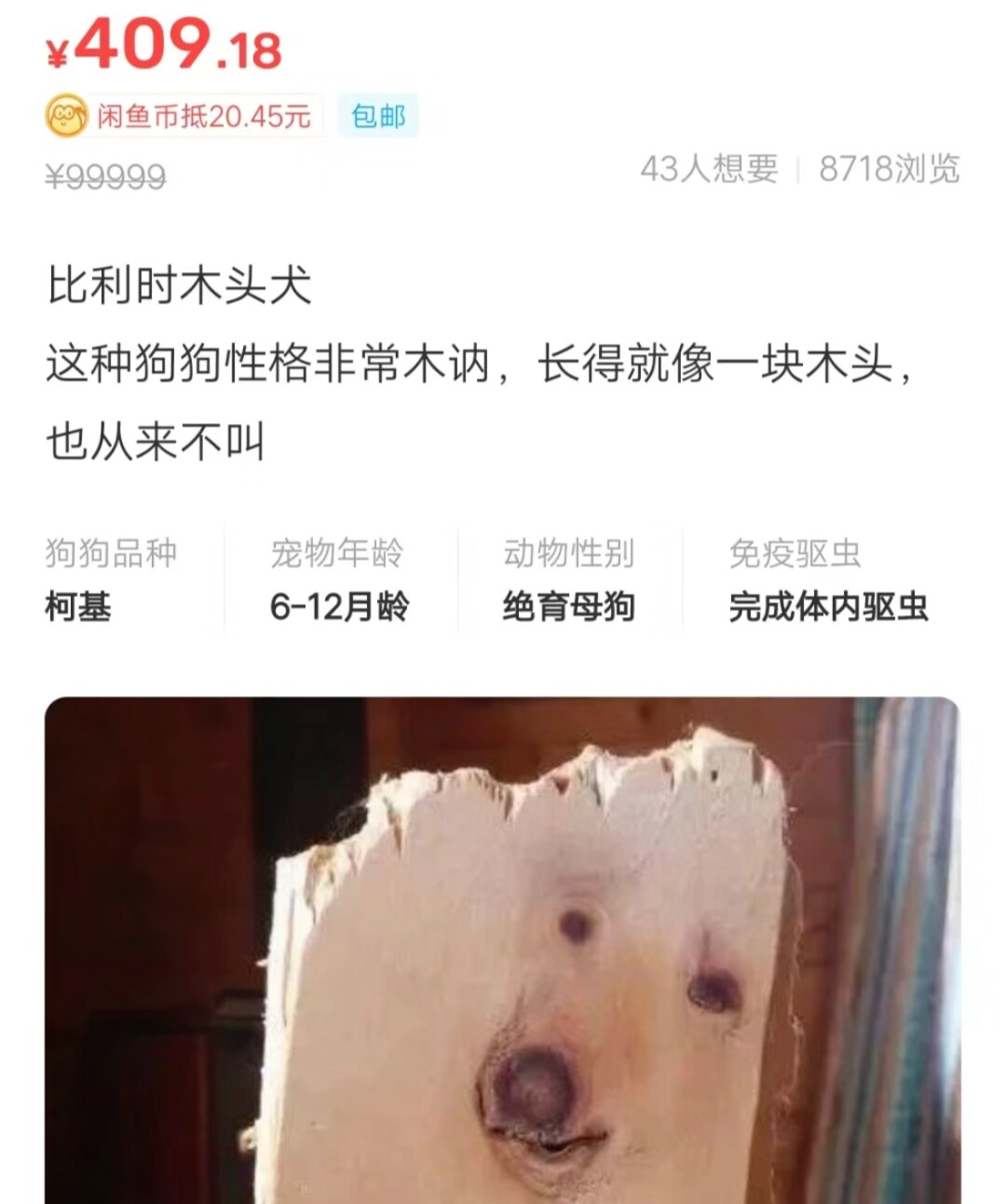
Someone “sells” rare purebred dogs on Xianyu at a low price—Belgian wood dog—claiming they’re “a spayed mother dog”;
A battle-worn used iPhone is already considered a rare “small case” on Xianyu.
As for booking hotels on Xianyu, buying tickets, buying discounted AI subscription memberships, finding helpers, hiring people, and even marriage and matchmaking blind dates—these are also just the platform’s “day-to-day business.”
With the seller’s out-of-the-ordinary imagination on Xianyu, the “source of goods” is also quite non-mainstream:
There are people who help obtain overdue wages—sending an 80-something-year-old grandma in a wheelchair to take the stage—
Help booking hotel breakfast for as low as 5 yuan, and only later did they realize it was because they’d obtained it by threatening to jump—
Want to go see a music festival but didn’t buy a ticket? You think scalpers have their own connections to get you in—but you didn’t expect that he turned around and led you to squeeze into a dog burrow—
The previously famous “Xianyu agent for refunding plane tickets” has also sparked a lot of discussion across major social media platforms, and the shady move behind it is “applying for a death certificate for the user”— #
Want to buy discounted scenic spot tickets? Xianyu sellers’ off-menu tactics involve making a phone call to the scenic area staff telling them, “This person is already almost not okay”—and then something happens.
On this second-hand transaction internet platform with over 200 million monthly active users, all kinds of niche market demands hidden in the micro-capillaries of China’s internet market coexist in one room with an assortment of flexible supply. As a result, within less than 13 years, a consumption market parallel to mainstream e-commerce platforms and offline shopping channels has gradually ballooned into today’s universe of diversified transactions. In March, it recorded 217 million monthly active users, even surpassing Xiaohongshu.
As early as early 2024, its daily average GMV (gross merchandise value) had already exceeded 1 billion yuan. And now, thanks to the “AI camera function” launched at the beginning of March, the number of new listings on Xianyu surged by over 50 million, with more than 12 million users participating in and experiencing it. Also, industry forecasts say that in 2026, the size of China’s second-hand transaction market may exceed 3.1 trillion yuan, and Xianyu will play a major role in it.
The “premium” economics behind Xianyu and the theory of free power: leverage, arbitrage, collaboration, and productivity
Unlike other e-commerce platforms’ unique rules for survival, Xianyu has broken through amid stock-based competition in China’s internet user market and found its own comfort zone.
And behind this situation, it’s actually quite similar to AI that has advanced rapidly in recent years and OpenClaw, which topped GitHub’s star ranking list this year—it hides its own set of “premium” economics and a theory of free power.
Last month, Tron founder Justin Sun also wrote about this phenomenon:
Although some of the wording is quite extreme, the “premium theory” and “power theory” in it truly reveal the unique value and market pricing system of Xianyu as a second-hand transaction platform. And behind these keywords, we can see more of why Xianyu is called the “China-based local OpenClaw”:
1. AI arms and legs, plus a human-power and material-power leverage
If OpenClaw is the first to give AI independent execution capabilities, then Xianyu’s value lies in enabling human power and material resources to flow, circulate, and generate value with very low barriers.
Just like that sarcastic line about educational credentials losing value: “For 3,000 yuan, you can’t even buy a 5090 graphics card; but you can hire a college student to work for you.”
Whether it’s second-hand goods or cheap labor, Xianyu’s platform prices them fully in the market and quantifies their value. In a two-sided market where supply far exceeds demand, Xianyu’s human and material resources are even more abundant than the AI models and Token resources that OpenClaw requires.
2. Token arbitrage and two-sided arbitrage
For countless human users, OpenClaw—which responds within 24 hours and lets people freely add Skill configuration files to expand the boundaries of their abilities—undoubtedly functions as a “Token arbitrage tool.” You add as cheap as possible Token ingredients into the machine, then produce specific content production materials according to your own instructions. Although this brings a problem of large-scale, even exponential Token usage and consumption, it still lets countless people experience for the first time the thrill of “controlling AI production resources” and becoming an “AI capitalist.”
On Xianyu, however, the commodity resources and market demand represent a kind of two-sided arbitrage built on the buyer and seller. With relatively lower entry thresholds, lower transaction fees_ (Odaily Planet Daily Note: In June 2024, the Xianyu platform announced that starting September 1 of that year, it would charge all sellers a 0.6% basic software service fee, with a maximum of 60 yuan per single transaction; individual merchants would be included_) as well as the large pool of idle labor gathered by the platform, people do business on the platform.
And not only that—similar to how OpenClaw balances Token providers and Token consumers, Xianyu satisfies two-sided needs: both for product and service providers and for market demanders, corresponding to the hierarchy of needs as well.
3. Lobster collaboration and human collaboration
In terms of teamwork, compared with OpenClaw’s “lobster legion” and “AI Agent teams,” Xianyu also has its advantages—namely, it can filter professional “mercenaries” that meet different requirements, have different abilities, and play different roles.
Just like how the intelligent driving sector for new energy vehicles strongly favors intent engines, and the crypto market, as well as the AI field’s self-driven, self-evolving, and self-researching large language models, Xianyu can also be seen as a “selection platform” for finding collaboration members.
At bottom, the “jigsaw puzzle” formed by combining the above technologies and people is the same thing; users’ ultimate goal is always: think what you want and get what you think, say what you want and get what you use, see what you want and get what you get.
4. Information productivity and information-gap productivity
Strictly speaking, AI doesn’t originate information. Large language models and various AI Agents only follow reasoning rules to combine, match, and call different information inputs (including text, images, videos, and other multimodal content), and then output information products in different forms;
By contrast, humans can absorb information and learn from it, but they can also produce all kinds of information—and they can even create information gaps through different information, thereby creating value. On Xianyu, all kinds of service providers have their own subjective judgment, self-selection abilities, and self-driven capabilities.
For overseas countries where labor costs are high and population aging is accelerating, AI Agent applications represented by OpenClaw, or embodied intelligence robots, may open a new “window for developing productivity.” For China’s internet population, which has enjoyed past demographic dividend and resource dividend—even manufacturing dividend—maybe a platform like Xianyu, which provides internet labor and goods and services, is the better answer. Just like the blunt truth that Robin Li, founder of Baidu, once pointed out: when it comes to trading privacy for convenience, Chinese people have historically been totally unrestrained. In front of Xianyu, which allows users to voluntarily hand over personal information in exchange for efficient convenience, OpenClaw—with potential security risks—can only be considered minor compared to it.
With the heat around AI Agents and OpenClaw cooling down, looking from another angle, the biggest reason may be—
Xianyu, the OpenClaw that’s even more suitable for Chinese babies.
References:
OpenClaw, is it already over?
I haven’t been on Xianyu for 3 days—how did it become China’s dark web?!
The Chinese version of the dark web—people get what young people want
Xianyu doesn’t want to compete with Xiaohongshu, but it really has no moves
600 million people are using it to find services—when the economy gets worse, does “China’s version of the dark web” get hotter?