
Futures
Access hundreds of perpetual contracts
TradFi
Gold
One platform for global traditional assets
Options
Hot
Trade European-style vanilla options
Unified Account
Maximize your capital efficiency
Demo Trading
Introduction to Futures Trading
Learn the basics of futures trading
Futures Events
Join events to earn rewards
Demo Trading
Use virtual funds to practice risk-free trading
Launch
CandyDrop
Collect candies to earn airdrops
Launchpool
Quick staking, earn potential new tokens
HODLer Airdrop
Hold GT and get massive airdrops for free
Launchpad
Be early to the next big token project
Alpha Points
Trade on-chain assets and earn airdrops
Futures Points
Earn futures points and claim airdrop rewards


More





#GateSquareAprilPostingChallenge
Oil, War, and Bitcoin: How the Iran-US Crisis Is Rewriting the Rules of Crypto Markets
The Day the World Changed — February 28, 2026
On February 28, 2026, U.S. and Israeli forces launched military strikes against Iran. Within hours, the global financial system trembled. Oil prices surged past $100 a barrel. Airlines canceled flights across the Middle East. Saudi Arabia's stock market fell, Dubai markets dropped, and major trading houses suspended crude shipments through the Strait of Hormuz, the narrow 21-mile waterway through which roughly 20% of the world's daily oil supply flows. Crypto reacted violently — falling, recovering, and falling again — in a real-time macro experiment that combined geopolitics, oil shocks, inflation fears, and risk sentiment.
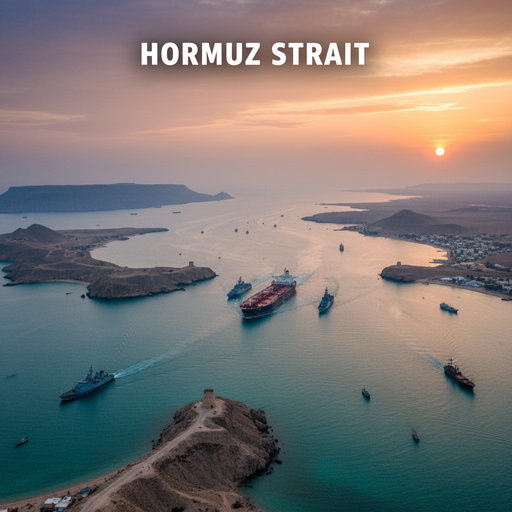
Hormuz: The 21-Mile Chokepoint That Moves the World
To understand why crypto reacted the way it did, you need to understand the Strait of Hormuz. This 21-mile chokepoint connects Persian Gulf oil fields to the Gulf of Oman and the open ocean. Approximately 20 million barrels of oil pass through it daily, fueling factories, planes, and supply chains worldwide. In early 2026, as U.S. and Israeli military operations escalated, Iran tightened its control. Nearly 2,000 tankers were stuck at sea. Iran passed a law imposing tolls of up to $2 million per tanker in Chinese yuan or cryptocurrency for safe passage, reportedly through a company linked to the Revolutionary Guard Corps. Crypto instantly became more than speculation — it became a geopolitical instrument embedded in the world’s most critical oil chokepoint.
Oil Shocks, Inflation, and Crypto Sell-Offs
The impact on crypto followed a clear pattern. When oil prices spiked — WTI crude briefly touched $115 per barrel in early April — inflation fears surged. Transport, manufacturing, and energy costs increased, threatening to undo years of central bank efforts to control inflation. Central banks could not lower rates; safe assets became more attractive, and traders pulled back from risk assets. Bitcoin dropped roughly 10% from March highs. On the day Trump vowed to "continue the war against Iran," BTC fell 2% immediately, trading near $66,631. Yet the story did not end there. Each time de-escalation appeared — such as Iran drafting a protocol with Oman to manage Strait traffic — oil fell $5 per barrel in minutes, Nasdaq erased losses, and Bitcoin surged. The oil-to-crypto transmission belt is real, fast, and now observable in near real-time.
$400 Million Liquidation Event: A Sign of the Times
The volatility culminated in roughly $400 million in crypto liquidations in early April. Leveraged traders, especially in thinly liquid altcoins, were most exposed. BTC and ETH absorbed shocks better due to their liquidity. This $400M event highlighted a key truth: geopolitical shocks now move through crypto almost instantaneously thanks to institutional algo trading, margin positions, and global interconnectedness. Grayscale observed that despite turbulence, BTC remained flat since the start of the conflict, outperforming many equities and demonstrating a level of resilience unseen in previous crises.
Bitcoin: Safe Haven or Hybrid Hedge?
Bitcoin’s safe haven narrative is under debate. Traditional havens like gold, Treasuries, and low-volatility reserve currencies outperform in acute military crises. Bitcoin initially fell alongside equities after the strikes but held its ground over weeks. Data from the Iran conflict suggests BTC is a hybrid asset — a "macro hedge" that performs well against fiat debasement and systemic instability but not during sudden military shocks. Traders must understand this distinction in 2026’s volatile macro environment.
Crypto as a Geopolitical Tool: Double-Edged Sword
Iran demanding crypto payments introduces a double-edged narrative. On one hand, it validates crypto’s censorship-resistant, global utility — the ability for any actor, sanctioned or not, to transact freely. On the other, it raises regulatory risks. OFAC and U.S. authorities could impose stricter regulations if exchanges facilitate sanctioned transactions. Crypto’s permissionless nature fuels volatility and uncertainty in real time.
$200 Oil: Catastrophe or Crypto Catalyst?
Analysts warned that a permanent closure of Hormuz could push oil to $200 per barrel, an unprecedented shock far beyond the 2008 peak of $147 or the 2022 Russia-Ukraine crisis peak of $130. Such a scenario would trigger global inflation, force aggressive central bank tightening, risk a worldwide recession, and heavily pressure risk assets, including crypto. Conversely, $200 oil could validate Bitcoin as "digital gold," incentivize countries to transact in crypto, and replicate Iran’s toll-payment model on a global scale. Recovery depends on oil stabilizing below $80 and any credible de-escalation in the Gulf.
Current Market Reality: April 6, 2026
As of April 6, 2026, BTC trades at $69,118, ETH at $2,135, the Fear & Greed Index sits at 13 (Extreme Fear), WTI crude hovers around $110, and gold nears $4,491 per ounce. Despite sentiment indicators signaling panic, crypto is quietly recovering. The Oman protocol talks, signaling partial reopening of Hormuz, triggered market optimism. Trump's crypto-friendly policies — including the GENIUS Act — act as a structural floor, ensuring that even during geopolitical shocks, regulatory clampdowns remain unlikely. BTC flat since the war began reflects resilience and continued institutional accumulation. Analysts see the de-escalation trade as the asymmetric opportunity of 2026: the upside from peace far outweighs marginal downside from further escalation.
Smart Traders’ Playbook in a War-Driven Market
Smart traders are now acting on four fronts. They watch oil headlines first, crypto charts second; avoid leverage in high-uncertainty environments; position for asymmetrical gains from de-escalation; and treat BTC and ETH differently from altcoins, which are far more vulnerable during geopolitical shocks. BTC and ETH now serve as the bunker assets of crypto — liquid, stable relative to altcoins, and capable of surviving extreme macro risk.
Conclusion: Crypto Enters the Geopolitical Era
The Iran-U.S. conflict of 2026 will be studied as the moment crypto entered real-world geopolitics. From Iranian crypto tolls to $400 million liquidations driven by military strikes, from BTC reacting to Trump’s war tweets to ETH rebounding on peace signals, this is no longer the speculative market of 2017 or 2021. This is a mature, globally interconnected ecosystem, sensitive to oil, politics, and sanctions, yet resilient enough to attract institutional money mid-war. The rules are different. The macro matters. The Strait of Hormuz matters. Geopolitics matters. But so does this: Bitcoin is still trading at $69,000, still outperforming some equity indices, and still representing an accessible store of value in extreme uncertainty. For traders and investors who can navigate both risk and opportunity, this moment — in Extreme Fear, at the peak of geopolitical tension — may only come once or twice per market cycle. Study it carefully