
Futures
Access hundreds of perpetual contracts
TradFi
Gold
One platform for global traditional assets
Options
Hot
Trade European-style vanilla options
Unified Account
Maximize your capital efficiency
Demo Trading
Introduction to Futures Trading
Learn the basics of futures trading
Futures Events
Join events to earn rewards
Demo Trading
Use virtual funds to practice risk-free trading
Launch
CandyDrop
Collect candies to earn airdrops
Launchpool
Quick staking, earn potential new tokens
HODLer Airdrop
Hold GT and get massive airdrops for free
Launchpad
Be early to the next big token project
Alpha Points
Trade on-chain assets and earn airdrops
Futures Points
Earn futures points and claim airdrop rewards


More






China's photovoltaic industry "stuck" in the Strait of Hormuz
Ask AI · How Can China’s Photovoltaic Companies Address the Logistics Crisis Caused by a Hormuz Strait Blockade?
Issue 06 of The Energy Singularity series: Interpreting how fluctuations in the situation in the Strait of Hormuz under the U.S.-Iran conflict affect Chinese PV exporting companies.
By Li Hailun
Edited by Xu Qingyang
More than a month has passed since the U.S.-Iran conflict began, yet the fighting has not stopped. The Strait of Hormuz has not yet fully returned to normal passage conditions. This waterway, which grips the world’s energy “throat,” is stirring not only oil prices, but also the entire PV industry chain.
Trade sources say that the most direct risks currently facing the photovoltaic industry are concentrated in delivery execution: shipping lane diversions, booking restrictions, and conflict-related surcharges. These factors increase the risk of cargo delays in the near term.
In early March, Active Energy Group, which focuses on energy and digital infrastructure, said that the delivery timeline for its first project in the UAE would be delayed compared with the original plan. The company said the delay was driven by a combination of factors, including regional disruptions caused by the situation in the Middle East in the near term and a slowdown in approval processes, which affected the project’s commissioning schedule.
And this crisis has also hit Chinese photovoltaic companies that have made deep investments in the Middle East. They are now bearing multiple pressures, including delays in construction projects, blocked export corridors, rising raw material costs, and a tightening financing environment.
A source at a Chinese PV module manufacturer said, “We’ve heard that several shipping routes to the Middle East have already been suspended. At the same time, due to regional tensions, freight insurance premiums have risen by 3 to 5 times, and the situation is not optimistic.”
Another Chinese PV downstream manufacturer also said that cargo planned to be shipped to the Middle East soon faces higher uncertainty. The company has stepped up communication with regional customers and discussed contingency plans.
At the same time, Iran is the world’s second-largest methanol producer. In just one month after the conflict broke out, Iran’s domestic methanol market was also affected: spot prices surged by 46%, putting broad pressure on costs across the chemical industry chain. Meanwhile, disruptions to Iran’s supply of soda ash and higher oil and gas prices are also driving up the manufacturing cost of photovoltaic glass.
How much impact has this crisis actually had on the Middle East PV industry? And how will Chinese PV companies that have heavily bet on this market bear pressure and respond to the challenges?
This image may be AI-generated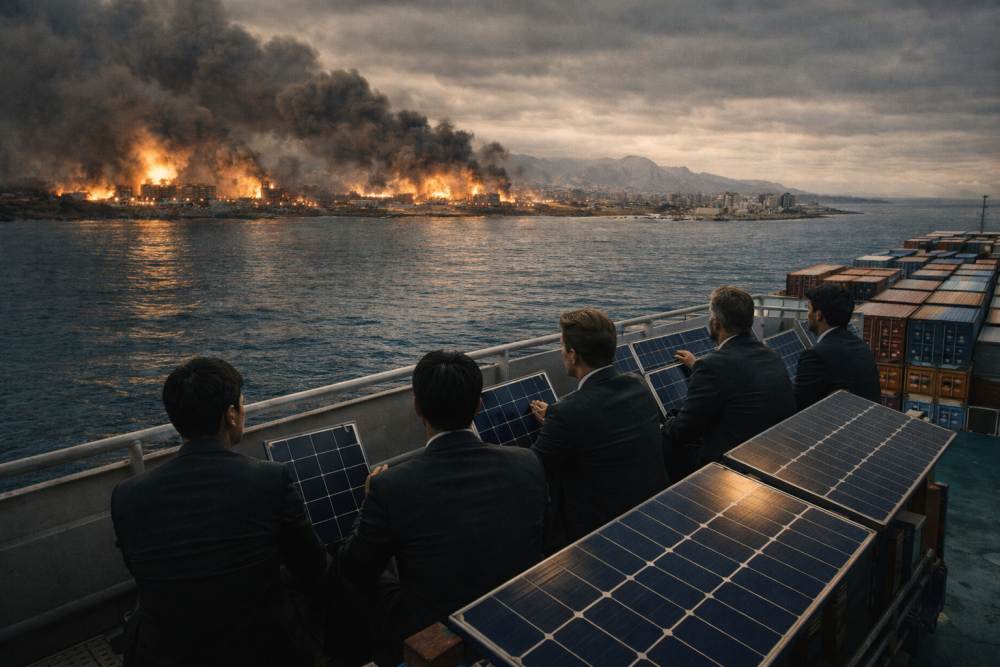 Image created using AI tools
01 Middle East PV industry slams on the “emergency brake”
An interesting fact is that although the Middle East is the region with the richest oil reserves in the world, it is pursuing energy substitution.
The Middle East is full of deserts, with abundant sunshine and vast land. To break away from path dependence on a single oil-based economy, in recent years, governments across the region have been strongly pushing energy transitions, electricity demand has continued to grow, and the green hydrogen industry has been getting off the ground quickly. Today, the Middle East is already the fastest-growing PV market globally.
And the global development of the PV industry depends on China’s supply chain.
According to data from organizations including the Middle East Solar Industry Association and Dii Desert Energy (a research and cooperation platform focused on energy in the Middle East and North Africa), in mid-2024 the Middle East and North Africa PV market’s new installed capacity increased year over year by about 25%, higher than the global average. Entering 2025, as mega projects such as those in Saudi Arabia and the UAE come online in a concentrated way, the region’s total installed capacity surged by over 40% year over year, entering a phase of rapid expansion, and also becoming a key incremental driver for China’s PV exports.
In the Middle East PV module market, Chinese manufacturers hold an absolute leading position. Among them, JinkoEnergy, Trina Solar, JA Solar Technology, and LONGi Green Energy form the core supply lineup. Based on global shipment data from organizations such as InfoLink Consulting, these companies have long ranked among the industry’s top tier and are deeply involved in multiple multi-GW-scale projects across the Middle East.
Of them, JinkoEnergy ranks first. JinkoEnergy’s chairman, Li Xian de, introduced: “Since the company entered the Middle East market in 2011, it has now covered nearly half of the countries in the Middle East, and it holds about half of the market share in the region.”
Iran has announced a blockade of the Strait of Hormuz. This energy artery, which carries one-fifth of the world’s crude oil shipments, is suddenly obstructed. The spillover of this crisis goes far beyond oil and gas markets. From module transportation to supply-chain coordination, from project financing to shifts in energy policy, the rapidly advancing Middle East PV industry chain is also absorbing severe pressure brought by this turbulence.
The most direct impact is on the logistics side. According to data from the UK Lloyd’s Ship Information Service, between March 1 and 13, 2026, only 77 vessels passed through the Strait of Hormuz, whereas during the same period last year there should have been 1,229 vessels; the passage volume plunged by 93.7%. More noteworthy is that, according to public information, most of those 77 vessels are “shadow fleets” that evade Western sanctions. And by March 14, even these “shadow fleets” stopped operating—the number ultimately fell to zero.
In early March, Mediterranean Shipping Company (MSC Mediterranean Shipping Company) announced that it had suspended accepting cargo reservations from around the world to the Middle East until further notice, and said it would continue monitoring the situation and cooperate with relevant departments to resume operations after safety conditions improve.
For Middle East PV projects under construction, most of the core equipment required—modules, inverters, and tracking brackets—depends on ocean shipping from China or Southeast Asia manufacturing bases to local ports. If shipping lanes are nearly shut, it means cargo can only wait at the entrance to the Persian Gulf, or be forced to detour around the Cape of Good Hope. According to an analysis by The Economist, detouring around the Cape of Good Hope would increase the voyage by about 40%.
An industry insider familiar with recent multi-crystalline silicon projects in the Middle East said that in the Middle East, some factories originally planned to enter a critical stage in March, covering pilot-order deliveries and collecting customer feedback. This would provide a basis for subsequent production adjustments and price negotiations. But now it is expected that this timeline will be affected by logistics constraints.
In addition, fluctuations in energy prices are being transmitted through the industry chain to the costs of PV auxiliary materials. Although PV appears unrelated to oil, it is actually deeply embedded in the petrochemical industry chain. For example, the aluminum ingot smelting required for EVA (ethylene-vinyl acetate copolymer) encapsulant films, backsheet materials, and aluminum frame components are energy-intensive processes.
A veteran professional in the energy sector said that the Strait of Hormuz accounts for about 20%–30% of global seaborne oil shipments and about 20% of liquefied natural gas trade. Once transportation is restricted, it will raise shipping and insurance costs, disrupt global energy supply, and drive fluctuations in oil and gas prices. Such volatility is then further transmitted to the upstream of PV. It mainly shows up in two categories of auxiliary materials: (1) PV glass, whose production relies heavily on natural gas and electricity, and upstream soda ash is also sensitive to energy prices; (2) encapsulant film materials such as EVA and POE (polyolefin elastomer, more durable than EVA) , which originate from the petrochemical system and are directly linked to oil prices—when crude oil rises, the costs of related materials will rise directly.
However, for pricing at present, some industry insiders say that component prices have not been directly affected for the moment, because Middle East buyers typically sign contracts one to two years before delivery. The long-term nature of these contracts means that discussions of forward market prices have basically not been influenced by near-term spot market fluctuations. Buyers can postpone procurement decisions until transportation conditions stabilize.
02 Multiple Chinese companies exporting to the Middle East are affected
As the Middle East grows into one of the world’s fastest-growing core PV markets, it is also gradually becoming a key battleground for China’s PV companies’ “global expansion.”
According to industry statistics, in 2025 the value of PV battery module exports from China to the Middle East reached $2.997 billion, accounting for 10.63% of total exports.
Several major Chinese PV giants have already deeply deployed there or are planning to do so. In 2024, TCL Zhonghuan announced a 20GW project plan in Saudi Arabia. In the same year, JinkoEnergy laid out a 10GW battery and 10GW module engineering plan. In addition, companies such as Envision Energy, Trina Solar, Nans玻, and Amaton are also accelerating the rollout of localized deployment. Therefore, as geopolitical tensions continue to disrupt the environment, those investment plans and execution tracks that were originally relatively certain may start facing new variables.
In addition, a batch of ultra-large-scale projects is also moving through this “risk node.”
Based on publicly available industry materials and organizational compilations, in 2025–2026 large PV projects under construction and in operation in the Middle East region are mainly concentrated in Saudi Arabia and the UAE.
Saudi Arabia is the most heavily pressured area. The fourth round PV project group (PIF4), led by Saudi Arabia’s sovereign fund PIF (Public Investment Fund), includes three power stations: Haden (2GW), Muwayh (2GW), and Al Khushaybi (1.5GW). The total scale is 5.5GW, planned to be commissioned in a concentrated way around 2027.
In this PIF4, multiple Chinese companies have already participated across multiple layers. For example, China Energy Engineering Group has entered some projects in EPC general contracting; meanwhile, companies such as JinkoEnergy provide core module equipment. Although construction of the projects themselves has not stopped, the underlying cost structure has become a key focus: How will the equipment be transported in the future? Can the delivery cycle still be secured? How should insurance be priced? A series of critical questions remains uncertain.
The situation in the UAE is more complex. For instance, in January 2025, Masdar, the Abu Dhabi Future Energy Company, announced that it would lead the RTC PV-storage project. With 5.2GW of PV paired with 19GWh of energy storage, it is not an ordinary power plant but a tightly coupled energy system: PV generation, battery energy storage, and grid dispatch must all be synchronized to achieve near “all-weather” stable power supply.
This means that any delay in any link is not merely a matter of “arriving a few days late.” It will also involve impacts on the dispatch rhythm of the entire system. More critically, in this project, Chinese companies have extremely deep participation from modules all the way to the energy storage system. For example, JinkoEnergy and JA Solar Technology are responsible for PV module supply; Ningde Era provides the full energy storage system; and China Energy Engineering Corporation participates in engineering construction. Any disruption in the supply chain will transmit directly along this chain.
Moreover, the expansion of PIF-led projects has not stopped. After PIF4, in July 2025, Badeel, ACWA Power, and SAPCO jointly signed a power purchase agreement with a total scale of 15GW. It covers five PV projects—Bisha (3GW), Humaij (3GW), Khulis (2GW), Afif 1&2 (total 4GW)—as well as two wind power projects, Starah (2GW) and Shaqra (1GW). Total investment is about $8.3 billion.
Public information shows that multiple Chinese companies are already involved. In October 2025, China Power Construction Group and China Energy Engineering Group each separately announced that they had signed relevant EPC contracts, with the projects expected to be commissioned successively from 2027 to 2028. And as Middle East conditions remain tense, uncertainty in project advancement is also rising.
03 The response logic behind China’s PV exports
As geopolitical tensions continue to disrupt the environment, the Middle East PV growth curve is showing subtle changes, and some export-oriented Chinese companies are also adjusting strategies.
A portion of companies are becoming more cautious and seeing the Middle East as a “high-potential but high-volatility region” during assessment. An exclusive response from a source related to GCL Group said that fossil energy in the Middle East is abundant and the urgency to transition to new energy is clear, but due to uncertainty in geopolitics and instability in Middle East conflicts, investment in the Middle East still remains at the intention stage. At present, there is more of a tendency to focus on new carbon-zero high-tech materials industries such as perovskites in the United States.
Meanwhile, another group of leading companies chooses to further strengthen its globalization strategy. At the Boao Forum for Asia 2026 Annual Conference held recently, Gao Haichun, co-chairman of Trina Solar, responded and emphasized Trina Solar’s global layout: “The value of PV is not limited to supplementing traditional energy. In some regions, it can help local areas move directly toward a more advanced energy structure. For example, in the Maldives, Trina Solar has built a ‘PV + energy storage + diesel generator’ integrated standalone microgrid for 27 islands. In Indonesia, similar projects are also continuously being advanced,” Gao Haichun said.
From a more macro perspective, this geopolitical conflict is also triggering reflections at the policy level. Liu Zhenmin, China’s Special Envoy for Climate Change Affairs, said that the tensions in the Strait of Hormuz are particularly significant for Asian countries that are highly dependent on energy imports. He believes there are two points worth serious review: (1) At the regional security level, based on the long-term cooperation foundation between China and ASEAN, maintain peace and stability for key shipping lanes to avoid repeating the same mistakes; (2) At the energy-structure level, the risk of overdependence on oil and gas resources from a single region has already been fully exposed, and energy security should be improved through diversified supply systems.
Deeper down, under this crisis, the globalized pathway of China’s PV industry is also being reshaped. The change in competitive dimensions is becoming clearer: what determines who wins is not only price and capacity, but also who can better get through the cycle in an environment of uncertainty—who has the ability for a more stable and sustainable global energy layout.