


Futures
Access hundreds of perpetual contracts
TradFi
Gold
One platform for global traditional assets
Options
Hot
Trade European-style vanilla options
Unified Account
Maximize your capital efficiency
Demo Trading
Introduction to Futures Trading
Learn the basics of futures trading
Futures Events
Join events to earn rewards
Demo Trading
Use virtual funds to practice risk-free trading
Launch
CandyDrop
Collect candies to earn airdrops
Launchpool
Quick staking, earn potential new tokens
HODLer Airdrop
Hold GT and get massive airdrops for free
Launchpad
Be early to the next big token project
Alpha Points
Trade on-chain assets and earn airdrops
Futures Points
Earn futures points and claim airdrop rewards


More

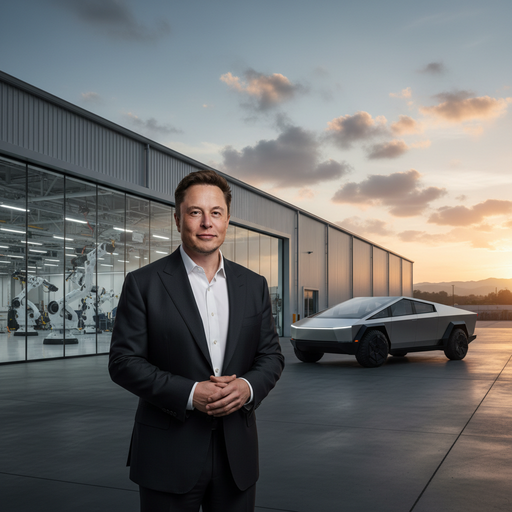



ARM chip manufacturing and Tesla building a factory: South Korea's semiconductor giant faces a "double-edged sword"
【CNMO Tech】Recently, ARM, this British chip design giant, after 35 years since its founding, for the first time began selling chips directly to the market under its own brand. It rolled out its in-house processor for AI data centers, the Arm AGI CPU, and is teaming up with partners such as Meta to move into the AI infrastructure market. Meanwhile, Musk is integrating Tesla, SpaceX, and xAI under his umbrella, pushing a chip self-manufacturing plan codenamed “TerraFab,” with the goal of building an advanced wafer fab that covers design, manufacturing, packaging, and testing in one integrated facility. It aims to produce as many as 100 billion to 200 billion 2-nanometer chips per year.
Tesla chip concept image
These two developments may appear independent, but they both point to a deeper trend: tech giants are no longer satisfied with playing a single role in the existing supply chain, and instead are trying to build a complete closed loop spanning design, manufacturing, and deployment. For South Korea’s semiconductor industry, this transformation brings not a simple “positive” or “negative,” but a highly divided picture.
Samsung Electronics and SK hynix, the two major giants, because of differences in their business structures, will face distinctly different opportunities and risks under ARM’s transformation and the impact of Tesla’s in-house designs—foundry orders may be lost, but memory demand is expected to expand; former customers may become competitors, while the entry of new platforms could also dilute an over-concentrated supply landscape. And more urgent than capacity competition is Musk’s public “hunt” for South Korean semiconductor talent on social media, signaling that talent is becoming the strategic high ground that will determine the competitive landscape in the next phase.
So, in this “two-pronged attack” initiated by former partners, where should South Korean semiconductor giants go from here?
ARM’s “identity shift”
With the launch of its first in-house processor, the Arm AGI CPU, ARM marks a shift from its long-standing business model of “only licensing designs, not developing its own chips” toward a transition into its own chip products. Meta has already been confirmed as the first major customer, and market analysis suggests that the AI server CPU battlefield has officially entered a new phase of “three-horse competition” among ARM, Intel, and AMD.
ARM chips
This identity shift has completely different impacts on different business divisions within Samsung Electronics. For the System LSI business division, Samsung has long purchased ARM’s design blueprints to build Exynos chips, but now ARM has changed from a partner into a direct competitor. For the foundry business division, although ARM’s production is mainly handled by TSMC, it has indicated that it may also use Samsung for manufacturing, creating potential opportunities for Samsung to secure orders. For the memory business division, ARM’s expansion in the server CPU market will drive growth in memory demand such as HBM and DDR5, forming a clear positive.
For SK hynix, a pure-play memory company, ARM’s transformation can be read even more as a positive signal. ARM’s partnership with Meta implies that the HBM supply structure could move from its current highly concentrated arrangement centered on NVIDIA toward a more diversified direction. SK hynix has already successfully secured exclusive HBM3E supply rights for Microsoft’s Maia 200 AI chip, demonstrating its competitive advantage in diversifying customers. The congratulatory videos given at ARM’s new product launch—featuring Samsung Electronics vice chairman Young-Hyun Chun and SK hynix president Ruu Kwak—also indirectly confirm that South Korea’s two major players are positively adapting to these ecosystem changes.
Tesla’s “manufacturing closed loop”
However, while Korean companies are actively responding to ARM’s “new era of competition and cooperation,” another more aggressive force—the manufacturing closed-loop strategy of Tesla—is launching pressure from the other end of the industrial chain. Its impact path is completely different from ARM’s, yet equally profound.
According to CNMO, in March 2026, Musk officially announced the launch of the “TerraFab” chip factory project. The plan is to build an advanced wafer fab in Austin, Texas that combines design, manufacturing, packaging, and testing. The project’s long-term goal is to produce 100 billion to 200 billion 2-nanometer chips per year. Its annual computing capacity is equivalent to roughly 50 times the total annual computing capacity of AI chips worldwide at present.
However, this concept faces multiple challenges. On the technology front, advanced-process chip manufacturing highly depends on ASML’s EUV lithography machines, and delivery cycles are typically longer than 12 months. A Bernstein Research analyst said bluntly that the difficulty of building TerraFab is “greater than sending a rocket to Mars.” On the construction timeline, Morgan Stanley noted that it usually takes several years for advanced wafer fabs in the United States to go from construction to stable mass production. The capital investment is even more astronomical: Morgan Stanley estimates that building a factory with the capacity to produce 100,000 advanced logic wafers per month could cost as much as 45 billion USD.
For Samsung Electronics, Tesla’s manufacturing closed-loop strategy poses a direct threat—Samsung’s foundry business could lose an important potential customer, and even more concerning is that the customer is turning into a competitor. For SK hynix, Tesla’s impact from in-house chips takes on a different shape: even if Tesla can manufacture logic chips on its own, in the short term it still cannot produce memory. Instead, Tesla may become a new memory demand party, further dispersing the demand structure currently concentrated on NVIDIA.
Behind the shifts in the industry
In this semiconductor industry reshuffling led by ARM and Tesla, the most direct and urgent threat to Korean companies is not capacity competition, but talent drain. In February, Musk reposted on a social platform a hiring notice from Tesla’s Korea branch seeking AI semiconductor engineers, leaving 16 South Korean flag emoji symbols and clearly stating, “If you are in South Korea, join Tesla.” Reports say the company offers conditions with annual pay of 300 million KRW (about RMB 1.44 million) or more, with some positions offering annual pay up to 500 million KRW.
This “war for talent” is by no means something Tesla is doing alone. NVIDIA is hiring HBM development engineers on the LinkedIn platform, with starting annual pay as high as $259,000. Apple is publicly recruiting NAND flash product engineers, with annual pay reaching $306,000. Micron is reportedly poaching engineers from Samsung and SK hynix by offering double the salary and a signing bonus of 300 million KRW.
Faced with this trend, although Korean companies have already taken aggressive incentive measures—SK hynix issued a performance bonus equivalent to 2964% of the monthly base salary at the beginning of the year, and Samsung Semiconductor also offered bonuses up to 47% of annual salary—industry observers point out that in a reality where base annual pay for senior engineers in Silicon Valley easily exceeds $300,000, these measures may still be insufficient to fully curb talent outflow.
Microsoft Maia 200 chips
In the memory market, SK hynix, leveraging its early lead in the HBM field, has already successfully secured exclusive HBM3E supply rights for Microsoft’s Maia 200 chip, and has continued supplying HBM to Google’s TPU. Samsung, meanwhile, received high recognition from Jensen Huang at the NVIDIA GTC 2026 conference—on two wafers displayed at Samsung’s booth, he wrote “AMAZING HBM4!” and “Groq Super FAST.” SEMI expects that global semiconductor output value in 2026 will surpass the $1 trillion mark earlier than planned, but talent recruitment has become the biggest bottleneck restricting industry growth.
Conclusion
ARM and Tesla’s “independent moves” are not something that happens overnight. While ARM has already launched its in-house chips, its penetration in the server CPU market still takes time. For Tesla’s TerraFab project, moving from vision to large-scale deployment still requires overcoming multiple challenges such as technological hurdles, construction timelines, and capital investment. However, these developments have clearly conveyed a signal: the power structure and collaboration model in the semiconductor industry are undergoing fundamental changes, and the shift from “globalized division of labor” to an “ecosystem closed loop” has become an irreversible trend.
For South Korean semiconductor companies, responding to this new situation requires finding a new balance across three dimensions. On the business level, Samsung needs to seize opportunities for memory demand growth while facing competitive pressure in foundry and System LSI. SK hynix, meanwhile, should consolidate its HBM leadership amid the trend toward customer diversification.
At the strategic level, Korean companies need to redefine their relationship with tech giants—acting as a supplier, but potentially also becoming a competitor in certain areas. This new normal of “competition and cooperation” requires more flexible strategic resilience. On the talent level, retaining core technical talent has risen to a strategic-level agenda, requiring the building of a more complete technical development path and an innovation culture.