


Futures
Access hundreds of perpetual contracts
TradFi
Gold
One platform for global traditional assets
Options
Hot
Trade European-style vanilla options
Unified Account
Maximize your capital efficiency
Demo Trading
Introduction to Futures Trading
Learn the basics of futures trading
Futures Events
Join events to earn rewards
Demo Trading
Use virtual funds to practice risk-free trading
Launch
CandyDrop
Collect candies to earn airdrops
Launchpool
Quick staking, earn potential new tokens
HODLer Airdrop
Hold GT and get massive airdrops for free
Launchpad
Be early to the next big token project
Alpha Points
Trade on-chain assets and earn airdrops
Futures Points
Earn futures points and claim airdrop rewards


More



CEO responds to crisis with a joke, AI entrepreneurs secretly learn Crypto's marketing tactics
Original | Odaily Planet Daily (@OdailyChina)
Author | Dingdang (@XiaMiPP)
In most startups, if someone exposes “inflated revenue,” they will likely face a public relations crisis—issuing statements, explaining misunderstandings, correcting data, apologizing, and then steering the conversation back to product or business growth.
But Cluely’s CEO Roy Lee clearly didn’t plan to do that.
A company born from “cheating tools”
Cluely was founded in 2025, and its initial product came from Roy Lee and his college roommate Neel’s joint project, Interview Coder. It was a tool that uses AI to help users cheat during LeetCode interviews. Because of this project, both were eventually expelled from Columbia University.
If it were an ordinary person, being expelled from school would be a black mark to hide. But Roy Lee turned this into a marketing opportunity, even a “life turning point.”
Cluely’s original product slogan was: “Cheat on Everything.” Until November 2025, Cluely gradually shifted its product narrative from “cheating tool” to AI note-taking assistant, such as automatically organizing meeting content, optimizing collaboration efficiency, and even modifying participants’ expressions to hide distraction. But no matter how the product was adjusted, the company—or rather, its CEO—never shed a very obvious trait: it almost grew through controversy.
And the subsequent storm also somewhat continued this path.
An absurd performance triggered by “inflated revenue”
The incident started when someone uncovered a report published by TechCrunch in July 2025. The article mentioned that Cluely’s annual recurring revenue doubled within a week to $7 million, which was suspected to be fabricated.
Faced with the doubt, Cluely CEO Roy Lee was quite candid. He quickly posted a confession, saying that when he received a call from the reporter, he casually reported that number and didn’t expect it to be included in the official report. To prove it wasn’t an exaggeration, he also posted the actual data from June 2025: consumer business annual revenue of $2.7 million, enterprise business annual revenue of $2.5 million, totaling $5.2 million.
There was nothing particularly sensational here, and the explanation seemed reasonable.
But on the same day, TechCrunch journalist Julie Bort rebutted Roy’s statement. She said the interview was arranged proactively by Cluely’s PR team, with records, not a casual chat.
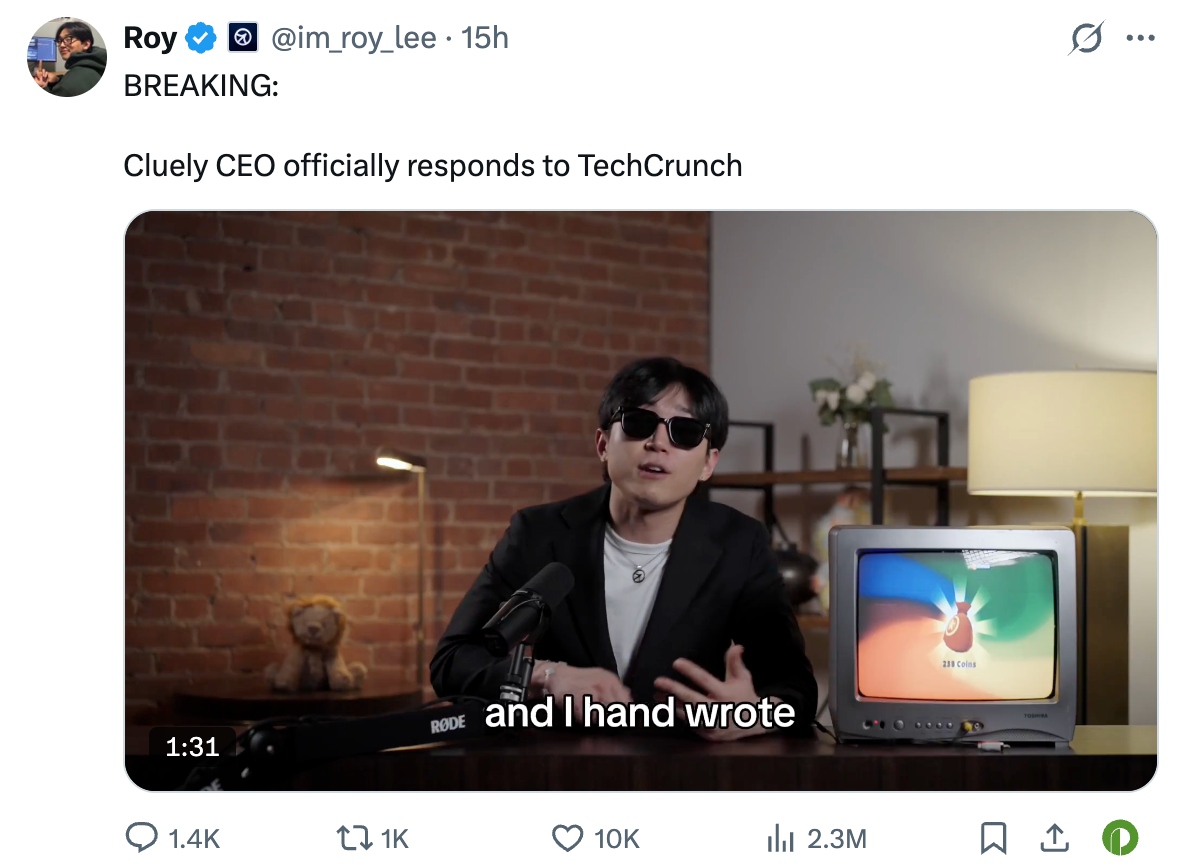
Roy Lee didn’t continue to explain in writing but chose a more theatrical response. He posted a video with the caption, Breaking News: Cluely CEO Officially Responds to TechCrunch.
In the video, he wears sunglasses, a suit, sits in front of the camera with a microphone on the table, looking like he’s about to make a serious statement. But the environment isn’t an office; it looks more like a living room, with an old desktop computer beside him, screen playing Subway Surfers—a classic distraction game. Roy’s content is far from formal, more like a self-deprecating performance, mixing self-mockery and bragging, like a rapper freestyle.
Even more absurd, at the end of the video, he stands up from behind the table. This upper-body serious CEO, and he’s not wearing pants…
_
Thus, a crisis originally about “inflated revenue” was turned into a self-mocking performance to attract attention.
a16z’s focus is actually on the attention economy
The capital market doesn’t mind this kind of performative founder. In June 2025, Cluely announced a $15 million Series A funding round, with notable investors including Andreessen Horowitz (a16z). Partner Bryan Kim mentioned in a podcast: In the AI era, the traditional “craftsman product + slow growth” model is no longer enough; viral spread itself is part of the product.
He believes the “new AI startup template” is that, as model capabilities become commoditized, attention itself begins to be a key resource. Whoever can seize user attention first may establish a new moat.
From the “cheating controversy” of Interview Coder, to the expulsion story from Columbia, and now this absurd “response video,” Roy Lee’s entire personal brand has been built along this path: controversy itself is content. This also helps explain why a16z chose to invest in Cluely and Roy Lee.
When controversy becomes a growth strategy
In traditional startup narratives, growth usually comes from product capabilities, technological barriers, and business models. But in today’s internet environment, another resource is becoming increasingly important—attention.
This logic has long been validated in the crypto industry. Many crypto projects generate buzz, controversy, or even dramatic events to grab user attention, then convert that traffic into product growth or commercial value. Especially with the rise of memes, pure dissemination without (traditional) product.
To some extent, Roy Lee’s response video is a typical example of this logic: when negative news appears, instead of trying to suppress controversy, it’s better to repackage the controversy itself as content for dissemination.
It’s clear that in today’s internet environment, attention often outweighs the importance of explaining the truth.