

Trade
Basic
Futures
Futures
Hundreds of contracts settled in USDT or BTC
Options
HOT
Trade European-style vanilla options
Unified Account
Maximize your capital efficiency
Demo Trading
Futures Kickoff
Get prepared for your futures trading
Futures Events
Participate in events to win generous rewards
Demo Trading
Use virtual funds to experience risk-free trading
Earn
Launch
CandyDrop
Collect candies to earn airdrops
Launchpool
Quick staking, earn potential new tokens
HODLer Airdrop
Hold GT and get massive airdrops for free
Launchpad
Be early to the next big token project
Alpha Points
NEW
Trade on-chain assets and enjoy airdrop rewards!
Futures Points
NEW
Earn futures points and claim airdrop rewards
Investment
Simple Earn
Earn interests with idle tokens
Auto-Invest
Auto-invest on a regular basis
Dual Investment
Buy low and sell high to take profits from price fluctuations
Soft Staking
Earn rewards with flexible staking
Crypto Loan
0 Fees
Pledge one crypto to borrow another
Lending Center
One-stop lending hub
VIP Wealth Hub
Customized wealth management empowers your assets growth
Private Wealth Management
Customized asset management to grow your digital assets
Quant Fund
Top asset management team helps you profit without hassle
Staking
Stake cryptos to earn in PoS products
Smart Leverage
NEW
No forced liquidation before maturity, worry-free leveraged gains
GUSD Minting
Use USDT/USDC to mint GUSD for treasury-level yields

More





Strength of TOPIX at Fair Value | Strategy Report | Moneyクリ Moneyx Securities Investment Information and Media Useful for Money
Japanese stocks have completely shaken off the impact of the plummet caused by Trump’s tariffs.
The Nikkei average closed almost at its high with a rise of over 700 yen. It broke above the 200-day moving average without being held back. The 25-day moving average achieved a golden cross by moving above the 75-day moving average from below, and the next golden cross with the 200-day line is now in sight.
[Nikkei Average and Moving Average Line Trends (Green: 25 days, Yellow: 75 days, Orange: 200 days)]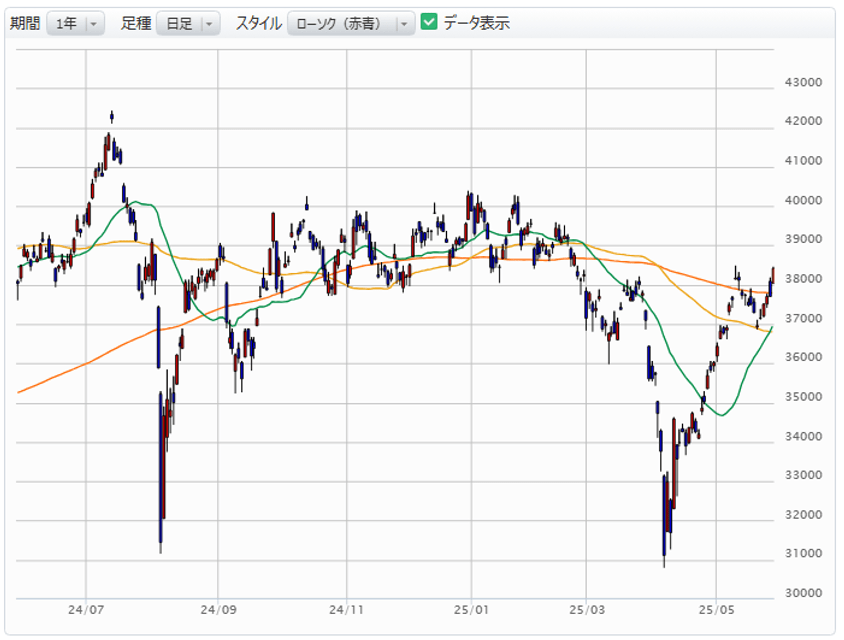 Source: Monex Securities Site
Looking at it this way, it can be said that Japan stocks have completely dispelled the impact of the sharp decline due to the Trump tariffs. The reason for this, as I have said before, is that the limits of Trump’s policies are beginning to be seen. Yesterday’s sharp rise came after the U.S. Court of International Trade ruled that a blanket tax on imports was beyond the president’s authority, blocking most of the tariffs imposed by President Trump. At first, the world was confused by the announcement of a tariff policy that was too reckless, but in the end, Yomi is becoming mainstream because it will “settle down where it settles.”
Source: Monex Securities Site
Looking at it this way, it can be said that Japan stocks have completely dispelled the impact of the sharp decline due to the Trump tariffs. The reason for this, as I have said before, is that the limits of Trump’s policies are beginning to be seen. Yesterday’s sharp rise came after the U.S. Court of International Trade ruled that a blanket tax on imports was beyond the president’s authority, blocking most of the tariffs imposed by President Trump. At first, the world was confused by the announcement of a tariff policy that was too reckless, but in the end, Yomi is becoming mainstream because it will “settle down where it settles.”
The Difference in Stock Price Trends Between the Nikkei Average and TOPIX Lies in the Strength of Earnings Forecasts
The TOPIX chart is looking even better. Since the plummet in the summer of 2024, the movement from the end of August shows a gradual but upward trend. It is just 10 points shy of the recent high of 2821 points reached in late March. If it surpasses this level, the upward trend will strengthen even further.
[TOPIX Movement]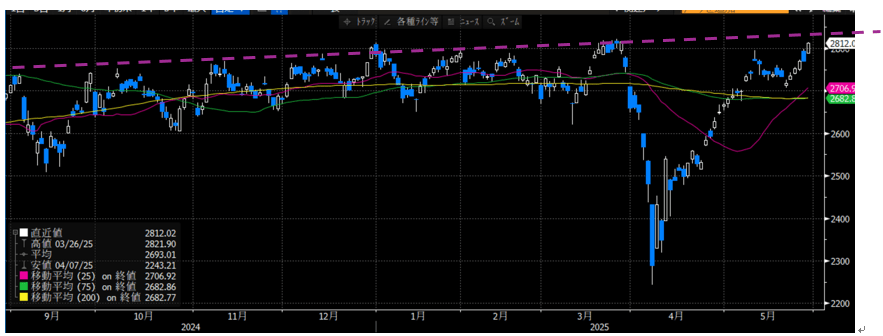 (Source: Boomberg)
While the Nikkei Average has not yet reached the consolidation range for autumn 2024, the strength of the TOPIX is prominent. This difference is due to the disparity in the robustness of earnings forecasts.
(Source: Boomberg)
While the Nikkei Average has not yet reached the consolidation range for autumn 2024, the strength of the TOPIX is prominent. This difference is due to the disparity in the robustness of earnings forecasts.
When comparing the forecasted EPS (earnings per share) for the Nikkei Average and TOPIX, using October 1, 2024, as the baseline of 100, the EPS for the Nikkei Average has not fully escaped its downward trend since peaking in February, whereas TOPIX has nearly returned to its highest value and is positioned higher than last autumn.
The differences in stock price trends honestly reflect the performance.
While the Nikkei Average is influenced by the high-priced semiconductor stocks, the strength of the domestic sector, led by the strong performance of banks in particular, seems to more than offset the significant decline in profits of the automobile sector.
[Comparison of the expected EPS of the Nikkei Average and TOPIX]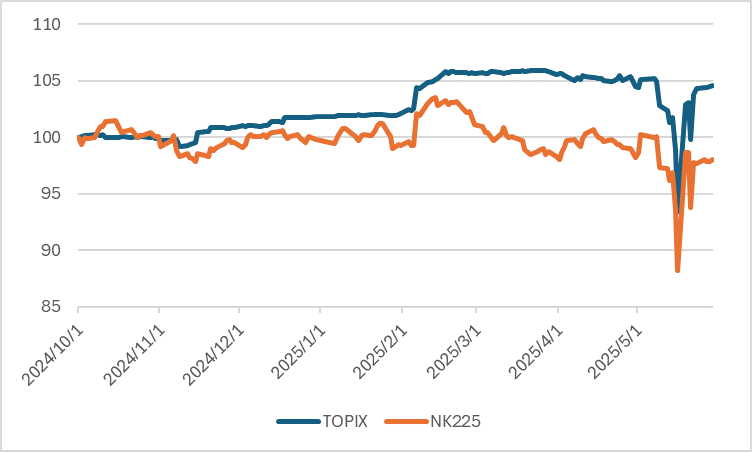 (Source: Created by Monex Securities from QUICK data)
Attention is being drawn to long-term interest rates, but I will comment on this at another time. Although the benchmark 10-year government bond yield remains elevated, it has not reached a new high.
(Source: Created by Monex Securities from QUICK data)
Attention is being drawn to long-term interest rates, but I will comment on this at another time. Although the benchmark 10-year government bond yield remains elevated, it has not reached a new high.
[Japan Government Bond Yield Trends]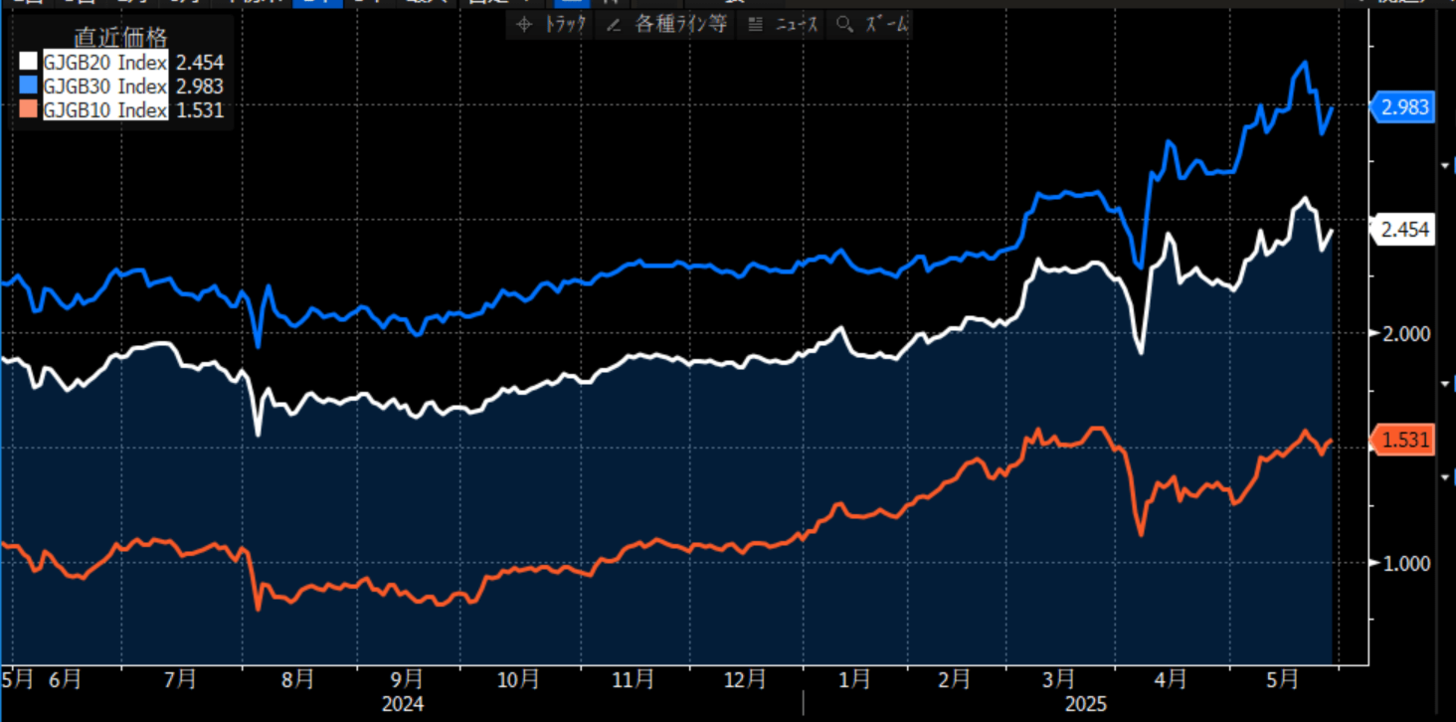 (Source: Bloomberg)
If we discount the forecast EPS of TOPIX with the current 10-year bond yield plus a 5% risk premium, it amounts to 2780 points. It can be said that the current level of TOPIX is roughly at fair value.
(Source: Bloomberg)
If we discount the forecast EPS of TOPIX with the current 10-year bond yield plus a 5% risk premium, it amounts to 2780 points. It can be said that the current level of TOPIX is roughly at fair value.