


Five-year backtest: Does dollar-cost averaging with leverage on BTC really make more money?
Five-year backtest data shows that Bitcoin’s 3x leveraged dollar-cost averaging returns are only 3.5% higher than 2x leverage, but it carries nearly zeroing-out risk. From a risk-reward perspective, spot dollar-cost averaging is the best long-term solution; 2x is the limit, and 3x is not worth it. This article is adapted from a piece by CryptoPunk, compiled, translated, and written by PANews.
(Background: Bitcoin breaks $96,000, Ethereum surpasses $3300, the entire network experiences $750 million in liquidations, “shorts liquidated for $660 million”)
(Additional context: US December core CPI slightly below expectations! Gold and silver continue to hit new highs, Bitcoin breaks $92,000, Ethereum surpasses $3100)
Table of Contents
- One | Five-year dollar-cost averaging net value curve: 3x does not “widen the gap”
- Two | Final return comparison: Marginal gains of leverage rapidly diminish
- Three | Maximum drawdown: 3x is close to “structural failure”
- Four | Risk-adjusted returns: Spot is actually the best
- Why does 3x leverage perform so poorly in the long run?
- Final conclusion: BTC itself is already a “high-risk asset”
Summary upfront:
In the past five years of backtesting, BTC’s 3x leveraged dollar-cost averaging yields only 3.5% more than 2x leverage, but at the cost of nearly zeroing out the risk.
From a comprehensive view of risk, reward, and feasibility—spot dollar-cost averaging is actually the best long-term solution; 2x is the limit; 3x is not worth it.
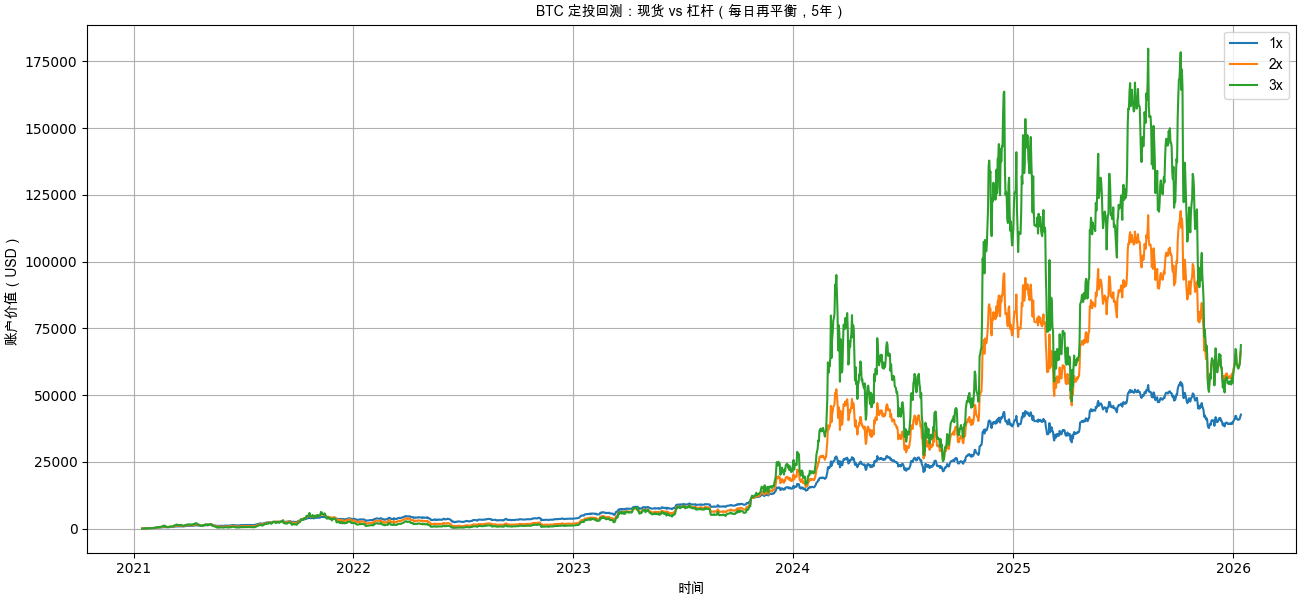
One | Five-year dollar-cost averaging net value curve: 3x does not “widen the gap”
| Key Indicators |
|---|
| 1x Spot |
| 2x Leverage |
| 3x Leverage |
| — |
| Final Account Value (Final Value) |
| $42,717.35 |
| $66,474.13 |
| $68,832.55 |
| Total Invested (Total Invested) |
| $18,250.00 |
| $18,250.00 |
| $18,250.00 |
| Total Return (Total Return) |
| 134.07% |
| 264.24% |
| 277.16% |
| CAGR (CAGR) |
| 18.54% |
| 29.50% |
| 30.41% |
| Max Drawdown (Max Drawdown) |
| -49.94% |
| -85.95% |
| -95.95% |
| Sortino Ratio (Sortino Ratio) |
| 0.47 |
| 0.37 |
| 0.26 |
| Calmar Ratio (Calmar Ratio) |
| 0.37 |
| 0.34 |
| 0.32 |
| Ulcer Index (Ulcer Index) |
| 0.15 |
| 0.37 |
| 0.51 |
From the net value trend, it is clear that:
- Spot (1x): The curve is smooth and upward, with manageable drawdowns
- 2x leverage: Significantly amplifies gains during bull markets
- 3x leverage: Multiple “ground-hugging” phases, long-term oscillations erode value
Although in the rebound of 2025–2026, 3x slightly outperforms 2x,
but over several years, the net value of 3x always lags behind 2x.
Note: The backtest used daily rebalancing for leverage, which introduces volatility decay.
This means:
The final victory of 3x heavily depends on “the last phase of the market”
Two | Final return comparison: Marginal gains of leverage rapidly diminish
| Strategy |
|---|
| Final Asset |
| Total Invested |
| CAGR |
| — |
| 1x Spot |
| $42,717 |
| $18,250 |
| 18.54% |
| 2x Leverage |
| $66,474 |
| $18,250 |
| 29.50% |
| 3x Leverage |
| $68,833 |
| $18,250 |
| 30.41% |
The key is not “who earns the most,” but how much more:
- 1x → 2x: earns approximately $23,700 more
- 2x → 3x: earns only about $2,300 more
Returns hardly grow, but risks increase exponentially
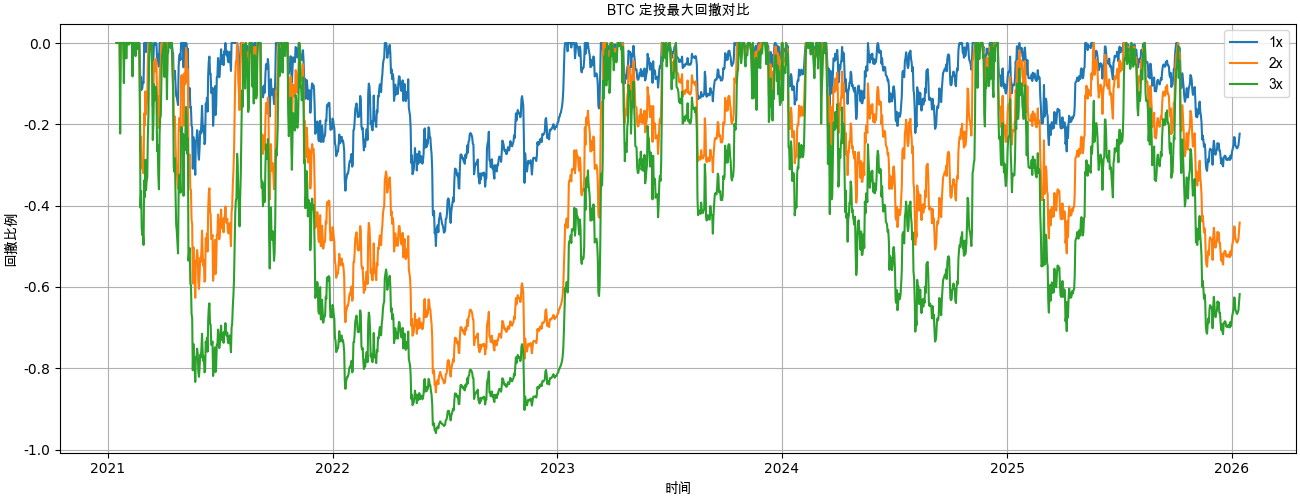
Three | Maximum drawdown: 3x is close to “structural failure”
| Strategy |
|---|
| Max Drawdown |
| — |
| 1x |
| -49.9% |
| 2x |
| -85.9% |
| 3x |
| -95.9% |
A very critical real-world issue here:
- -50%: psychologically tolerable
- -86%: requires +614% to recover
- -96%: requires +2400% to recover
In the 2022 bear market, 3x leverage has essentially “mathematically failed,”
and subsequent profits are almost entirely from new capital injected at the bottom of the bear market.
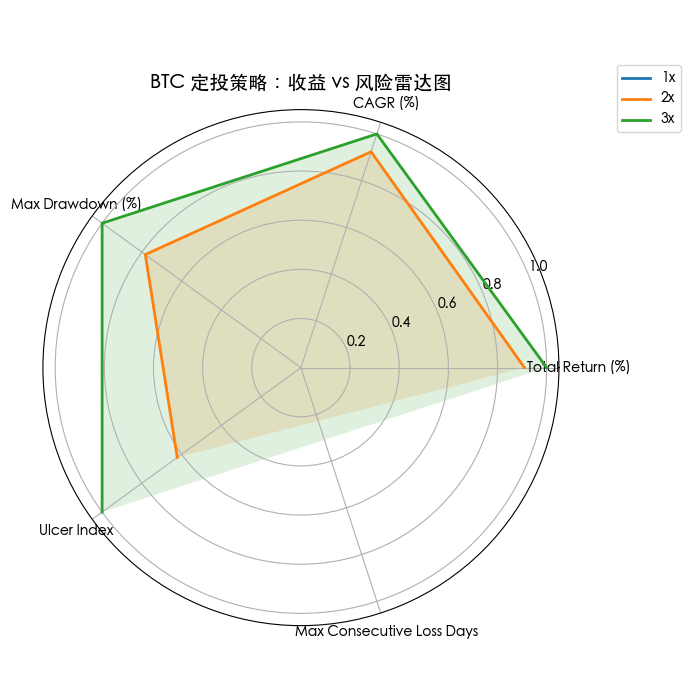
Four | Risk-adjusted returns: Spot is actually the best
| Strategy |
|---|
| Sortino Ratio |
| Ulcer Index |
| — |
| 1x |
| 0.47 |
| 0.15 |
| 2x |
| 0.37 |
| 0.37 |
| 3x |
| 0.26 |
| 0.51 |
This data shows three things:
- Spot has the highest risk-adjusted return per unit of risk
- The higher the leverage, the worse the “cost-performance” of downside risk
- 3x remains in deep drawdown zones long-term, with extreme psychological pressure
What does an Ulcer Index of 0.51 mean?
The account stays underwater long-term, almost giving no positive feedback
Why does 3x leverage perform so poorly in the long run?
The reason is simple:
Daily rebalancing + high volatility = continuous decay
In volatile markets:
- Rising → Increase position
- Falling → Decrease position
- No change → Account value continues to shrink
This is a classic volatility drag.
And its destructive power is proportional to the square of the leverage multiple.
On high-volatility assets like BTC,
3x leverage endures a 9-fold volatility penalty.
Final conclusion: BTC itself is already a “high-risk asset”
The answer from this five-year backtest is very clear:
- Spot dollar-cost averaging: the best risk-reward ratio, suitable for long-term execution
- 2x leverage: aggressive upper limit, only suitable for a few
- 3x leverage: extremely low long-term cost-performance, not suitable as a dollar-cost averaging tool
If you believe in BTC’s long-term value,
then the most rational choice is often not “adding another layer of leverage,”
but letting time work in your favor instead of becoming your enemy.
Related Articles
Is Bitcoin nearing the cycle bottom? Jan van Eck says the four-year cycle is coming to an end, and BTC is expected to gradually rebound.
Data: 60 BTC transferred from an anonymous address to Cumberland, worth approximately 3.4 million US dollars
Bitcoin mining companies under pressure: Core Scientific's earnings report falls short of expectations, stock price drops, Riot Platforms' revenue is also disappointing
Bitcoin Futures Demand Falls to Lowest Since 2024, but CME Open Interest Signals Resilience
Analysis: Bitcoin futures demand drops to the lowest level since 2024