
Futures
Access hundreds of perpetual contracts
CFD
Gold
One platform for global traditional assets
Options
Hot
Trade European-style vanilla options
Unified Account
Maximize your capital efficiency
Demo Trading
Introduction to Futures Trading
Learn the basics of futures trading
Futures Events
Join events to earn rewards
Demo Trading
Use virtual funds to practice risk-free trading
Launch
CandyDrop
Collect candies to earn airdrops
Launchpool
Quick staking, earn potential new tokens
HODLer Airdrop
Hold GT and get massive airdrops for free
Pre-IPOs
Unlock full access to global stock IPOs
Alpha Points
Trade on-chain assets and earn airdrops
Futures Points
Earn futures points and claim airdrop rewards


Promotions
AI
Gate AI
Your all-in-one conversational AI partner
Gate AI Bot
Use Gate AI directly in your social App
GateClaw
Gate Blue Lobster, ready to go
Gate for AI Agent
AI infrastructure, Gate MCP, Skills, and CLI
Gate Skills Hub
10K+ Skills
From office tasks to trading, the all-in-one skill hub makes AI even more useful.
GateRouter
Smartly choose from 40+ AI models, with 0% extra fees


NVIDIA Earnings Brief: AI has been rising for so long, is the demand for computing power still being realized?
Google and NVIDIA—both the AI industry’s applications and the underlying entry points—have delivered their answers this week.
If Google I/O is about the imaginative space for AI applications, then NVIDIA’s earnings report verifies whether the compute power required behind those imaginations has actually come to fruition.
After the market close in the U.S. on May 20, NVIDIA released its FY2027 first-quarter financial results. Revenue reached $81.615 billion, up 85% year over year and 20% quarter over quarter; data center revenue reached $75.2 billion, up 92% year over year and 21% quarter over quarter. At the same time, NVIDIA announced an additional $80 billion in stock buyback authorization and raised its quarterly cash dividend per share from $0.01 to $0.25.
This set of numbers is already impressive on its own, but what the market truly cares about is not “whether NVIDIA is still growing,” but rather whether—given that market expectations are already very high—it can continue to prove that the AI main theme is intact, that demand for compute power hasn’t peaked, and that NVIDIA’s pricing power remains solid.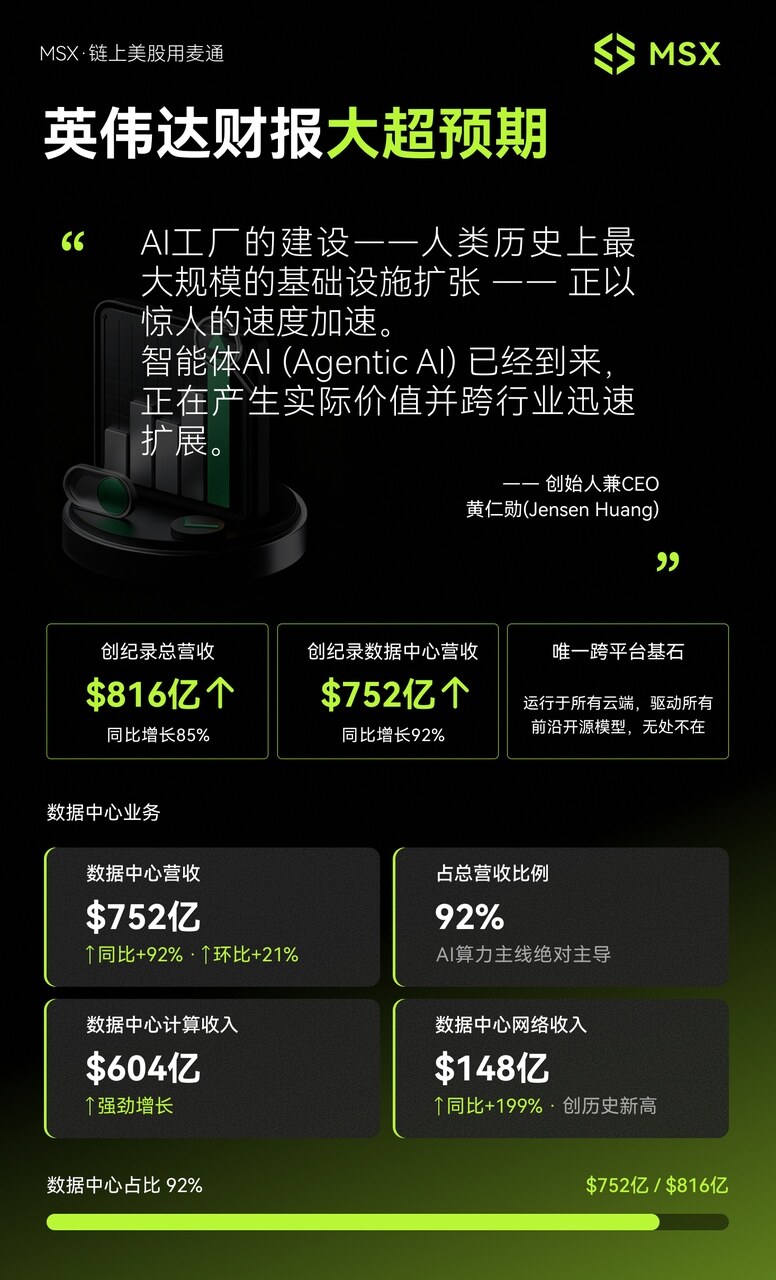
1. A snapshot of revenue, guidance, and gross margin: Is the AI engine still accelerating?
First, it’s important to clarify one thing: NVIDIA’s most core business is no longer the traditional “graphics cards” in the usual sense, but data centers—the compute infrastructure behind AI factories.
In this quarter, NVIDIA’s data center revenue reached $75.2 billion, accounting for more than 92% of total revenue. Breaking it down using the old business classification framework, compute revenue from data centers was $60.4 billion, up 77% year over year; data center networking revenue reached $14.8 billion, up 199% year over year, also setting a new historical high.
This points to a key takeaway: AI demand isn’t only confined to GPU “single points.” It is expanding into the full AI infrastructure—where GPUs do the computing, networking connects the compute capacity, and the entire rack system, NVLink, InfiniBand, Ethernet, optical communications, power, and cooling all become part of the AI factory.
So, the significance of this data center revenue isn’t just “NVIDIA is selling more.” It indicates that global cloud providers, AI model companies, enterprise customers, and sovereign AI initiatives have not yet shown any clear cooling in their investment in compute power. From this perspective, if data center revenue continues to exceed expectations in the future, the risk appetite for the AI hardware supply chain could further expand. But if this indicator begins to fall below expectations, that’s when the market would truly worry that AI capital expenditures have peaked.
Of course, beyond revenue, for a high-expectation company like NVIDIA, after the earnings are released, the stock price typically doesn’t only react to this quarter’s numbers—it should also be analyzed against next quarter’s guidance.
NVIDIA’s FY2027 second-quarter revenue guidance is $91 billion (with a ±2% range), which is clearly higher than the roughly $86 billion–$87 billion range that the market generally expected before the report. The company also explicitly stated that this guidance does not assume revenue from China’s data center compute. This is crucial: if China’s data center compute revenue is excluded and the guidance still reaches $91 billion, it suggests that overseas cloud providers, AI factories, enterprise AI, and demand from other regions are enough to keep supporting high growth.
In other words, the market’s original concern was that NVIDIA’s growth might be moving too fast, making it difficult to continue beating expectations. But the signal from this guidance is that, at least over the next quarter, AI compute demand is still not showing any obvious slowdown.
That said, it’s also worth noting: as market expectations rise higher and higher, what NVIDIA needs to deliver isn’t just “good earnings,” but “earnings that are clearly better than expected.” Therefore, whether the stock jumps significantly in the short term still depends on whether investors think this guidance is enough to cover a richly valued price point.
Meanwhile, NVIDIA’s high valuation comes not only from strong revenue growth, but also from its very strong profitability.
In this quarter, NVIDIA’s GAAP gross margin was 74.9%, and its Non-GAAP gross margin was 75.0%. The company’s gross margin guidance for the next quarter is also GAAP 74.9% and Non-GAAP 75.0%, with a ±50 basis point range.
This shows that although Blackwell systems, HBM, advanced packaging, and full rack solutions may bring higher costs, NVIDIA is still able to keep gross margin stable around 75%. For the market, this clearly points to two things:
Of course, if gross margin clearly falls below 74% in the future, the market will start worrying about pressures stemming from product switching costs, customer bargaining power, and substitute solutions—this is something that needs to be tracked over the long term.
2. Is NVIDIA shifting toward an “AI cash flow platform”?
A very noteworthy change in this earnings report is shareholder returns.
In Q1, NVIDIA returned about $20 billion to shareholders, including stock buybacks and cash dividends. As of the end of the first quarter, the company’s remaining share repurchase authorization was $38.5 billion. Then the board approved an additional $80 billion in stock buyback authorization and increased the quarterly dividend from $0.01 per share to $0.25 per share.
The significance behind this isn’t only that the company has money on its balance sheet. More importantly, NVIDIA is sending a positive signal to the market: that AI dividends will not only be invested in ecosystem partners, AI startups, and the supply chain—but will also begin returning to shareholders.
After all, in the past the market worried that NVIDIA’s heavy investment in AI ecosystem partners such as OpenAI and Anthropic might be “circular financing.” But if the company raises buybacks and dividends at the same time, it can partially alleviate long-term investors’ concerns about capital allocation efficiency.
This also makes NVIDIA gradually shift from being just a purely high-growth AI stock toward having characteristics of an “AI cash flow platform.”
3. After Blackwell, what is the market watching?
Another focus for NVIDIA is whether the product cycle can continue.
In this quarter, NVIDIA highlighted the Vera Rubin platform, including products such as Vera CPU and BlueField-4 STX, and it also mentioned collaboration with Google Cloud. This includes Vera Rubin-driven A5X instances, as well as previews of Google Gemini models on NVIDIA Blackwell and Blackwell Ultra GPUs.
This shows that NVIDIA is not stopping its story at Blackwell—it is laying groundwork for the next-generation platform ahead of time.
For investors, this is important because if Blackwell were only a strong-cycle product, the market would worry about growth reverting downward after the peak. But if Vera Rubin can connect smoothly, NVIDIA won’t just be relying on a single generation for explosive growth—it will have the capability for ongoing platform iterations.
As for whether Google TPU and CPUs will threaten NVIDIA, I think it needs to be looked at in two layers.
In the short term, TPUs, ASICs, and CPUs do indeed take on more tasks in some scenarios—especially internal models and inference workloads within large enterprises. But over the medium term, this looks more like multiple routes coexisting because AI demand is too big, rather than NVIDIA being replaced immediately.
NVIDIA’s real advantage isn’t just the GPU itself, but the “platform capability” formed by the combination of GPU, CPU, networking, software, full-system racks, and ecosystem partners. As long as customers need to rapidly deploy large-scale AI factories, NVIDIA still occupies the most central position in the industry chain.
Written at the end
This earnings report at least proves one thing: the AI main theme is not broken.
Data center revenue continues to set new records, next quarter’s guidance keeps exceeding expectations, gross margin holds around 75%, buybacks and dividends have clearly increased, and the product cycle extends from Blackwell to Vera Rubin—these all indicate that NVIDIA remains at the core position of the AI infrastructure expansion.
But for the stock price, the question isn’t whether the report is “good.” It’s whether it is good enough to exceed expectations that are already very high in the market. If the market believes this earnings report only confirms what was expected, there may be volatility in the short term. If investors further upgrade AI capital expenditure and NVIDIA’s long-term revenue upside, then the AI supply chain still has the possibility to continue expanding.
Moreover, from the perspective of the industry chain, NVIDIA’s strong earnings don’t just affect NVDA.M. They can also lead the market to reassess the entire AI infrastructure supply chain:
Of course, if you work backward from the entry point: since these days’ Google I/O has proven that AI applications are still expanding, it’s easy to understand why the compute demand in NVIDIA’s earnings report is still being realized—as long as the application side keeps generating new demand, the AI infrastructure supply chain is nowhere near reaching the end.