On August 12, 2026, the U.S. Bureau of Labor Statistics released the July Consumer Price Index (CPI) data. On a seasonally adjusted basis, U.S. CPI rose 0.1% month over month in July, compared with a 0.4% decline in June. Overall CPI rose 3.4% year over year in the 12 months through July, slightly below June’s 3.5% increase. Core CPI, excluding food and energy, rose 0.2% month over month in July, compared with no change in June. Core CPI rose 2.5% year over year, below the previous reading of 2.6%. Both the headline and core figures matched market expectations, with inflation continuing to cool moderately.
By component, the shelter index rose 0.1% month over month, accounting for two-thirds of the monthly increase in CPI. The energy index fell 1.5% month over month, significantly less than June’s 5.7% decline. Food prices rose 0.1% month over month. Within core CPI, conditions diverged: prices for medical care, airfares, communication, education, recreation, and used cars rose month over month, while motor vehicle insurance continued to decline.
The key message from the July CPI report was that inflation is gradually improving but has not yet established a sufficiently definitive trend for the Fed to fully let down its guard. After the data release, Wall Street Journal Fed reporter Nick Timiraos wrote that the July inflation report somewhat eased pressure on the Fed to raise interest rates in September, but that the latest data offered little clear guidance on the longer-term interest-rate outlook. This means that an inflation report in line with expectations did not end the suspense surrounding the September interest-rate decision—it merely tilted the decision-making balance slightly from “rate hike” toward “wait and see.”
How inflation readings are transmitted into rate-hike probabilities
After the July CPI data was released, pricing in the interest-rate market changed significantly. Before the release, CME FedWatch showed the probability of a 25-basis-point rate hike in September at approximately 50%. After the release, the interest-rate swaps market’s implied probability of a September rate hike fell from around 50% to below 40%. As of August 13, CME data showed a 59.9% probability that the Fed would leave interest rates unchanged in September and a 40.1% probability of a 25-basis-point rate hike.
The transmission chain between inflation data and rate-hike probabilities is not complicated: Core CPI at 2.5% year over year remains above the Fed’s 2% target, but the trend is moving in the right direction and the pace is moderate. Goldman Sachs Chief Economist Jan Hatzius stated clearly before the release that he did not expect the Fed to raise interest rates in the second half of 2026, believing that cooling inflation would outweigh stagnation in the labor market. JPMorgan Chief U.S. Economist Michael Feroli, meanwhile, said that a 0.22% month-over-month increase in core CPI “may still be insufficient to prompt the Fed to raise interest rates at its September meeting,” but that consecutive readings near 0.3% could change the situation.
The July core CPI reading of 0.2% month over month landed squarely in the “not hawkish enough” range. However, the market has not completely abandoned rate-hike bets—a 40.1% implied probability means that a considerable amount of capital is still positioned for a September rate hike.
How labor-market weakness is changing the policy balance
Before the July CPI data, the July nonfarm payrolls report released by the U.S. Department of Labor on August 7 had already cast a shadow over rate-hike expectations. The data showed that nonfarm payrolls unexpectedly fell by 23k in July, far below the market expectation of an increase of 83k. Employment data for the previous two months was revised down by a combined 103k. By sector, the employment decline was concentrated mainly in local government education (-50k), retail trade (-19k), and financial activities (-14k).
The unexpected weakening in employment data and the moderate cooling in inflation created a cumulative policy effect. CMB International noted in a report that the increase in U.S. nonfarm payrolls in July weakened sharply and fell significantly short of expectations, with employment trends slowing notably and wage growth slowing further. Against this backdrop, the “threshold” for a Fed rate hike has effectively risen: although inflation remains above target, if the labor market weakens at the same time, the cost of a one-way rate hike will increase significantly.
Neil Dutta, head of economic research at Renaissance Macro Research, was more direct: because the inflation data could not provide a clear conclusion, the outcome of the September meeting was roughly a 50-50 proposition. This “50-50” setup clearly shows that the market is simultaneously digesting two opposing forces—the pressure of inflation remaining above target and the constraint imposed by a weakening labor market.
Why divisions within the Fed continue to widen
The July FOMC meeting voted 9 to 3 to leave interest rates unchanged, with three voting members favoring an immediate rate hike. This was the first time since 2016 that three voting members had held the same dissenting position. Cleveland Fed President Hammack said this week that a 25-basis-point rate hike “may do little to help the economy” and that the Fed may need to make a series of such adjustments. San Francisco Fed President Daly, who supports leaving interest rates unchanged, questioned whether gradual rate hikes would actually be effective.
Fed Chair Warsh took office as the 17th chair on May 22 and reiterated the 2% inflation target at the press conference following the July meeting, while remaining vague on the specific policy path. The June FOMC dot plot showed the median federal funds rate at the end of 2026 rising to 3.8% from 3.4% in March, with as many as nine voting members expecting one or more rate hikes this year.
This internal division means that the September interest-rate decision will depend heavily on a series of data releases in August. Before the September 15–16 policy meeting, the Fed will also receive the August employment report, August CPI, and August PPI. Any data point that exceeds or falls short of expectations could become a key variable in changing the voting dynamic.
How the Event Contracts market is pricing the September interest-rate decision
Beyond the traditional interest-rate futures market, prediction markets and Event Contracts provide another window into market expectations. Gate Event Contracts are designed around major macroeconomic events with binary outcomes—probability bets on “yes” or “no.” Taking the Fed’s interest-rate decision as an example, users can choose a side based on their assessment of the policy outcome.
 Politics
Fed Decision in September?
+3 more
Gate Event Contracts market data showed that, as of August 13, the probability implied by positions on the platform that interest rates would remain unchanged in September was 72%, while the probability of a 25-basis-point rate hike was 27%. This distribution differs significantly from CME FedWatch’s 59.9% probability of no change. In early August, the probability assigned to a 25-basis-point September rate hike had at one point reached as high as 54%. At that time, the July nonfarm payrolls data had not yet been released, and the market was still digesting the hawkish signal from the June dot plot.
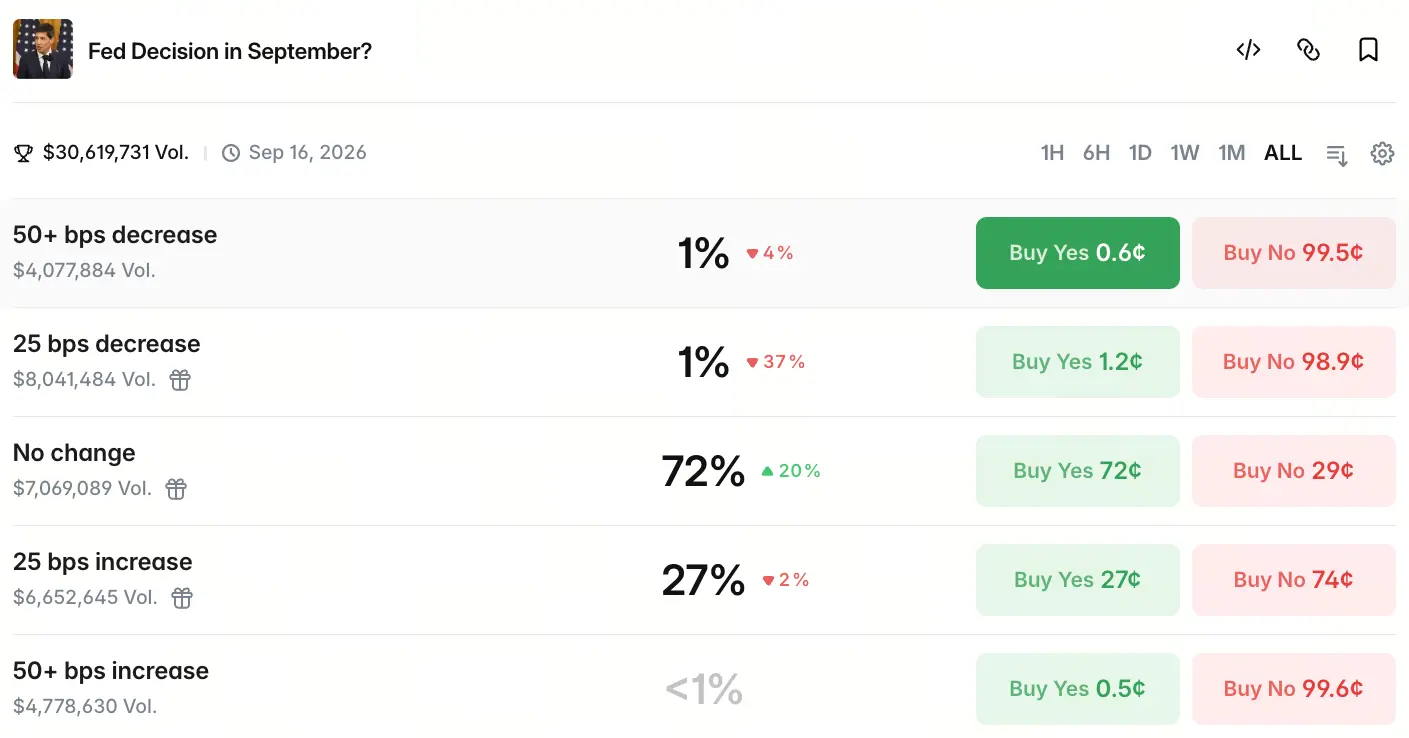
From 54% to 27%, the rate-hike probability was nearly cut in half in just two weeks. This trajectory clearly reflects the successive impact of two key data points: first, the unexpected contraction in nonfarm employment on August 7, followed by the moderate, in-line CPI reading on August 12. Together, the two reports shifted market expectations for a September rate hike from “highly probable” to “a low-probability event.”
The existence of pricing differences between markets is itself informative. The participant structure, liquidity, and pricing mechanisms of the Event Contracts market differ from those of traditional interest-rate futures, and its probability distribution reflects the information and judgments of another group of market participants. The gap between 72% and 40% clearly shows that a consensus on the September interest-rate path has yet to form.
How uncertainty over the interest-rate path is transmitted to asset prices
Changes in interest-rate expectations are producing chain reactions across multiple asset classes. Goldman Sachs noted that if CPI data comes in above expectations, it will rekindle September rate-hike bets, push up Treasury yields, and pressure growth stocks; if the data is soft, it will strengthen the case for the Fed to remain patient. After the July nonfarm payrolls data was released, U.S. Treasuries rose and Wall Street’s major stock indexes hit record highs.
Gold rose more than 7% in the final week of July, reflecting both the impact of lower bond yields and demand for geopolitical hedges. Brent crude traded near $84 per barrel in mid-August. The greater the uncertainty over the Fed’s policy path, the more difficult it is for volatility in asset prices to subside.
For crypto assets, interest-rate expectations are also an important macroeconomic pricing factor. Small-cap tokens are currently moving in tandem with U.S. technology stocks, while Bitcoin is moving in tandem with Fed interest-rate expectations—two lines of logic operating in parallel. On the Gate platform, users can participate in trading traditional markets such as gold, foreign exchange, and stock indexes through contracts for difference (CFDs), enabling multi-asset allocation around FOMC-related market movements.
FAQ
Q1: What exactly were the July CPI figures?
U.S. CPI rose 3.4% year over year and 0.1% month over month in July; core CPI rose 2.5% year over year and 0.2% month over month. Both the headline and core figures matched market expectations.
Q2: What is the current probability of a Fed rate hike in September?
Pricing differs across markets. CME FedWatch showed a 59.9% probability of interest rates remaining unchanged in September and a 40.1% probability of a 25-basis-point rate hike. The Gate Event Contracts market showed a 72% probability of no change and a 27% probability of a 25-basis-point rate hike.
Q3: Besides CPI, what other data will affect the September interest-rate decision?
Before the September 15–16 policy meeting, the Fed will also receive the August employment report, August CPI, and August PPI. Any data point that exceeds or falls short of expectations could change the voting dynamic.
Q4: How deep are the divisions within the Fed over a September rate hike?
The July FOMC meeting voted 9 to 3 to leave interest rates unchanged, with three voting members favoring an immediate rate hike, marking the largest dissent since 2016. The June dot plot showed that as many as nine voting members expected one or more rate hikes in 2026.
Q5: How can Event Contracts help assess the direction of interest rates?
Event Contracts structure macroeconomic events as probability bets on binary outcomes (yes/no), with prices between 0 and 100 reflecting the market’s assessment of the probability that an event will occur. Compared with traditional interest-rate futures, Event Contracts provide expectation signals from a different market structure and participant perspective, serving as an additional reference for cross-validation.


