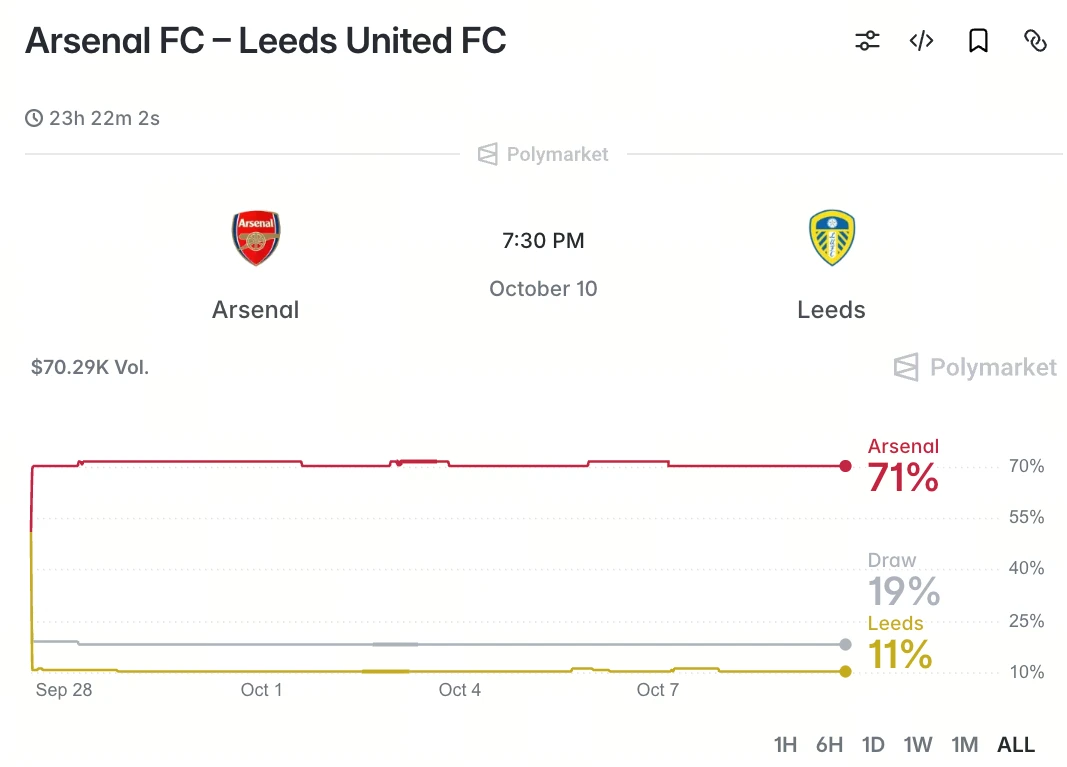
When the probability of each outcome is collectively “voted on” with real money by traders worldwide, the meaning of odds figures changes fundamentally. According to Gate Event Contracts data, as of October 9, 2026, the pricing for Premier League Round 6阿森纳主场迎战利兹联 is: Arsenal Win Rate 71%, draw 19%, and Leeds United Win Rate 11%.
Where does the Win Rate pricing in Event Contracts come from?
The core logic of Event Contracts: price equals probability. On Gate Event Contracts, each outcome corresponds to a binary contract, with prices fluctuating between 0.01 and 0.99 USDT. If the Arsenal win contract price remains around 0.71, it means participants are willing to buy it for 0.71 USDT—if Arsenal wins, the contract settles at 1 USDT; otherwise, it becomes worthless.
This pricing differs fundamentally from traditional fixed odds. Bookmakers set odds through market-maker models that include operating margins and risk premiums; Event Contracts are matched through an order book, with prices formed by the actual bids and offers of buyers and sellers, making liquidity more transparent.
Arsenal’s 71% pricing means the market believes the probability of the Gunners taking all three points at home is about 6.5 times that of Leeds United pulling off an upset win. Whether this gap is reasonable requires examining the teams’ fundamentals.
Can Arsenal’s attacking efficiency support a 71% market consensus?
Arsenal recorded 4 wins, 0 draws, and 1 loss in their first 5 rounds, earning 12 points and ranking second in the table. They won their first 4 rounds while conceding just 1 goal, but suffered their first defeat in Round 5, losing 0-3 away to Brighton.
In attack, Arsenal scored 8 goals in their first 5 rounds, averaging 1.60 goals per game. Saka leads with 3 goals, while Havertz and Ødegaard have 2 each. Defensively, Arsenal concede 0.80 goals per game and have kept 3 clean sheets. These attacking and defensive figures support pricing above a 70% Win Rate.
But does 71% fully reflect recent volatility? The heavy defeat in Round 5 exposed vulnerabilities in defensive transitions. The market has already incorporated this negative information—71% is down from the 75% to 80% typically seen at the start of the season against mid-to-lower-table teams.
Why is Leeds United’s unbeaten start priced at just 11%?
Leeds United made an impressive start. They remained unbeaten through their first 5 rounds with 2 wins and 3 draws, earning 9 points and ranking fifth, making them one of only a few unbeaten teams in the league. They conceded just 3 goals in their first 5 rounds, averaging 0.60 goals conceded per game—better defensive figures than Arsenal.
However, Event Contracts give them only an 11% away-win price for two key reasons.
The first is their poor head-to-head record. Arsenal have beaten Leeds United in 7 consecutive league meetings, scoring 24 goals and conceding just 5. From 4-2 and 4-1 to 5-0 and 4-0, Leeds United have almost never found an effective response. This long-term pattern is given significant weight in the pricing.
The second is insufficient attacking efficiency. Leeds United scored 7 goals in their first 5 rounds, but their expected goals (xG) reached 7.72, meaning their actual goals were slightly below what the quality of their chances should have produced. Their ability to convert chances will be tested against an Arsenal defense that concedes only 0.80 goals per game.
What risk signals are concealed in the 19% draw pricing?
The 19% draw pricing merits analysis. The long-term historical draw rate in the Premier League is approximately 25% to 26%. When draw pricing is significantly below that benchmark, it usually means the market believes there is a large gap in the teams’ strengths and that the match will likely produce a winner.
But Leeds United have drawn 3 of their 5 matches, for a 60% draw rate. The defensive system built by manager Daniel Farke gives the team the ability to “keep matches tight” against stronger opponents. If they adopt a low defensive block and quick counterattacks away from home, the possibility of the match remaining evenly balanced for a long period is not low. The 19% pricing may underestimate their ability to drag the game into a stalemate.
External prediction models are also worth noting. Based on 10,000 pre-match simulations, Opta’s supercomputer gives Arsenal a 68.9% Win Rate and Leeds United a 13.7% Win Rate. The Event Contracts pricing of 71% is slightly higher than the model output, and the deviation may reflect the market placing additional weight on home advantage and recent results.
What is the long-term value of Event Contracts in sports?
Sports have become the category with the strongest liquidity and highest participation in Event Contracts. From the World Cup to the Premier League, the prediction-market pricing mechanism provides traditional sports analysis with a quantifiable and trackable indicator of market consensus.
Unlike traditional odds, Event Contracts prices change in real time and continuously. When starting lineups, injury information, or pre-match news is updated, contract prices fluctuate immediately, reflecting the speed and direction with which the market processes new information. For crypto users, hedging combinations involving Event Contracts and spot holdings are also creating a new strategic dimension.
In the first quarter of 2026, trading volume across global prediction market platforms reached $25.7 billion, up more than 90% quarter over quarter. Sports are a core driver. Event Contracts not only provide probability pricing for match outcomes but also serve as infrastructure for converting collective intelligence into tradable assets.
FAQ
How does probability pricing in Event Contracts differ from traditional betting odds?
Traditional odds are set by bookmakers and include operating margins and risk premiums. Event Contracts prices are formed by matching buyers and sellers through an order book; in essence, “probability equals price,” with more transparent liquidity.
What does Arsenal’s 71% Win Rate pricing mean?
It means participants are willing to buy an Arsenal win contract for approximately 0.71 USDT, reflecting the market’s view that Arsenal’s probability of winning at home is about 70%. The pricing incorporates multiple dimensions of information, including team strength, recent form, and historical head-to-head results.
Leeds United are unbeaten, so why is their win pricing only 11%?
Although Leeds United started the season unbeaten, their attacking efficiency is relatively low, and they have lost 7 consecutive league matches against Arsenal, conceding 24 goals in total. Their poor head-to-head record and attacking efficiency issues are the main factors weighing down the pricing.
Can Event Contracts data be used as an investment reference?
Event Contracts probability pricing reflects collective judgment and can serve as a reference for understanding market consensus. However, probability pricing is not a guarantee of future results; trading decisions should be based on independent judgment and risk assessment.


