Source: Gate 行情数据
CPI and PCE Tell Different Stories, with Wall Street Showing Significant Divergence in Data Interpretation
The Current Market has significant disagreements over expectations for August CPI. The root of this divergence lies not only in differences between the forecasts themselves, but also in the structural divergence between the core inflation indicator referenced by the FED in its decision-making and the CPI that the market generally focuses on.
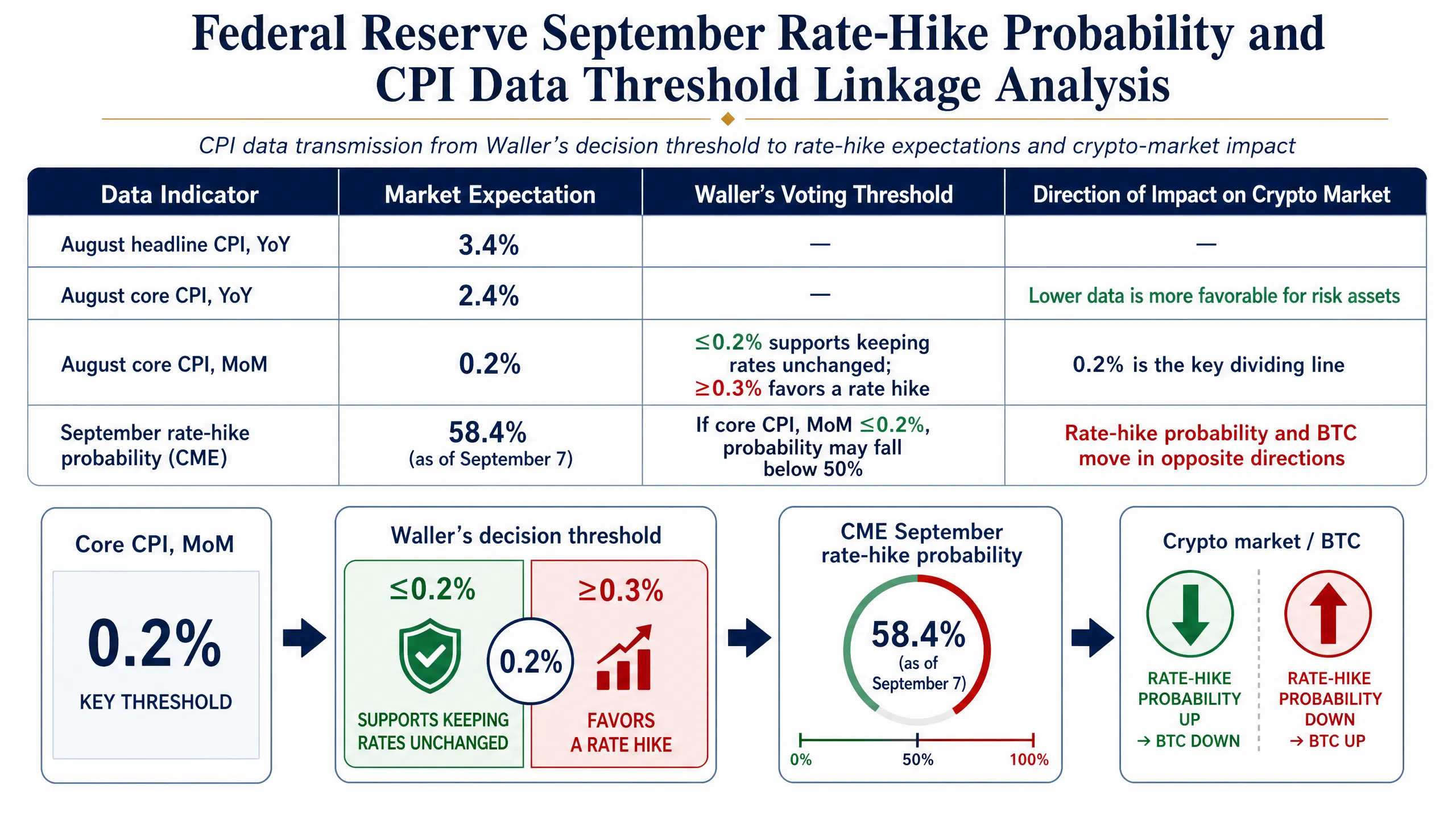
Analysis of the Link Between the FED's September Rate-Hike Probability and CPI Data Thresholds
BofA Securities forecasts that August core CPI will rise 0.22% month over month and calculates that this would correspond to core PCE rising approximately 0.24% month over month and returning to 3.4% on an annualized basis. It believes this level would be sufficient to convince FED Chair Warsh that inflation is not yet adequately controlled, thereby supporting another rate hike in September. Citi expects core CPI to increase only 0.184% month over month, with the annual rate falling to 2.3%. If realized, this would be the lowest annual core CPI reading since April 2021, sufficient to lead most officials to keep Interest Rates unchanged.
The difference between the two institutions' core CPI forecasts is only 0.036 percentage points, yet they point to diametrically opposed policy conclusions. Behind this phenomenon is the structural difference between the two major inflation indicators, CPI and PCE. Housing accounts for approximately one-third of the CPI basket, while PCE uses a different method to price housing and assigns it a lower weight. Meanwhile, PCE gives greater weight to healthcare, and rising healthcare costs are pushing up core PCE. The Cleveland FED's inflation nowcasting model shows that core CPI is expected to fall further to around 2.3%, while core PCE is expected to rise to approximately 3.5% over the same period, with the two clearly diverging.
In his Jackson Hole speech, FED Chair Warsh explicitly confirmed that PCE inflation is the FED's preferred policy reference indicator, with particular attention to “supercore PCE,” which excludes energy and housing. This indicator has now risen to 3.9% and continues to climb. This means that even if August core CPI declines, the FED may still lean toward tightening if core PCE or supercore PCE continues to rise.
Internal FED Divisions Persist, with the Decision Thresholds of Key Swing Votes Becoming the Focus of the Contest
The hawkish and dovish camps within the FED are currently evenly matched, and the positions of key swing voters will directly determine the final outcome of the September meeting.
FED Governor Waller is widely regarded by the market as the key swing vote in this decision. Waller recently told Reuters, “If inflation continues to make progress toward the 2% target, I would be willing to support keeping the current policy rate unchanged,” and explicitly pointed out that August inflation data would be a key basis for his decision. BofA's analysis suggests that Waller's implied threshold for supporting a rate hike is core PCE rising more than 0.30% month over month. BofA forecasts core PCE at approximately 0.24%, below this threshold, but believes that if Warsh supports a rate hike and the data is broadly in line with expectations, the committee could still form a sufficient majority.
An analysis by Soochow Securities indicates that Waller currently leans toward giving inflation more time to continue falling rather than immediately tightening policy further. As long as August inflation does not clearly reaccelerate, keeping Interest Rates unchanged in September is becoming his preferred policy choice. After Waller's remarks, the probability of a September rate hike briefly fell from 63.2% to 51%.
It is worth noting that the FED's July policy meeting approved keeping Interest Rates unchanged by a 9–3 vote. The three dissenting voters—Cleveland FED President Hammack, Minneapolis FED President Kashkari, and Dallas FED President Logan—all voted for a 25-basis-point rate hike. This means that three members of the committee already clearly favor tightening, and the hawkish force cannot be overlooked ahead of the September meeting.
Crypto Market Pricing Logic: $80,000 Becomes a Key Watershed
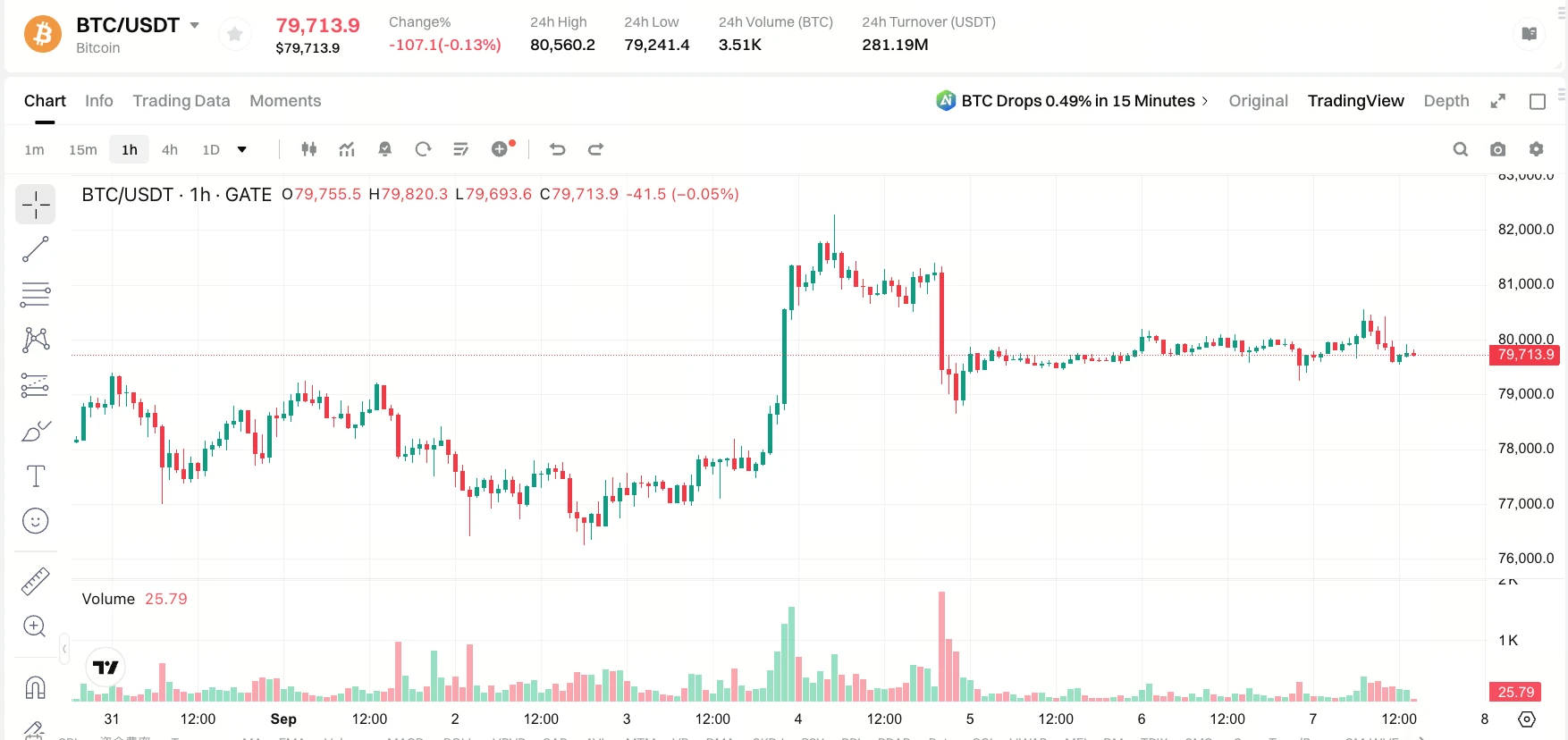
From the perspective of the crypto market's technical structure, $80,000 has become Bitcoin's most important short-term price anchor.
The rapid decline and rebound after the NFP data was released constituted an effective “stress test”: Bitcoin fell from above $81,000 to approximately $78,600 but recovered to above $80,000 over the weekend. During this process, U.S. spot Bitcoin ETFs recorded approximately $1 billion in net inflows last week, bringing cumulative inflows over the past three weeks to approximately $3.8 billion, the strongest three-week inflow record of the year. At the same time, Bitcoin Futures open interest fell from approximately $54.9 billion to around $53 billion, indicating that the selling pressure cleared some leveraged positions rather than the price recovery being driven by new leverage. Sustained ETF buying and the reduction of some leverage have made the $80,000 region more resilient than during several previous rounds of macro shocks.
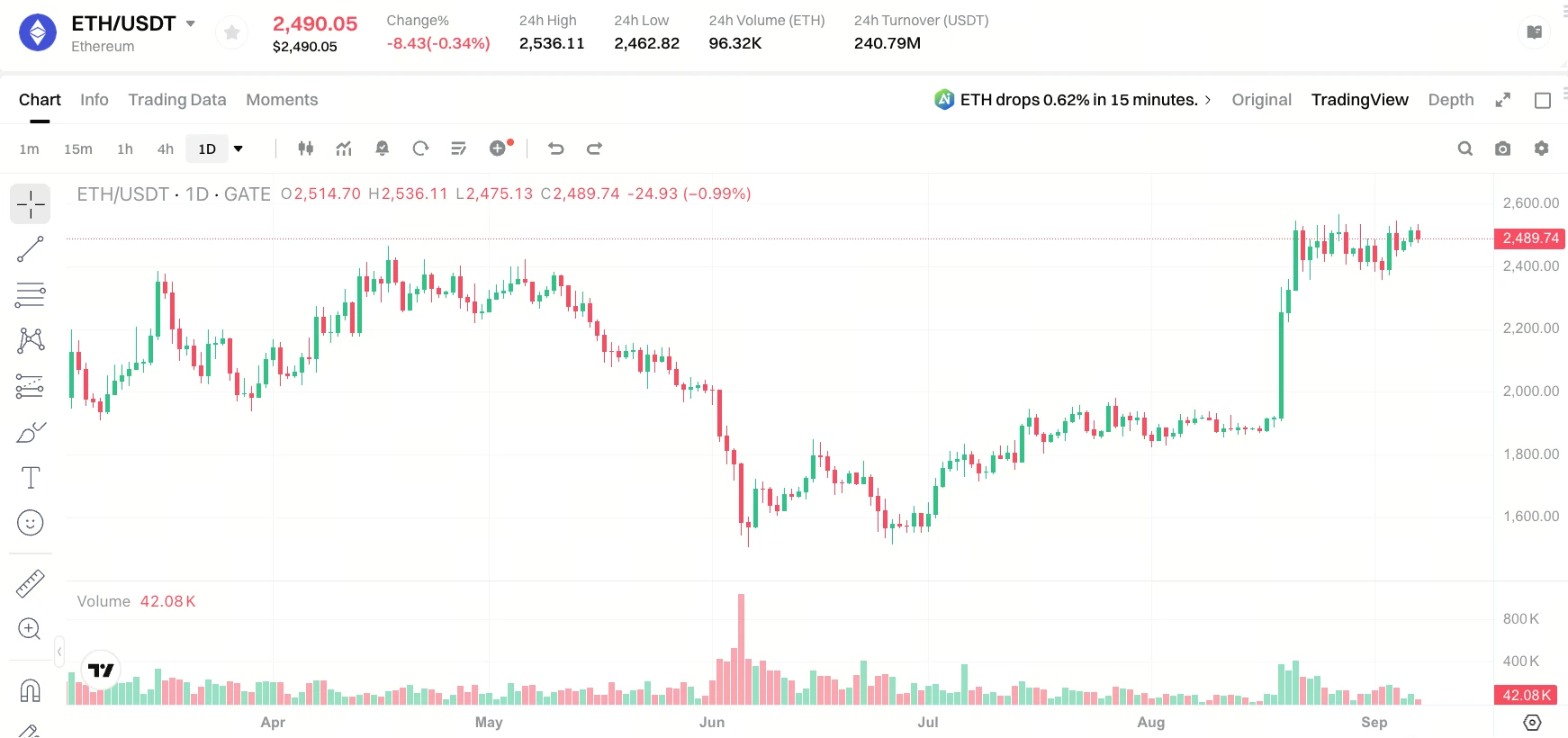
In terms of price performance, Bitcoin has risen 22.66% over the past 30 days and 29.10% over the past 90 days. Ethereum has risen 32.28% over the past 30 days and 60.86% over the past 90 days. This rebound is already substantial, meaning that if the CPI data is hawkish, the market faces considerable downside risk.
The current technical structure shows $79,000–$78,000 as Bitcoin's first support zone and $81,000–$82,000 as the short-term resistance zone. A sustained break above $82,000–$83,000 would indicate that the rebound has stronger staying power.
How CPI Data Will Affect Crypto Asset Pricing Logic
Considering Current Market expectations and the policy contest, the August CPI data could produce three main scenarios:
If core CPI rises close to or above 0.22% month over month—the upper end of BofA's forecast—combined with the annual core PCE rate returning to above 3.4%, market expectations for a September rate hike will strengthen significantly. Under this scenario, Bitcoin could retest the $78,000 support zone, while Ethereum could fall back to around $2,400. Higher Interest Rates mean greater appeal for risk-free Assets and a tighter liquidity environment, which would directly suppress the valuation midpoint of risk assets.
If core CPI rises between 0.18% and 0.20% month over month, the data interpretation will be subject to considerable divergence. The market may initially move sideways, while the eventual Interest Rate decision will depend on how FED officials interpret the PCE indicator. If Waller leans toward keeping Interest Rates unchanged, risk assets could see a period of recovery. Under this scenario, if Bitcoin can hold above $80,000, it could move higher to test the $82,000 resistance level.
If core CPI rises less than 0.18% month over month, approaching the lower end of Citi's forecast, rate-hike expectations will decline significantly. Bitcoin could test the $82,000–$83,000 range, while Ethereum could challenge $2,600. More importantly, this would provide crypto assets with a more favorable macro narrative over the medium term. Unchanged Interest Rates would mean reduced marginal pressure from tightening Dollar liquidity, and the trend of ETF inflows could continue.
Beyond the scenario analysis, two external variables also need to be considered. First, U.S.–Iran geopolitical tensions remain elevated, and Brent crude has risen above $96 per barrel. Higher energy prices will indirectly affect the FED's policy space through the inflation-expectations channel. Second, the U.S. August PPI data—due at 9:00 p.m. Beijing time on September 10—and initial jobless claims will also be released this week. These data points will provide cross-validation alongside CPI.
This week's CPI data is important not only because it could determine whether the FED hikes Interest Rates in September, but also because it will verify whether the current decline in inflation is sustainable. Behind the divergence between CPI and PCE is the differentiation of price pressures across economic sectors: cooling in the housing market coexists with sticky costs in the services sector. For the crypto market, understanding the FED's actual decision-making framework is more important than forecasting the monthly data itself. The FED looks at PCE, especially supercore PCE; the market looks at CPI; and the price gap between the two happens to be the main source of the current divergence in market expectations.
From a longer-term perspective, regardless of whether there is a September rate hike, the pricing logic of crypto assets has undergone an important shift over the past month: macro factors have once again become the dominant variable, ETF fund flows have become a key market stabilizer, and the $80,000 price level has become the psychological anchor in the battle between bulls and bears. For investors, preparing two-way risk plans before and after the CPI release and understanding the transmission mechanisms under different data scenarios is more practical than simply betting on a single direction.
FAQ
Q: Why is the August CPI data crucial to the FED's September rate-hike decision?
August CPI is the last key inflation data release before the FED's September 15–16 policy meeting. FED Chair Warsh and key voter Waller have both explicitly stated that the August inflation data will be the core basis for deciding whether to resume rate hikes. Although the employment data was strong, the FED's policy focus has shifted to inflation.
Q: What is the difference between CPI and PCE? Which indicator does the FED focus on more?
CPI measures price changes in a basket of goods and services purchased by consumers, with a relatively high housing weight. PCE covers a broader range of consumer spending and gives greater weight to healthcare. FED Chair Warsh has confirmed that PCE inflation is the preferred policy reference indicator, with particular attention to “supercore PCE,” which excludes energy and housing.
Q: If August CPI exceeds expectations, how much adjustment pressure could the crypto market face?
If core CPI rises more than 0.22% month over month, rate-hike expectations will strengthen significantly. Bitcoin could retest the $78,000 support level, while Ethereum could fall back to around $2,400. Higher Interest Rates raise the opportunity cost of holding non-yielding Assets and tighten financial conditions.
Q: What is the Current Market probability of a FED rate hike in September?
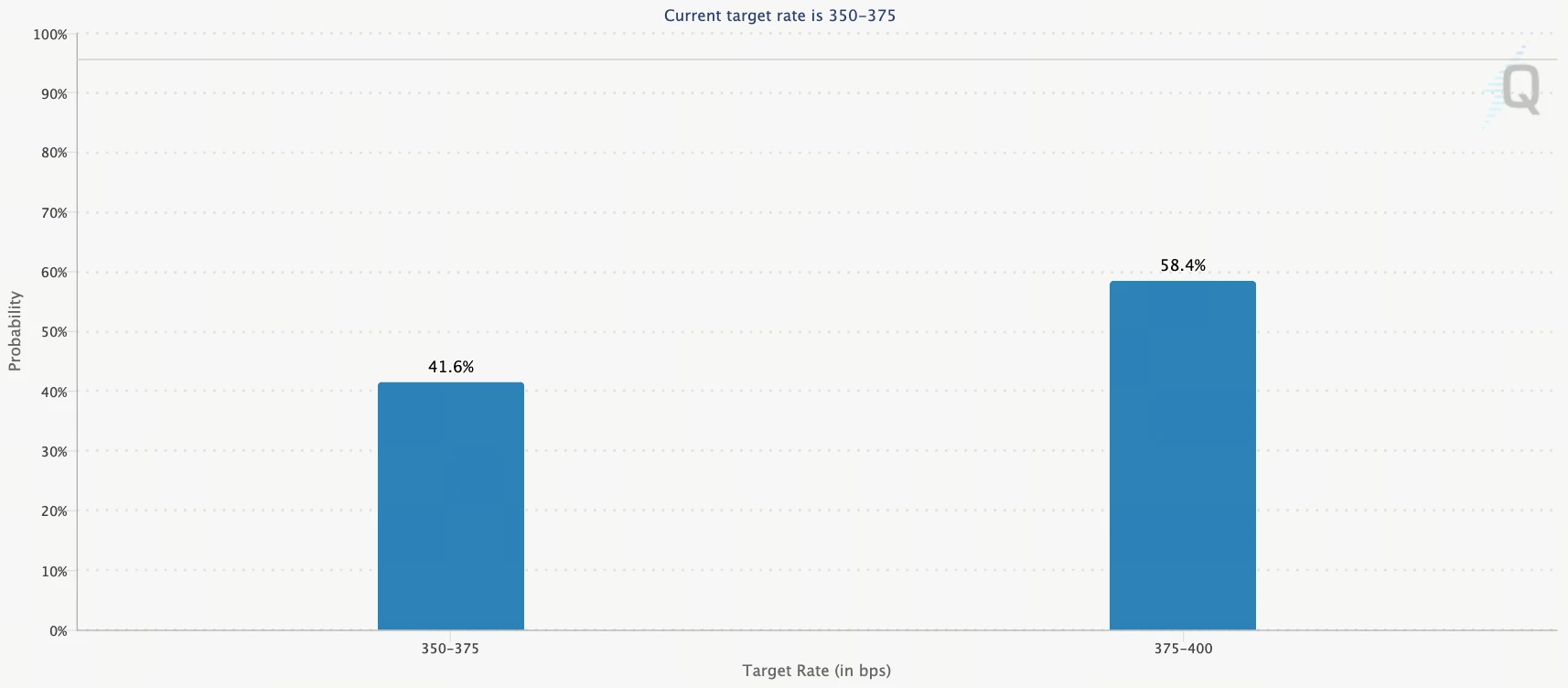
As of September 7, CME FedWatch shows the probability of a September rate hike at approximately 60%. The probability briefly rose from around 49% to 58.4% after the NFP data was released. Estimates differ somewhat across data sources, indicating that the market has not yet reached a clear consensus.
Q: Which key technical levels around $80,000 should be watched for Bitcoin?
$79,000–$78,000 is the first support zone, while $81,000–$82,000 is the short-term resistance zone. A sustained break above $82,000–$83,000 would indicate that the rebound has stronger staying power.