The Standard Reserve is a DeFi mechanism designed to manage protocol reserves, bond issuance, and token supply—enabling a protocol to function as a coded reserve institution through smart contracts that accumulate assets, issue tokens, and adjust market liquidity.
These projects are commonly called OHM-style DeFi, a term rooted in OlympusDAO’s early framework for protocol-owned liquidity and bond issuance. While traditional DeFi protocols rely primarily on user-supplied liquidity, OHM-style protocols aspire to gradually own the liquidity assets within trading pairs, backing a portion of token value with reserve assets.
The Standard Reserve is not simply about launching a new token; it’s about tackling the deeper question: Can a DeFi protocol manage its own balance sheet like a financial institution? Can code alone determine how many tokens to issue, the amount of reserves to hold, when to expand supply, and when to mitigate risk?
These challenges position it as both a monetary experiment and a testbed for protocol governance and capital management.
Key Points
- The Standard Reserve is a DeFi experiment focusing on protocol reserves, bond issuance, and token supply management.
- The OHM-style mechanism is centered around staking, bonds, and protocol-owned liquidity.
- Owning liquidity reduces reliance on external LPs but introduces asset price and liquidity risks.
- High APY is typically driven by token inflation and does not represent genuine protocol income.
- Reserve size is not equivalent to token value—unvested bonds, future emissions, and asset liquidity must also be considered.
- A new generation of projects is revisiting OHM mechanisms, emphasizing improved supply controls, reserve transparency, and real income models.
- Before joining these protocols, it’s essential to review reserve composition, fully diluted supply, bond vesting, governance controls, and stress test results.
What Is The Standard Reserve
Fundamentally, The Standard Reserve functions as an on-chain reserve management system. Smart contracts handle asset intake, liquidity management, and token issuance or adjustment per preset rules.
Unlike typical lending protocols or decentralized exchanges, its primary objective isn’t facilitating trades or collecting interest—it’s creating a protocol-owned balance sheet.
In standard DeFi, protocols depend on external liquidity providers. Users deposit assets into liquidity pools to earn fees and rewards; when incentives dwindle, liquidity can be pulled rapidly. OHM-style protocols aim to change this dynamic by acquiring LP tokens, stablecoins, and crypto assets directly via bonds or other means, slowly reducing reliance on short-term liquidity mining.
It's important to clarify: The Standard Reserve is neither a bank nor a fiat-backed stablecoin. Its "reserves" are on-chain assets subject to price volatility, and the protocol may not redeem tokens at a fixed price. Here, "reserve" reflects on-chain asset management, not a traditional risk-free fund.
OHM-Style DeFi Mechanism Logic
OHM-style systems are typically defined by three pillars: staking, bonds, and protocol-owned liquidity. Stakers lock tokens in the protocol to earn more tokens, with rewards issued by the protocol reflected as annual percentage yield (APY).
The bond mechanism lets users provide stablecoins, LP tokens, or other assets to the protocol, receiving protocol tokens at a discounted price—released gradually as per the vesting schedule. For protocols, bonds mean more reserve assets; for users, the discount offers potential gains but with risks from price movement and lockup periods.
Protocol-Owned Liquidity (POL) is the model’s signature concept. Where basic liquidity mining rents liquidity from users, POL aims for the protocol to permanently own LP shares in trading pools. Thus, the protocol maintains market depth over the long term without constantly paying high liquidity incentives.
The operational flow, in essence:
Users contribute assets, the protocol gains reserves/liquidity; tokens are issued at a discount, attracting new capital; some users stake tokens, narrowing circulating supply; token issuance is adjusted based on reserve and market demand.
The issue is sustainability absent continual new inflows. If token inflation outpaces reserve growth, staking rewards eventually fuel sell pressure.
How The Standard Reserve Operates
The Standard Reserve’s detailed parameters and contract architecture are found in official documentation and on-chain deployments. However, referencing OHM-style mechanisms, the framework usually consists of:
First: Reserve asset module. The protocol holds assets like stablecoins, major crypto tokens, LP tokens, or other verifiable holdings. Reserve asset quality determines balance sheet stability.
Second: Bond issuance module. Users sell certain assets to the protocol, which issues discounted tokens based on market prices and risk factors. Bond price, discount rate, and vesting period directly affect user participation.
Third: Staking or lockup module. Users lock tokens to earn protocol rewards. Staking may reduce circulating supply short-term but doesn’t create external value unless token demand or protocol cash flow increases.
Fourth: Supply adjustment module. The protocol may mint, buy back, burn, or adjust supply through other methods. If rules lack transparency, governance or team members could gain excessive influence.
Fifth: Governance and risk management. Asset types, bond parameters, token emission rates, and risk limits are often managed via governance mechanisms or multisig accounts. Efficiency increases with centralization, but so do governance risks for users.
The Standard Reserve is not defined by a single function, but by integrating these modules into a comprehensive asset management system.
Protocol Reserves, Bonds, and Token Supply
One typical analysis error for OHM-style protocols is equating reserve size directly with token value.
For example, a protocol holds $10 million in reserves and issues 10 million tokens—superficially, each token appears to have $1 backing. Yet, factoring in future bond releases, staking rewards, and other liabilities, true value per token may fall below $1.
Key indicators to differentiate:
- Market value of reserve assets;
- Tokens already issued;
- Bonds yet to vest;
- Future supply from staking rewards;
- Protocol debt and operational costs;
- Liquidity and volatility of reserve assets.
“Asset backing” is not just current reserve divided by circulating supply—fully diluted token supply must be considered. If many bond tokens are unvested, future sell pressure is not reflected in current circulation.
Bond discounts offer no risk-free returns. Buying a protocol token at $0.9 with an underlying value of $1 yields profit only if the price holds or rises. If the token falls 50% during vesting, the discount won’t offset the loss.
Why Did the OHM Model Gain Popularity
The OHM model’s innovation was shifting DeFi’s focus from “how to attract external liquidity” to “can the protocol own its assets.”
Conventional liquidity mining constantly issues tokens as rewards—reduce incentives, and funds withdraw. Protocol-owned liquidity channels incentives into long-term assets, giving the protocol ongoing control of trading depth.
High APY boosted market appeal. Users saw ever-increasing tokens through staking; compounding returns in the UI were highly enticing. Compared to trading mining, staking facilitated community cohesion and long-term participation.
The “on-chain central bank” narrative was also appealing. Reserve management, money supply, bond issuance, and price controls were rebranded as decentralized finance governance. Observers seized the chance to debate if DeFi protocols could codify monetary policy and sustain stability over time.
These concepts drove DeFi to rethink asset ownership, liquidity structures, and the monetary nature of tokens.
Why Did the OHM Model Expose Risks
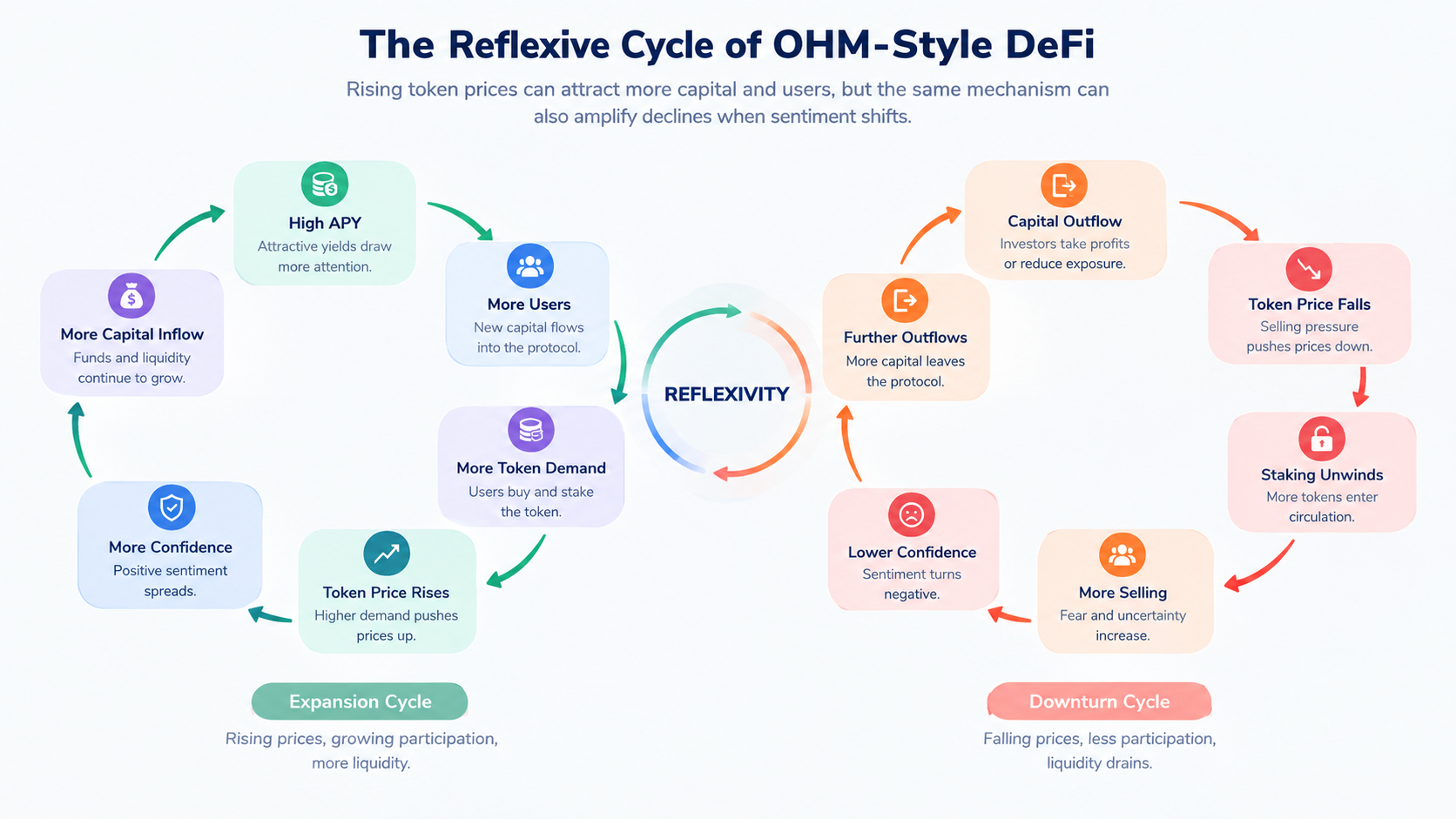
The OHM model’s biggest flaw is that high yields are commonly the result of token inflation, not real cash flow.
If staking rewards are paid out via new tokens, stakers get more tokens but the protocol doesn’t acquire matching new assets. Without sufficient buy-side demand, swelling token supply leads to price pressure.
Reflexivity is the second issue. Rising token prices fuel confidence and attract buyers/stakers, which pushes prices up further. If sentiment reverses, users unstake and bonds vest, triggering mass sales and accelerating price drops.
Third, reserve assets can disconnect from market prices. Assets may quickly depreciate or include LP tokens with thin liquidity. Stated reserves don’t guarantee redemption at market value during stress events.
Fourth, “high APY” can mask true sources of value. Greater yields usually mean faster supply inflation. If returns are merely new tokens—rather than profits or real cash flows—APY does not denote sustainability.
Fifth, governance risks loom. Bond pricing, reward parameters, reserve usage, and token supply may be controlled by few individuals. Lack of transparency impedes users’ ability to accurately assess protocol risk.
OHM model’s shortcomings do not invalidate protocol-owned liquidity or bond mechanisms—rather, they show unsustainable reliance on high yields and token narratives.
What Is The Standard Reserve Trying to Improve
The Standard Reserve’s revival follows a new DeFi wave aiming to repair past models.
First, lowering dependency on high APY. Rather than pulling funds via extreme issuance, newer projects focus on reserve asset quality, actual revenue, and sustainable policy.
Second, enhancing supply management. Protocols seek stricter caps, dynamic emission controls, buyback/burn, and transparent income distribution to avert runaway supply growth.
Third, advancing balance sheet transparency. Users need full visibility into reserve assets, composition, liquidity, volatility, unvested bonds, and future liabilities.
Fourth, bonds are now tied to productive assets—not just speculative tokens but stablecoins, liquidity, fees, or verifiable income.
Fifth, reimagining token utility. If tokens only support staking and governance, demand is speculation-driven; by adding fee sharing, risk coverage, and service access, usage stabilizes. Yet income distribution introduces regulatory complexity.
Success depends on results post-launch—reserve growth, token supply, real income, and stress test performance, not just whitepaper promises.
True Value of These DeFi Mechanisms
The lasting value of OHM-style systems is not high APY, but posing three critical DeFi design questions:
First, can protocols own their own liquidity? Persistent reliance on rented liquidity makes withdrawal risk acute. POL boosts control—but protocols must absorb asset volatility.
Second, can tokens become protocol assets meeting real demand? Minting and staking alone cannot confer lasting value. Tokens should connect to fees, services, collateral, governance, or risk sharing for enduring demand.
Third, can protocols manage their balance sheets? Traditional DeFi targets TVL and trade volume; reserve protocols must factor asset mix, duration, liquidity, liabilities, and stress scenarios—ushering in conventional risk management.
The Standard Reserve’s value lies in exploring how protocols accumulate capital, manage liquidity, and craft monetary frameworks—not in replicating an “on-chain central bank.”
Risks to Consider Before Participating
First, reserve asset risk. Investigate reserve assets—are they volatile, illiquid, or protocol-issued tokens? Over-reliance on own assets inflates risk.
Second, supply expansion risk. Scrutinize actual annual emissions, origins of staking rewards, bond vesting timelines, and fully diluted supply, not just current circulation.
Third, liquidity risk. Holding LP assets doesn’t guarantee sales at intended prices during turmoil. Inadequate trading depth can cause severe slippage.
Fourth, contract and governance risks. Examine upgrade permissions, admin controls, oracles, addresses, multisig requirements, and audit reports. Audits mitigate technical risks but don’t ensure economic sustainability.
Fifth, reflexive price risk. Price appreciation can stem from new inflows and leverage rather than income. When inflows slow, prices and staking rates may fall in tandem.
Sixth, regulatory risk. Income distribution, buybacks, or investment contract attributes may trigger different regulatory interpretations depending on jurisdiction.
Summary
The Standard Reserve’s resurgence marks DeFi’s return to a fundamental debate: Can protocols use code to own assets, manage liquidity, and issue native tokens with persistent value?
OHM models brought “protocol-owned liquidity” and “on-chain central banks” into the spotlight, but high emissions, reflexivity, and scarce actual income revealed the fragility of such designs. New experiments like The Standard Reserve focus on building more resilient links among reserves, bonds, supply, and governance.
Evaluating these projects means looking beyond high yields and big reserves—what matters is whether the protocol genuinely secures external assets and lasting cash flow. Sustainable reserves tie token issuance to real income, asset growth, or specific protocol utility; only then does the mechanism transition from pure narrative to a viable economic model.
FAQ
Is The Standard Reserve a stablecoin project?
Not necessarily. It’s more an experiment in reserve management and token issuance. Unless there is a formal fixed-price redemption commitment, it should not be treated as a stablecoin.
What is OHM-style DeFi?
OHM-style DeFi refers to protocol designs inspired by OlympusDAO, with protocol-owned liquidity, bond issuance, staking rewards, and reserve asset management as key features.
How does the bond mechanism work?
Users submit stablecoins, LP tokens, or other assets; the protocol issues its own tokens at a discounted price, released gradually over time. Discounts do not guarantee risk-free returns since token prices can decline during vesting.
What are the advantages of protocol-owned liquidity?
Protocol-owned liquidity reduces reliance on short-term liquidity mining and enables long-term control of trading pool liquidity. However, protocols must absorb price volatility, impermanent loss, and redemption risk.
Does high APY mean higher returns?
No. High APY is usually a result of token inflation. If new supply isn’t matched by external demand and asset growth, returns are offset by falling token prices.
How to assess the reliability of protocol reserves?
Review asset types, price stability, on-chain addresses, depth of liquidity, audit reports, administrative privileges, and fully diluted token supply. If reserves largely consist of the project’s own tokens, exercise caution.
Can The Standard Reserve avoid OHM’s pitfalls?
Avoidance depends on real-world parameters, reserve asset quality, income sources, and performance under stress. The mechanism itself is not a guarantee—ongoing on-chain validation is essential.