Short-Term Prediction Markets Face New Design Challenges
(Image source: Settlement Manipulation in Prediction Markets)
Prediction markets have become an increasingly popular application within the digital asset ecosystem, allowing users to trade contracts based on the outcome of future events. From cryptocurrency price movements to major global events, these platforms aim to provide market-based forecasts through collective participation.
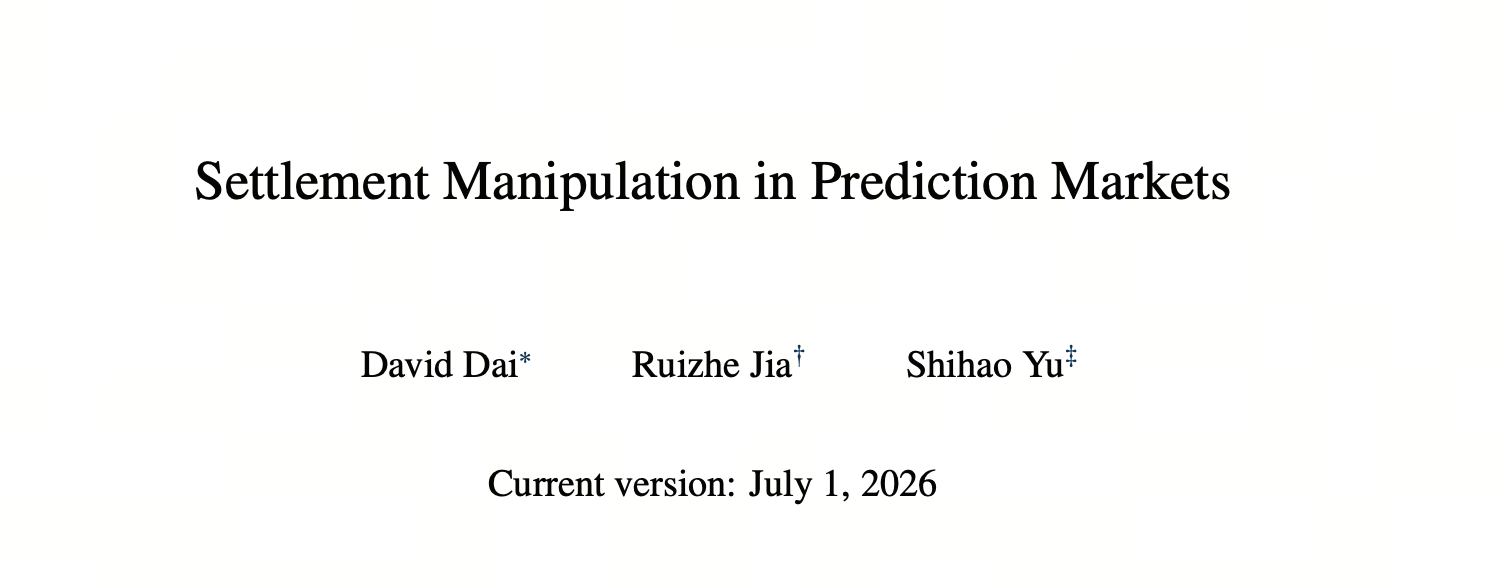
However, a recent study from researchers at Stanford University and Singapore Management University suggests that the design of short-duration prediction markets may introduce new risks.
The research focused on five-minute Bitcoin prediction contracts on Polymarket and found that the short settlement period may create opportunities for certain traders to influence market prices immediately before contracts expire.
The study does not suggest that prediction markets are fundamentally flawed. Instead, it highlights how contract structures, settlement mechanisms, and pricing methods can affect market integrity.
Five-Minute Bitcoin Contracts Create Settlement Incentives
The researchers analyzed prediction contracts that allow traders to bet whether Bitcoin’s price will finish above or below a specific level after a five-minute period.
These contracts rely on Chainlink price feeds to determine settlement outcomes based on Bitcoin’s market price at the end of each trading window.
Because the final price determines whether traders receive a payout, participants may have an incentive to influence Bitcoin’s spot price shortly before settlement. According to the research, this creates a situation where traders with sufficient market influence could potentially benefit by affecting the outcome of a contract.
The concern is particularly relevant for short-duration markets because even temporary price movements near the settlement point can determine the final result.
Research Identifies Unusual Price Activity Before Settlement
To investigate the issue, researchers compared Bitcoin market activity before and after Polymarket introduced five-minute Bitcoin prediction contracts in July 2024.
The analysis identified noticeable increases in Bitcoin spot-market order activity shortly before contract settlement. Following these movements, prices often reversed quickly after the settlement period ended.
Researchers stated that this pattern was consistent with potential settlement-price manipulation behavior.
During the study period, the estimated impact resulted in approximately $1.28 million being transferred from ordinary traders to participants engaging in the manipulation behavior.
The researchers also found that extending contract durations from five minutes to 15 minutes significantly reduced the observed effects.
Longer Settlement Windows Could Reduce Market Manipulation Risk
The study emphasized that prediction markets themselves are not necessarily vulnerable to manipulation. Instead, the researchers argued that better market design could reduce potential risks.
One possible solution is extending settlement periods to reduce the ability of individual traders to influence short-term price movements. Another approach involves alternative pricing methods, such as using time-weighted average prices instead of relying on a single point-in-time price.
These mechanisms could make prediction markets more resilient by reducing the impact of temporary price fluctuations around settlement times.
As prediction markets continue developing, settlement design is likely to become an important factor in determining how these platforms operate.
Prediction Markets Expand Beyond Crypto Applications
The implications of the research may extend beyond cryptocurrency markets.
The paper noted that traditional financial exchanges, including Nasdaq and Cboe, have explored event-based contracts linked to asset prices. As prediction markets become more integrated into regulated financial environments, contract design and settlement methods may become increasingly important considerations.
The findings suggest that market infrastructure, rather than simply market participation, plays a critical role in ensuring fair outcomes.
Prediction Market Activity Grows Alongside Global Events
Despite concerns surrounding market design, prediction markets have continued experiencing rapid growth.
Trading activity increased significantly in June as the expanded 2026 FIFA World Cup attracted greater attention from users. According to market data, Kalshi processed approximately $9.4 billion in trading volume during the month, while Polymarket International recorded around $4.3 billion.
World Cup-related prediction markets also generated substantial activity, with combined trading volume exceeding $5.4 billion across the two platforms.
The growth demonstrates increasing interest in event-based financial markets, but it has also attracted greater regulatory attention.
Regulatory Debate Surrounds Future of Prediction Markets
Alongside rising adoption, prediction market platforms have faced legal challenges in the United States.
Several states have questioned the operation of companies such as Kalshi and Polymarket, while the Commodity Futures Trading Commission (CFTC) has argued that federally regulated event contracts fall under its authority rather than state gambling regulations.
The issue is currently being addressed through federal court proceedings. Some legal observers believe that differing interpretations between courts could eventually lead the US Supreme Court to clarify whether states or federal regulators hold primary authority over prediction markets.
Conclusion
The Stanford study highlights an important consideration for the future development of prediction markets: the structure of financial contracts can directly influence market behavior.
While short-term Bitcoin prediction markets provide users with new ways to engage with crypto markets, extremely narrow settlement windows may create incentives for price manipulation. Adjustments such as longer settlement periods and improved pricing mechanisms could help strengthen market fairness.
As prediction markets continue expanding into both crypto and traditional finance, effective market design will become essential for building sustainable and trustworthy platforms.