For US users, Gate Spot Trading provides a spot trading interface where eligible users can select a trading pair, choose an order type, enter the amount, and submit a trade. Understanding how spot markets, order types, and trading fees work can help beginners navigate their first crypto trade with greater confidence.
Key Takeaways
- Gate Spot Trading allows users to buy and sell supported cryptocurrencies without leverage.
- A trading pair, such as BTC/USDT, represents the two assets being exchanged.
- Gate supports market and limit orders for spot trading.
- Market orders prioritize immediate execution, while limit orders execute only at the specified price or better.
- Trading fees vary according to the applicable maker or taker rate.
- Crypto prices can fluctuate significantly, so spot trading still involves the risk of loss even without leverage.
What Is Crypto Spot Trading?
Crypto spot trading is the buying or selling of digital assets at prices available in the spot market, giving direct ownership of the actual asset. When an order is matched, the corresponding assets are delivered with immediate settlement or immediate delivery, typically instantly in crypto or within two business days, and credited to the user’s spot account balance or exchange wallet. Unlike futures or margin trading, spot trading does not require additional margin or leverage.
A spot market consists of buyers and sellers submitting orders to an order book. When a buy order matches a compatible sell order, the trade is executed. For example, in the BTC/USDT trading pair, users can exchange USDT for BTC or BTC for USDT based on available market prices.
For beginners, spot trading can provide a relatively direct way to gain exposure to crypto assets because the trade involves the underlying asset rather than a leveraged contract. By contrast, futures trading involves contracts without owning the asset, while a spot position has no expiration date.
How Does Gate Spot Trading Work?
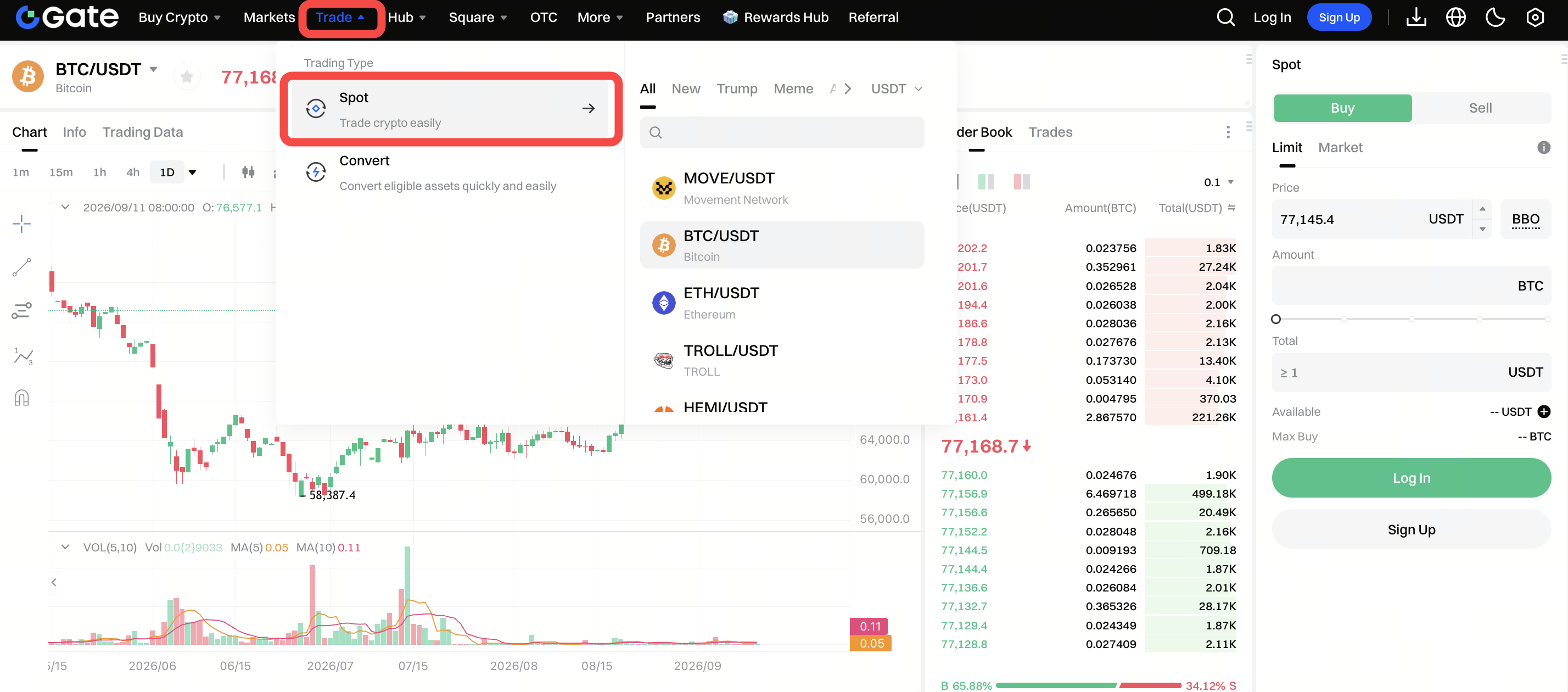
A typical Gate Spot Trading transaction follows a few basic steps:
- Choose a trading pair.
- Select an order type.
- Enter the price and amount, if applicable.
- Review the order details.
- Submit the order.
- Wait for the order to be executed.
- Check the resulting balance in the Spot Account.
Once a trade is matched, the platform’s order matching process completes trade execution and updates the user’s balance with the purchased asset or remaining quote currency.
The exact execution process depends on whether the order is a market order or a limit order, as well as the current price, available price levels, and real time market data on the crypto exchange.
What Are Crypto Trading Pairs?
A trading pair shows the two assets involved in a transaction. Common examples include BTC/USDT, ETH/USDT, and BTC/USDC.
The first asset is the base asset, while the second is the quote asset. In BTC/USDT, BTC is the base asset and USDT is the quote asset. The pair therefore shows how much USDT is required to buy one unit of BTC at the quoted price, and major platforms typically list several cryptocurrency pairs for spot trading.
For example, if BTC/USDT is quoted at 100,000, it means one BTC is currently priced at approximately 100,000 USDT. The actual execution price can differ depending on the order type, available liquidity, and market conditions.
US users who first need to acquire a stablecoin can also buy USDT with USD before using it for eligible spot trades.
What Is a Market Order?
A market order instructs Gate to execute a trade at the best available prices in the order book. It is generally used when immediate execution is more important than obtaining a specific price, and speed matters in fast-moving crypto markets because market orders prioritize execution over exact pricing.
For example, if a user wants to buy BTC immediately, a market buy order will match available sell orders starting from the best available price until the requested amount is filled.
Because market orders interact with available liquidity, the final execution price may differ slightly from the price displayed when the order is submitted, particularly in less liquid markets.
What Is a Limit Order?
A limit order allows users to specify the price at which they want to buy or sell an asset. The order is added to the order book and executes only when a matching market price becomes available.
For example, if BTC is trading at $100,000 and a user places a limit buy order at $98,000, the order will remain open until the market reaches a price that can execute the order or the user cancels it.
Limit orders can provide greater control over execution price, but they do not guarantee that the trade will be completed.
Market Order vs. Limit Order
Beginners should understand the difference before placing their first Gate Spot Trading order. Choosing an order type depends on whether the priority is immediate execution or control over the execution price.
How to Spot Trade Crypto on Gate US
The basic Gate Spot Trading process on Gate US is straightforward.
Step 1: Log In to Your Gate US Account
Log in to your Gate US account as your exchange account and open Trade from the top navigation bar. The Spot Trading interface provides access to supported trading pairs and order placement tools, with the trading interface on the crypto exchange also showing real time market data for those pairs.
Users who do not yet have an account can sign up for Gate US.
Step 2: Select a Trading Pair
Choose the crypto trading pair you want to trade, such as BTC/USDT or ETH/USDT.
Before placing an order, check the quoted price, available liquidity, and the assets in your account. The available trading pairs may vary based on the Gate US services available to the user.
If you need to fund your account first, you can transfer fiat currency, including local currencies where supported, into the platform before using USD to acquire another major cryptocurrency. For example, you can buy USDC with USD or buy Ethereum with USD.
Step 3: Choose Buy or Sell
On the Gate Spot Trading page, select whether you want to Buy or Sell the selected cryptocurrency.
For a BTC/USDT pair:
- Buy BTC: Exchange USDT for BTC.
- Sell BTC: Exchange BTC for USDT.
In spot trading, you can only sell assets you already hold in your spot account.
The amount available for trading depends on your current spot account balance.
Step 4: Select an Order Type
Choose either a Market Order or Limit Order, depending on how you want the trade to execute.
With a market order, enter the amount you want to trade and submit the order for execution at available market prices.
With a limit order, enter both the desired price and trading amount. The order will remain open until it is filled or canceled.
Step 5: Review and Submit the Order
Before confirming the trade, review the trading pair, order type, price, amount, estimated transaction cost, and the exchange’s fee structure.
Once the details are correct, submit the order, since understanding them helps you make informed decisions before submission. A market order may be filled immediately, while a limit order can remain open in the order book until its conditions are met.
Step 6: Check Your Spot Account
After the order is executed, the purchased cryptocurrency or remaining quote asset will be reflected in your Spot Account.
You can check the order status from the trading interface and review your updated balance under Assets → Spot Account.
What Should Beginners Consider Before Spot Trading?
Spot trading does not use leverage, but it is still exposed to cryptocurrency market risk. The value of an asset can rise or fall after a trade is completed, and crypto price movements are also influenced by market sentiment, potentially resulting in a loss.
Beginners should consider several factors before placing an order. In spot trading, your maximum loss is limited to the amount invested, so you cannot lose more than your initial investment. Risk management should focus on capital preservation rather than quick gains.
Understand the Trading Pair
Make sure you understand which asset you are buying and which asset you are using to pay for it. A BTC/USDT trade and a BTC/USDC trade involve different quote assets even though both can be used to purchase BTC.
Check Market Liquidity
Liquidity affects how easily an order can be executed at or near the displayed market price. More liquid trading pairs generally have greater order-book depth, and traders often use trading volume to judge whether a price move has real backing, while less liquid pairs may experience larger price differences between orders.
Choose the Appropriate Order Type
Market orders can prioritize execution speed, while limit orders provide more control over the execution price. Beginners should understand the trade-off between these two approaches before submitting an order.
Consider Trading Fees
Trading fees reduce the net value of a completed trade. Frequent trading can result in cumulative fees, so users should understand the applicable maker and taker rates before trading.
Manage Account Security
Users should enable available account security features, such as two-factor authentication (2FA), and protect their login credentials, since security risks can also include exchange hacks. Account security is separate from market risk and remains important when using any crypto trading platform.
Spot Trading vs. Other Crypto Trading Methods
Spot trading is only one way to interact with the crypto market.
Spot trading involves buying or selling the underlying crypto asset without leverage, giving you direct ownership rather than exposure through a contract. Margin and derivatives trading, by contrast, can involve borrowed funds or contracts instead of the coin itself, so the position may not represent real assets and is often grouped with leveraged products.
For beginners, Gate Spot Trading may be easier to understand because the transaction directly exchanges one asset for another. However, the appropriate trading method depends on the user’s objectives, experience, and risk tolerance.
US users who are still deciding how to purchase crypto can compare different crypto payment methods, fees, and steps in the US before choosing how to fund their account.
FAQ
What is spot trading in crypto?
Spot trading is the buying or selling of a cryptocurrency at the spot price for immediate settlement, with direct ownership of the actual asset credited to the user’s spot account after execution.
Can I spot trade without leverage?
Yes. Spot trading does not require leverage or additional margin. Users trade using the assets available in their account.
What is the difference between a market order and a limit order?
A market order prioritizes immediate execution at available market prices, while a limit order executes only when the market reaches the specified price or better.
Can a limit order fail to execute?
Yes. A limit order is not guaranteed to execute. If the market does not reach the specified price, the order may remain open until it is canceled or otherwise expires according to the platform’s rules.
Are spot trading fees charged on Gate US?
Yes. Applicable Gate Spot Trading fees depend on the user’s fee tier and whether the executed order is classified as maker or taker.
How do I start spot trading on Gate US?
Create and verify an eligible Gate US account, fund your account with supported assets, open Trade → Spot, select a trading pair, choose an order type, enter the required details, and submit the order.