In crypto, almost every project attempts to prove that it has a purpose: a roadmap, technological breakthroughs, and ecosystem partnerships. USELESS takes the exact opposite approach. This Solana-based meme asset openly declares itself "useless." Its whitepaper is deliberately satirical, while its roadmap is titled "Our Journey to Nowhere." Its official website invites users to click "Launch App," but the page simply loads indefinitely. This is not a technical malfunction; it is a deliberate expression of the project’s positioning.
In May 2025, USELESS launched fairly through BONKfun within the Solana ecosystem, with all 1 billion tokens released at launch and no team allocation, presale, or lockup. This minimalist launch structure, combined with its "anti-roadmap" branding, helped establish a distinctive identity within the meme community. The project’s tokenomics include an 8% transaction fee: 4% is allocated to holders and burn wallets, creating a deflationary effect, while another 4% is directed to liquidity pools. For an asset that openly describes itself as "useless," the existence of such a mechanism is itself a form of meta-level irony.

From the Margins to the Mainstream: Exchange Listings and Price Trajectory
USELESS began attracting broader market attention through a series of centralized exchange listings. Each listing announcement was accompanied by a notable market response.
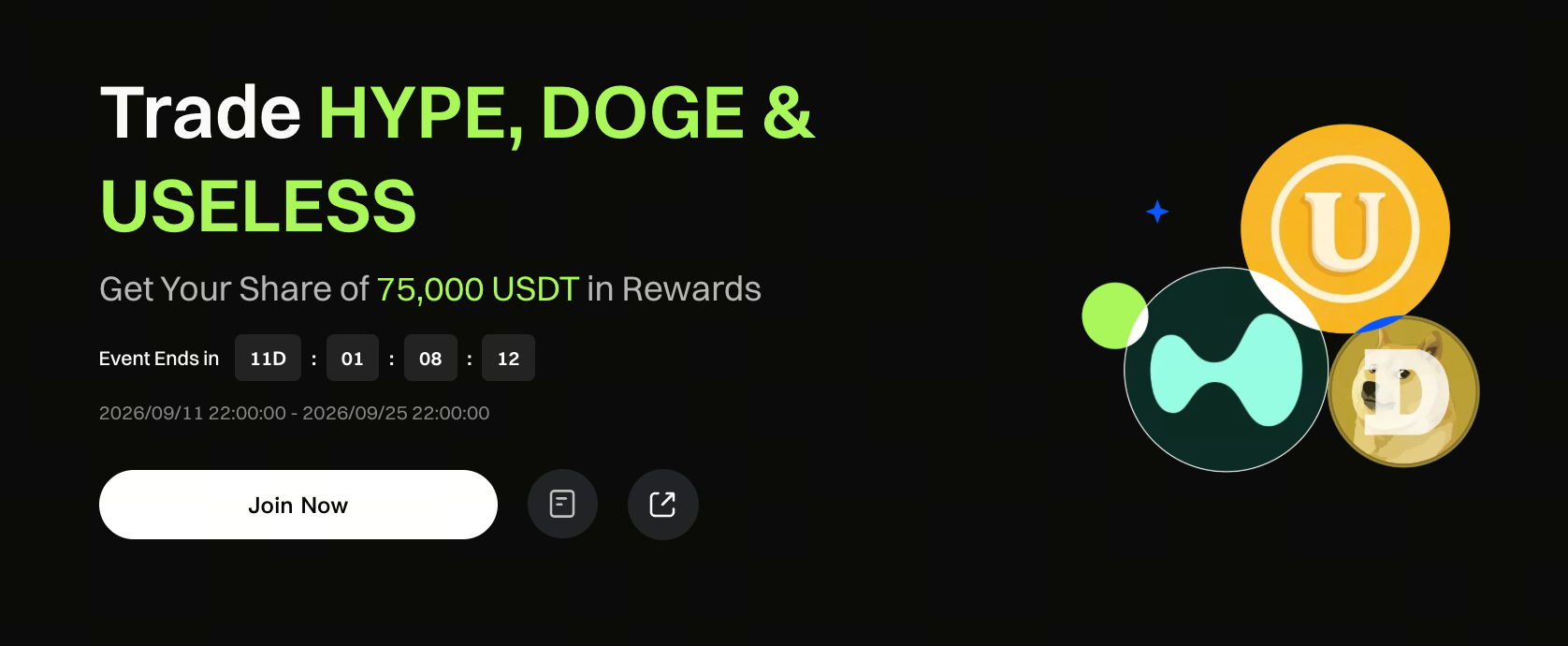
The expansion of the exchange ecosystem is reflected not only in spot listings but also in the structure of trading incentive campaigns . From 14:00 UTC on September 11, 2026, through 10:00 ET on September 25, Gate is running a trading campaign covering three popular assets—HYPE, DOGE, and USELESS—with total rewards of up to 75,000 USDT in Token Vouchers distributed on a first-come, first-served basis.
Source: Gate
The campaign consists of three reward tiers. The first-trade reward is available to users who complete a qualifying spot trade of at least 50 USDT in HYPE/USDT, DOGE/USDT, or USELESS/USDT during the campaign period. Eligible participants can receive a 10 USDT Token Voucher , limited to the first 1,000 participants.
The popular-token trading-day challenge requires users to reach at least 100 USDT in qualifying daily spot trading volume for 3, 5, or 7 days during the campaign period. The corresponding rewards are 15 USDT, 30 USDT, and 50 USDT in Token Vouchers. The qualifying days do not need to be consecutive. This tier has a 20,000 USDT reward pool, and each participant can claim only the highest reward tier they qualify for.
The popular-token trading-volume challenge is based on cumulative spot trading volume during the campaign period. Users who reach 5,000 USDT, 20,000 USDT, 50,000 USDT, 100,000 USDT, or 500,000 USDT in cumulative volume can receive 10 USDT, 30 USDT, 50 USDT, 100 USDT, or 300 USDT , respectively. This tier has a 45,000 USDT reward pool.
Participants must complete KYC verification and click "Join Now" on the campaign page to register. Trading volume is calculated as the combined value of buys and sells, and rewards will be distributed as Token Vouchers within 14 business days after the campaign ends. By covering first trades, trading frequency, and higher cumulative volumes, the campaign targets users across different participation levels and also illustrates how exchanges can actively support liquidity and engagement for highly volatile meme assets.
According to Gate market data, USELESS was trading at approximately $0.19656 on September 14, 2026, down approximately 10.95% over the previous 24 hours, with a market capitalization of around $206 million . Its 24-hour trading volume was approximately $2.6672 million , while total supply stood at 1 billion tokens . The market sentiment indicator was neutral.
Over a longer time horizon, USELESS had gained approximately 408.97% over the previous 30 days and approximately 159.65% over the previous 90 days, while remaining down approximately 23.33% over the previous year.
These figures outline a familiar pattern among meme assets: extremely strong short-term upside momentum can coexist with equally sharp drawdowns. On September 9, USELESS reached a high in the $0.335–$0.336 range before falling back toward $0.20–$0.22 within two days. Volatility of this magnitude is not unusual in the meme-asset sector, but it needs to be considered alongside market liquidity. When trading volume contracts from several hundred million dollars at its peak, the underlying liquidity supporting the price can become comparatively thinner.
Whale Concentration and Narrative Dependence: Two Sources of Risk
Understanding USELESS’s risk profile requires looking at two dimensions: token distribution and narrative structure.
From the perspective of token distribution, technical analysis indicates that whale wallets control nearly 47% of the token value . Such concentration means that position adjustments by a relatively small number of addresses could have an outsized effect on market prices. At the same time, nearly 100% of USELESS is in circulation, with almost the entire maximum supply of 1 billion tokens already circulating.
This removes the traditional tokenomics risk associated with scheduled unlock dilution, but it does not eliminate the possibility of concentrated selling. Instead, the risk shifts from dilution over time toward concentration in holder behavior .
From a narrative perspective, USELESS’s value proposition depends heavily on community consensus, social media attention, and visibility generated by exchange listings. The project does not have product development, protocol revenue, governance functionality, or a staking mechanism. Its "fundamentals" are, in effect, the deliberate rejection of conventional fundamentals.
This structure has one notable advantage: its narrative is difficult to invalidate using conventional project milestones. Without a roadmap, there are fewer unfulfilled roadmap promises; without specific product targets, there is no conventional product-failure benchmark. The trade-off is equally clear. When social attention fades and incremental capital from exchange listings diminishes, the asset has limited intrinsic anchors to support its market valuation.
Conclusion
USELESS offers a market example worth examining seriously: within the current crypto market structure, rejecting a conventional value proposition can itself become a tradable value proposition .
The model depends heavily on a continuous supply of attention—from the community, exchanges, and broader interest in meme assets. When those external conditions change, the magnitude of a potential price adjustment can be substantial, potentially mirroring the scale of the preceding rally.
For users following USELESS, several observable indicators are worth monitoring: changes in whale wallet holdings through on-chain data, the direction of trading volume, and the overall market-cap share of the meme-asset sector. Declining volume can indicate reduced liquidity depth, while changes in whale holdings may provide additional context for market concentration.
These indicators cannot predict future prices, but they can help assess whether the current market structure is becoming more resilient or more fragile. For an asset driven primarily by narrative, market structure may ultimately be more informative than the narrative itself .
FAQ
What type of crypto asset is USELESS?
USELESS is a Solana-based meme asset that launched fairly through BONKfun in May 2025. It is publicly positioned as a "useless" token with no governance, staking, or conventional product roadmap. Its market value primarily depends on community consensus, market attention, and trading demand.
What are USELESS’s current price and market capitalization?
According to Gate market data, as of September 14, 2026, USELESS was trading at approximately $0.19656 , with a market capitalization of around $206 million and 24-hour trading volume of approximately $2.6672 million . Total supply is 1 billion tokens, and the market sentiment indicator was neutral.
Why has USELESS gained so much over the past month?
USELESS gained approximately 408.97% over the previous 30 days. The move has been associated with factors including exchange-listing expectations, broader meme-market momentum, and increased speculative trading activity. The launch of the KRW trading pair on Bithumb, community speculation about a potential OKX listing, and technical price breakouts have also contributed to short-term market attention.
What rewards are included in Gate’s HYPE, DOGE, and USELESS trading campaign ?
The campaign runs from September 11 through September 25, 2026, with total rewards of up to 75,000 USDT in Token Vouchers. Eligible users who complete a first qualifying spot trade of at least 50 USDT can receive a 10 USDT Token Voucher, limited to the first 1,000 participants. Users who meet the 100 USDT daily trading-volume requirement on 3, 5, or 7 qualifying days can receive 15 USDT, 30 USDT, or 50 USDT , respectively. Cumulative spot trading volume between 5,000 USDT and 500,000 USDT can qualify users for rewards ranging from 10 USDT to 300 USDT . Rewards are distributed on a first-come, first-served basis, and users must complete KYC and click " Join Now " to register.
What are the main risks of holding USELESS?
Key risks include relatively high whale concentration, with technical analysis indicating that whales control approximately 47% of token value , as well as strong dependence on market attention and social narratives. The asset has limited conventional sources of intrinsic value, meaning its market valuation can be particularly sensitive to changes in sentiment, liquidity, trading activity, and meme-sector momentum.