In the decentralized derivatives trading sector, Hyperliquid is difficult to classify in simple terms. It is neither a general-purpose blockchain nor an application protocol that relies on an external settlement layer. Instead, it operates its own on-chain order book and liquidation system, while directing nearly all platform trading fees toward purchasing and burning its native token, HYPE, on the secondary market. This mechanism gives HYPE a fundamentally different value proposition from traditional "governance tokens": it more closely resembles an asset whose economics are directly linked to the platform’s cash flow.
In September 2026, the Hyperliquid ecosystem entered a notable new phase. On one hand, the permissioned-market expansion of the HIP-3 framework went live on testnet, providing an option for institutional participants seeking a more compliance-oriented access model. On the other hand, after HYPE approached an all-time high near $88, the token entered a consolidation phase. On-chain burns have continued, but the burn rate has been diluted by the higher token price. The relationship between ecosystem expansion and token value capture is therefore undergoing a subtle but important shift.
This article examines HYPE’s current value proposition across four dimensions: price conditions, the token-burn mechanism, HIP-3 expansion, and the structure of on-chain activity. It also identifies the key variables worth monitoring going forward.
Current Price: Bull-Bear Tension Behind the High-Level Consolidation
As of September 14, 2026, Gate market data shows HYPE trading at $80.42, up 3.88% over the past 24 hours, with a market capitalization of approximately $17.789 billion, ranking 14th across the broader crypto market. Its 24-hour trading volume was approximately $17.991 million, while the market sentiment indicator was neutral.
From a time-horizon perspective, HYPE’s price structure shows a clear "short-term weakness, long-term strength" pattern. The token is down 5.75% over the past seven days, up 41.04% over the past 30 days, up 9.04% over the past 90 days, and up 49.61% over the past year. This distribution suggests that HYPE experienced a rapid rally from late August into early September, driven by a combination of ecosystem catalysts, including cumulative HIP-3 trading volume surpassing $319 billion, expansion of RWA perpetual futures markets, and the implementation of a stablecoin yield distribution mechanism. The token subsequently entered a technical correction.
Key support and resistance zones are relatively well defined. On-chain and technical analysis generally place short-term structural support around $78. A sustained break below this level could expose the token to a deeper pullback toward the $73–$75 range. On the upside, the $88–$90 area represents the primary resistance zone, and a breakout would likely require a new incremental catalyst. With HYPE currently trading in the middle of this range, the next directional move remains unresolved.
Burn Mechanism: A Real but Increasingly Diluted Deflationary Engine
The core of HYPE’s value proposition lies in how its Assistance Fund operates. Hyperliquid directs approximately 97% to 99% of the net fees generated by platform perpetual futures trading toward continuously purchasing HYPE on the open market. The purchased tokens are then sent to addresses designated by validators as burn addresses, permanently removing them from circulation. The process is executed through on-chain logic without manual intervention, creating a mechanical link between platform trading activity and HYPE’s circulating supply.
As of mid-September 2026, approximately 48.6 million HYPE had been burned in total. At the current price, this represents roughly $3.8 billion in value and approximately 4.86% of the 1 billion maximum supply. In the 24 hours leading up to September 14 alone, the protocol repurchased and burned approximately 177,100 HYPE at a weighted average price of $78.37, representing roughly $1.39 million in total value.
However, the mechanism has a structural characteristic that is easy to overlook: the burn is effectively anchored to a dollar amount rather than a fixed number of tokens. As the price of HYPE rises, each dollar of fees can repurchase fewer tokens. Some estimates suggest that at the current price level, $1 of fee expenditure removes only around 0.012 HYPE, compared with approximately 0.037 HYPE based on the protocol’s historical average repurchase price. In other words, a higher HYPE price itself reduces the deflationary intensity of the burn mechanism.
At the same time, the other side of the token supply equation has not stopped. Core contributor vesting unlocks continue, with approximately 9.92 million HYPE unlocked in early September 2026, worth around $820 million. Although historical data indicates that only a limited proportion of unlocked tokens has flowed into exchanges, continued supply releases combined with declining burn efficiency create an important dynamic tension within HYPE’s token economics.
HIP-3 Expansion: From "Fully Permissionless" to an "Optional Compliance Layer"
One of the most important structural changes currently taking place within the Hyperliquid ecosystem is the functional expansion of the HIP-3 framework. HIP-3 originally allowed independent deployers to create perpetual futures markets on HyperCore infrastructure. Deployers can determine the assets, price oracles, leverage limits, and open-interest parameters for their markets, but must stake 500,000 HYPE. By June 2026, cumulative trading volume across HIP-3 markets had surpassed $319 billion, accounting for approximately 37.5% of Hyperliquid’s total trading volume.
On September 3, 2026, co-founder Jeffrey Yan announced an expansion of HIP-3 that went live on testnet. The new functionality allows market deployers to maintain on-chain allowlists and determine which wallet addresses can participate in specific markets. This functionality is optional : deployers that want to maintain fully permissionless markets do not need to impose any wallet restrictions, while deployers targeting institutions, regulated brokers, or users in specific jurisdictions can apply identity-verification or access requirements at the market level.
The strategic significance of this change is that it does not alter the permissionless nature of the Hyperliquid protocol itself, but instead provides a lower-friction path for compliance-oriented access within the ecosystem. Separately, reports indicate that Payward, the parent company of Kraken, has been exploring with Hyperliquid Labs a potential route for U.S. traders to access certain Hyperliquid-related perpetual futures through Bitnomial, a CFTC-regulated designated contract market. If such a route ultimately receives regulatory approval, it could give HYPE access to a user segment that has previously been difficult to reach.
It is important to note that the 500,000 HYPE staking requirement for HIP-3 represents a significant capital commitment for ecosystem participants. While this design may help filter out lower-quality projects, it also means that HIP-3 market growth depends heavily on institutions or teams with sufficient capital and a long-term commitment to HYPE.
On-Chain Activity Structure: The Real Picture Behind Open Interest and Market Depth
Hyperliquid’s platform-wide open interest reached a historical high area of approximately $14.3 billion from late August to early September 2026. This figure is often interpreted as direct evidence of platform liquidity and market participation. However, a closer examination of its composition presents a more complicated picture.
Data from mid-September 2026 shows that HIP-3 builder markets contributed more than $3.6 billion in open interest, representing a significant share of the platform-wide total. Within this segment, a single market built by the core-affiliated entity Hyperunit accounted for more than 90% of builder open interest, equivalent to roughly one-third of total platform open interest. This concentration suggests that part of the increase in open interest is attributable to affiliated or controlled trading environments rather than entirely organic retail or institutional demand.
Looking at derivatives positioning, HYPE’s open-interest-weighted funding rate briefly turned negative after September 8 before returning to positive territory around September 12 at approximately 0.0012%. This indicates that longs regained a modest premium at the funding-rate level, although the overall rate remained well below late-August readings. The relatively moderate funding rate is consistent with the ongoing consolidation in HYPE’s price.
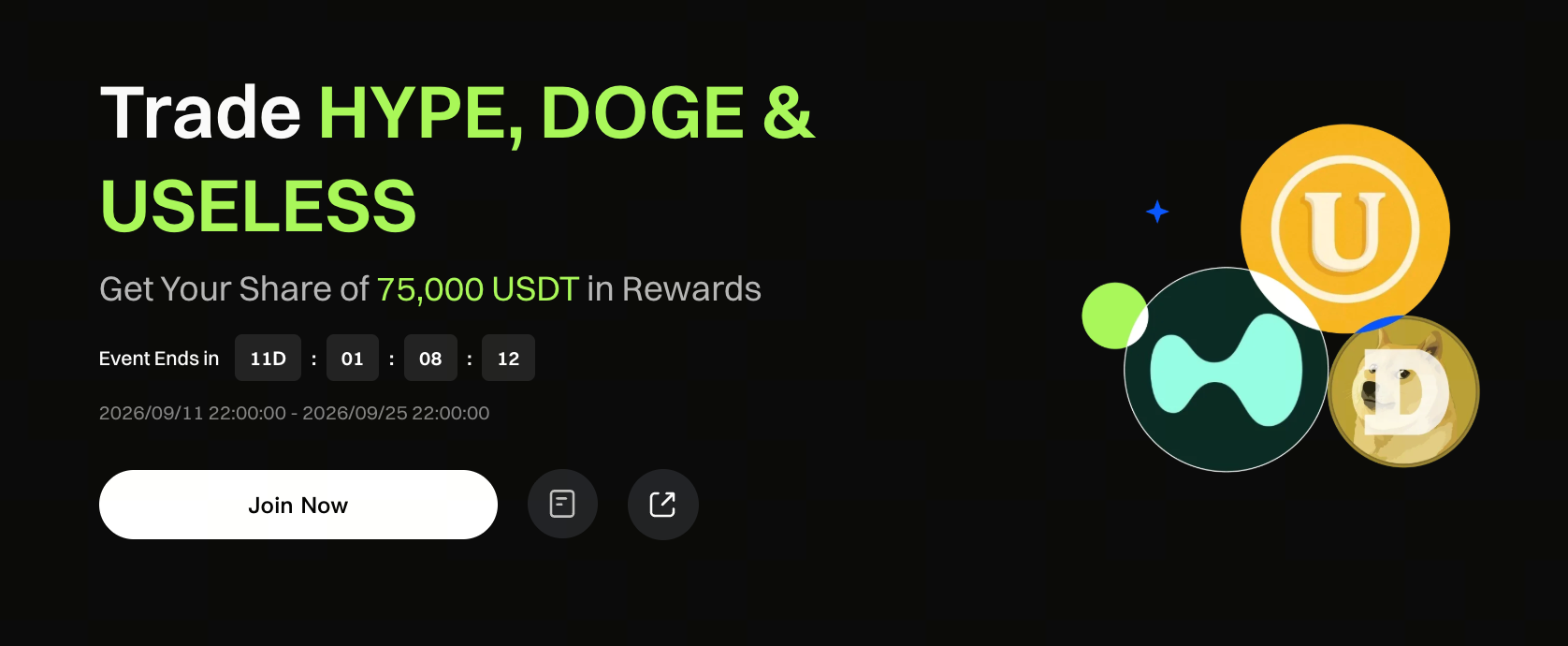
From an infrastructure perspective, spot support for popular assets such as HYPE across major trading platforms can also influence short-term trading activity. On September 11, 2026, at 14:00 UTC, Gate launched a spot trading campaign covering HYPE, DOGE, and USELESS, with a total reward pool of up to 75,000 USDT-equivalent token vouchers. The campaign runs through September 25, 2026, at 10:00 ET. The campaign features three reward tiers: users who complete a first spot trade of at least 50 USDT in HYPE/USDT, DOGE/USDT, or USELESS/USDT can receive a 10 USDT token voucher, limited to the first 1,000 eligible participants; users who reach at least 100 USDT in daily spot trading volume on 3, 5, or 7 different trading days during the campaign can receive 15, 30, or 50 USDT token vouchers, respectively; and users who reach different cumulative spot trading volume tiers between 5,000 and 500,000 USDT can receive 10 to 300 USDT token vouchers. Each tier is subject to limited availability and rewards are distributed on a first-come, first-served basis. Participants must complete KYC and click the " Join Now " button on the campaign page to register. Market makers, institutional accounts, and affiliated accounts are excluded from the campaign.
Source: Gate
Reassessing HYPE’s Value Proposition
Taken together, the factors above suggest that HYPE’s current value proposition can be summarized as follows: a functioning fee-funded token-burn engine is being reinforced by the incremental narrative of ecosystem expansion, while the token’s elevated price is simultaneously reducing the marginal deflationary impact of each dollar spent on burns.
The sustainability of the buyback-and-burn mechanism depends on two variables: the absolute scale of platform fees and the price of HYPE. Fee generation is determined in part by Hyperliquid’s share of the decentralized perpetual futures market, while the compliance-oriented expansion of HIP-3 and potential access to the U.S. market represent positive catalysts for this variable. The token price, meanwhile, has a self-limiting effect: a higher HYPE price means that each dollar of fees burns fewer tokens.
The launch of HIP-3’s expanded functionality does not directly alter HYPE’s supply-demand structure, but it could indirectly affect fee generation by expanding the addressable market that Hyperliquid can serve . Under favorable conditions, participation from institutions and regulated entities could generate more stable and sustainable trading activity rather than short-lived spikes driven primarily by temporary incentives.
Conclusion
Hyperliquid’s position in September 2026 can be described as a stage of "validated mechanics, ongoing expansion, and price consolidation." The on-chain execution of the buyback-and-burn mechanism is observable, while HIP-3’s extension into permissioned markets opens new possibilities for ecosystem expansion. At the same time, elevated token prices and continued supply unlocks mean that burn efficiency remains a variable that requires ongoing monitoring.
For readers following HYPE, the most informative indicators may not be short-term price movements, but rather the stability of platform fee revenue, the quality and diversity of new HIP-3 deployers, and the changing relationship between the burn rate and token unlock rate. These data points may provide a clearer picture of the underlying direction of HYPE’s value proposition than price alone.
FAQ
How does HYPE’s burn mechanism work?
Hyperliquid directs approximately 97% to 99% of the net fees generated by perpetual futures trading toward automatically purchasing HYPE on the secondary market. The tokens are then sent to burn addresses and permanently removed from circulation. The process is executed through on-chain logic and runs continuously. As of September 2026, approximately 48.6 million HYPE had been burned in total.
How does the expanded HIP-3 functionality differ from the original HIP-3?
The expanded HIP-3 functionality is an optional extension of the HIP-3 framework that allows market deployers to maintain on-chain allowlists and restrict participation in specific markets to designated wallet addresses. Original HIP-3 markets can remain fully permissionless, and deployers do not need to impose any restrictions. The functionality is currently on testnet and is expected to move to mainnet as part of a future upgrade.
What are the current support and resistance levels for HYPE?
Based on multiple technical-analysis sources, the area around $78 represents short-term structural support, while the $88–$90 range represents the primary resistance zone. If HYPE breaks below $78, the $73–$75 range may become the next area to monitor. If the token breaks above $90, the next potential range to watch would be approximately $95–$100.
Why is the concentration of Hyperliquid’s open interest worth monitoring?
As of September 2026, a significant portion of HIP-3 builder-market open interest was concentrated among affiliated entities, with a single entity-built market accounting for more than 90% of builder open interest. This means the overall open-interest figure needs to be interpreted alongside its underlying composition rather than treated as a direct proxy for organic market depth.
What are the key structural risks facing HYPE?
A key risk is that the deflationary efficiency of the burn mechanism declines as the token price rises, while token unlocks continue. If platform fee revenue fails to maintain or increase its current scale while HYPE remains at elevated price levels, the actual impact of burns on circulating supply could be lower than market expectations. Regulatory uncertainty is another long-term variable.
Does Gate currently have a trading campaign for HYPE?
Yes. Gate is running a HYPE, DOGE, and USELESS spot trading campaign from September 11 through September 25, 2026 (ET), with a total reward pool of up to 75,000 USDT-equivalent token vouchers. Users who complete a first qualifying trade of at least 50 USDT can receive a 10 USDT token voucher. Participants who meet the requirements on 3, 5, or 7 trading days can receive 15 to 50 USDT, while qualifying cumulative trading volumes can earn 10 to 300 USDT in token vouchers. KYC completion and registration by clicking " Join Now " are required.