In 2026, the narrative around combining AI and blockchain has moved beyond proof-of-concept discussions towards practical applications. As market attention shifts from general-purpose AI tokens to projects with specific use cases and defined token utility, Delysium and its ecosystem token AGI have returned to the spotlight following their recent market performance.
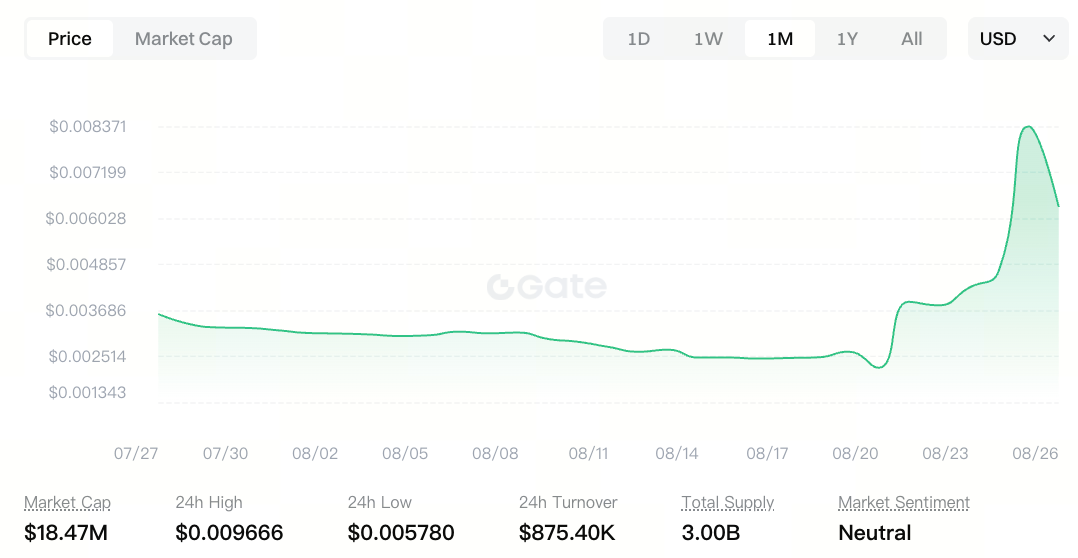
As of August 26, 2026, according to Gate market data, AGI is priced at $0.006501, up 9.80% over the past 24 hours, 157.17% over the past seven days, and 104.38% over the past 30 days. This price movement reflects market expectations surrounding the implementation of Delysium's 2026 roadmap and its AI agent economy narrative.
Source: Gate market data
Delysium's vision goes beyond simply launching an AI-focused token. The project aims to build a decentralised virtual world in which 1 billion humans and 100 billion AI-powered virtual beings can coexist. This article provides a structured analysis of AGI across four dimensions: tokenomics, technical architecture, governance mechanisms, and market performance.
Delysium's Project Positioning: The Operating Layer for an AI Agent Ecosystem
Delysium's core objective is to build a native economic operating system for AI agents. Within this ecosystem, AI agents are not merely digital representations of users; they can also function as autonomous virtual entities capable of participating in economic activities across different environments, including games, communities, and media platforms.
Unlike many AI-focused crypto projects that concentrate on a single functionality, Delysium is positioning itself as infrastructure for an "agent-native economy". Its 2026 roadmap points towards this broader objective: rather than being limited to individual product features, the project aims to develop an intelligent framework capable of understanding information, developing strategies, activating skills, and connecting with different parts of the ecosystem.
Lucy and the YKILY Network: A Dual-Core Architecture
The Delysium ecosystem is primarily supported by two core components:
Lucy: The Core Interface for the Agent Economy
Lucy is evolving from a standalone AI interface into a key coordination layer for the Delysium agent economy. According to the official roadmap, major Lucy developments planned for 2026 include a quantitative AI trading portal and an event-driven AI trading terminal.
The quantitative trading portal includes components such as the Idea-to-Strategy Engine, Strategy Tree Engine, Backtest Engine, and Dry-run Engine. These features allow users to transform market views expressed in natural language into strategy frameworks that can be backtested and simulated. This approach is designed to reduce the technical barriers associated with participating in on-chain quantitative trading. The event-driven trading terminal, meanwhile, combines the Global News Aggregator with the News-to-Strategy Engine to transform global market information into strategy-oriented context.
YKILY Network: A Decentralised Agent Network
The YKILY Network serves as Delysium's decentralised AI agent infrastructure layer and is designed to connect different products across the ecosystem. According to the roadmap, the YKILY Network is expected to upgrade more than 3,000 MCP servers into OpenClaw Skills in 2026 and connect them with various OpenClaw ecosystem products. The initiative is intended to improve interoperability between agents and provide technical infrastructure for cross-platform agent-based economic activity.
AGI Tokenomics: Circulation and Supply
AGI is the native utility token of the Delysium ecosystem, with a total supply of 3 billion tokens. According to CoinGecko data, approximately 2.588 billion AGI are currently in circulation, with a circulating market capitalisation of approximately $18.4735 million and a fully diluted valuation (FDV) of approximately $19.503 million.
In terms of token allocation, the ecosystem Treasury holds approximately 344 million AGI, which is not currently included in the circulating supply. Approximately 86.27% of the total supply is therefore in circulation. It is important to note the difference between market capitalisation and FDV, as the gradual release of Treasury-held tokens could potentially affect secondary-market supply and demand over time.
Governance Mechanism: A Community-Driven Decision Framework
In September 2025, Delysium published a preview of its community governance rules, establishing AGI as a key component of ecosystem governance. The main governance parameters include:
Submitting a proposal requires staking 10,000 AGI, while first-round voting requires a minimum stake of 250 AGI. A proposal can pass after receiving cumulative support of 100,000 AGI in votes. The total reward pool is 10,000 AGI, intended to incentivise both proposal creators and participating community members. Users holding DMA NFTs can receive additional voting weight and enhanced reward allocations.
This framework connects on-chain governance with the development of the AI agent ecosystem and gives AGI holders defined governance rights rather than purely symbolic voting participation.
Market Performance Review: What Is Driving the 157% Weekly Gain?
As of August 26, 2026, AGI has risen 157.17% over the past seven days and 104.38% over the past 30 days, with trading volume reaching approximately $875,400. During the same period, AGI traded between $0.002170 and $0.009666, indicating substantial price volatility.
From a technical perspective, AGI remains approximately 84.83% below its historical all-time high and is still trading within a relatively low historical price range. Its 90-day price change stands at -10.76%, suggesting that the recent weekly rally may reflect a combination of a rebound from previously depressed levels and renewed narrative-driven market interest.
Potential catalysts worth monitoring include continued development of the quantitative trading portal and event-driven trading terminal outlined in Delysium's 2026 roadmap, as well as the pace at which Lucy's planned functionality is delivered. Market sentiment is currently neutral, while the sustainability of the move may depend in part on whether trading volume continues to expand.
Risk Analysis: Key Variables to Monitor
As a small- to mid-cap token, AGI currently has a circulating market capitalisation of less than $20 million. Its relatively limited market depth means that price movements can be more sensitive to changes in trading activity. Investors should pay particular attention to the following risk factors:
Token release pressure: The release schedule for the approximately 344 million AGI held by the Treasury is not yet fully clear. A concentrated increase in circulating supply could potentially create additional selling pressure.
Product execution: Several features outlined in the 2026 roadmap remain under development or in relatively early stages of release. Actual user adoption and the development of the developer ecosystem will require further validation over time.
Market competition: Competition in the AI agent sector is becoming increasingly intense. Whether Delysium can establish an early advantage in cross-chain interoperability and the standardisation of agent-based economic activity remains uncertain.
Conclusion
Delysium is attempting to establish an underlying operating system for the emerging AI agent economy, with its technical architecture centred around Lucy and the YKILY Network. This gives the project a differentiated positioning within the broader AI and crypto landscape. As the ecosystem's utility token, AGI serves multiple functions related to governance, incentives, and ecosystem value flows.
The recent volatility in AGI's price highlights renewed market attention towards the AI agent narrative. From a fundamental perspective, however, continued monitoring of product development, developer ecosystem growth, and governance participation remains important. For researchers and market participants following the AI x Crypto sector over the longer term, Delysium provides a useful case study of how an AI agent ecosystem may evolve and attempt to connect blockchain-based infrastructure with practical applications.
FAQ
Q1: What is Delysium (AGI)?
Delysium is a decentralised project focused on building an AI agent-native economic ecosystem. Its broader vision is to enable billions of humans and hundreds of billions of AI-powered virtual beings to coexist and interact within a blockchain-based environment. Its ecosystem covers multiple use cases, including games, communities, and media platforms.
Q2: What are the main uses of the AGI token?
AGI is the utility token of the Delysium ecosystem. Its potential uses include participating in community governance through proposal and voting staking, incentivising ecosystem participants, facilitating economic activities between AI agents, and accessing various AI-related services within the ecosystem, such as Lucy's quantitative strategy engines.
Q3: What is the total supply of AGI?
AGI has a total supply of 3 billion tokens, with approximately 2.588 billion currently in circulation. The ecosystem Treasury holds approximately 344 million AGI that has not yet been released. The circulating market capitalisation is approximately $18.4735 million as of August 26, 2026.
Q4: How does Delysium's governance mechanism work?
AGI holders can submit governance proposals by staking 10,000 AGI, while first-round voting requires a minimum stake of 250 AGI. A proposal is considered approved after receiving cumulative support of 100,000 AGI. The governance reward pool contains 10,000 AGI, while DMA NFT holders may receive additional voting weight.
Q5: What risks should investors consider when evaluating AGI?
Key risks include the potential impact of Treasury token releases on circulating supply and market dynamics, whether the products outlined in the 2026 roadmap can be delivered and adopted as expected, intensifying competition across the AI agent sector, and liquidity-related volatility associated with AGI's relatively small market capitalisation.