Tea Protocol Prepares Mainnet Launch to Strengthen Open-Source Trust in the AI Era
What is Tea Protocol?
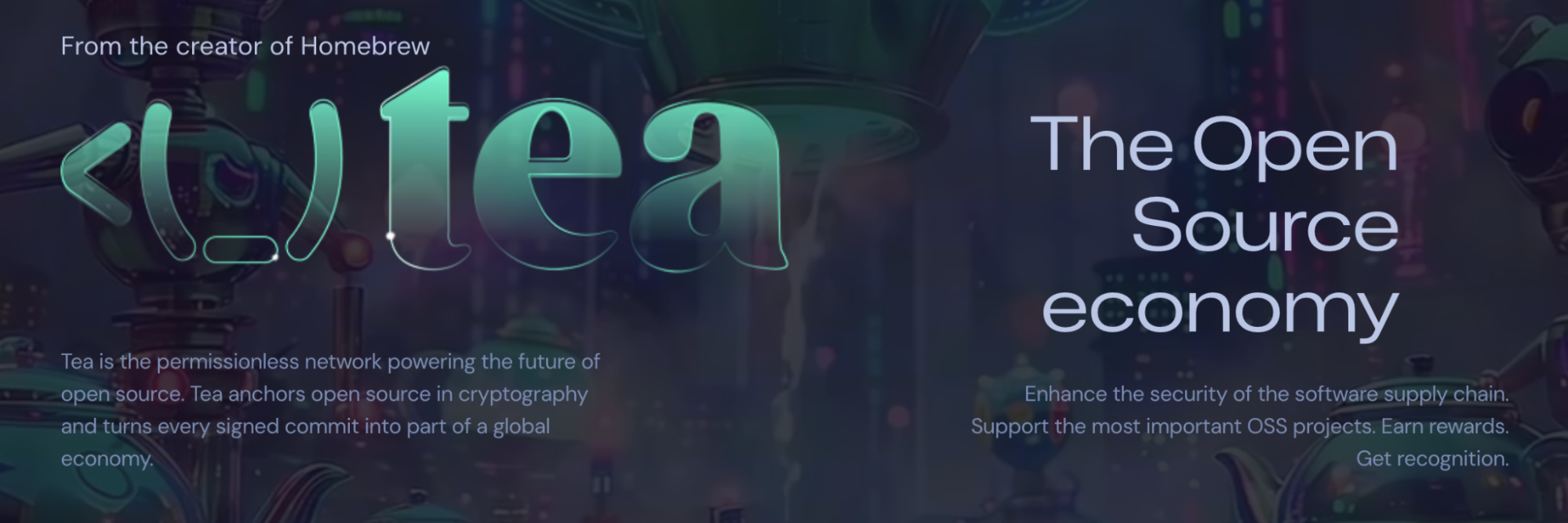
(Image source: teaprotocol)
Tea Protocol is a decentralized infrastructure project focused on improving trust, attribution, and verification within open-source software ecosystems. The platform is designed to create a transparent provenance layer where software packages, dependencies, and developer contributions can be cryptographically verified onchain.
The project positions itself as a foundational trust framework for an environment increasingly shaped by AI-generated code and autonomous software agents.
Tea Protocol announced that its mainnet launch is scheduled for June 4, alongside its token generation event (TGE) on Aerodrome Finance, one of the primary liquidity protocols within the Base ecosystem.
Why Open-Source Trust Is Becoming More Important
The announcement arrives during a period of rapid advancement in artificial intelligence-driven software development. Recent developments in generative AI models have demonstrated that autonomous systems are increasingly capable of writing code, identifying vulnerabilities, and even generating exploit strategies with limited human supervision.
At the same time, open-source AI models and developer tools are becoming widely accessible across consumer devices and cloud environments. As AI systems gain the ability to autonomously create and distribute software, verifying the origin and integrity of code is becoming a larger concern for developers, enterprises, and infrastructure providers.
Tea Protocol argues that traditional trust models may become insufficient in a future where software is produced faster than human reviewers can fully audit it.
Tea’s Role as a Software Provenance Layer
The protocol focuses on creating verifiable records tied to software development activity. This includes:
- Attribution of code contributions
- Verification of software dependencies
- Transparent package histories
- Economic incentives for open-source contributors
- Onchain tracking of software provenance
Rather than storing trust solely within compiled software binaries, Tea aims to anchor verification directly at the source-code and dependency level.
The broader objective is to provide AI agents and developers with more reliable contextual information when interacting with open-source ecosystems.
Mainnet Launch and Aerodrome Integration
Tea Protocol selected Aerodrome as the venue for its token launch due to Aerodrome’s position as a major liquidity hub on Base, the Ethereum Layer 2 network incubated by Coinbase.
According to the project, the launch is intended to combine transparent market infrastructure with a decentralized software trust layer. The integration with Aerodrome also allows TEA token liquidity to operate within an onchain governance and emissions framework visible to market participants in real time.
Voting related to the launch is expected to begin on May 28, ahead of the June 4 mainnet activation.
AI, Open Source, and the Future of Verification
The rise of AI-generated software is creating new discussions around digital trust and cybersecurity. If autonomous systems increasingly participate in writing, modifying, and deploying code, developers may require stronger methods to verify software origins and dependency integrity.
Tea Protocol’s model reflects a broader trend toward embedding provenance and accountability directly into software infrastructure. Similar conversations are also emerging around decentralized identity systems, AI safety tooling, and blockchain-based verification networks.
The project describes its long-term goal as creating economic infrastructure capable of supporting sustainable open-source development while also improving transparency for AI-native software environments.
Conclusion
Tea Protocol’s upcoming mainnet launch highlights the growing intersection between artificial intelligence, blockchain infrastructure, and open-source software governance. As AI systems become more capable of autonomously generating code, questions around software authenticity, provenance, and trust are becoming increasingly important.
By introducing a decentralized verification and attribution layer for open-source ecosystems, Tea Protocol aims to address some of the structural trust challenges emerging in the agentic AI era. Whether such systems become a standard part of future software infrastructure may depend on how rapidly AI-generated development continues to expand.
* The information is not intended to be and does not constitute financial advice or any other recommendation of any sort offered or endorsed by Gate.
* This article may not be reproduced, transmitted or copied without referencing Gate. Contravention is an infringement of Copyright Act and may be subject to legal action.


Related Articles

What Is Technical Analysis?

What Is Fundamental Analysis?

Risks You Must Be Aware Of When Trading Crypto

Influence360 Introduces AI-Powered Infrastructure for Data-Driven Web3 Influencer Campaigns

What Kalshi’s New Employer Disclosure Rule Means for Prediction Markets and Insider Trading