StablR Stablecoin Depeg Highlights Governance and Key Management Risks in Digital Asset Infrastructure
Understanding the StablR Stablecoin Incident
StablR, a European stablecoin issuer supported by investors including Tether and Kraken, suffered a major exploit after attackers reportedly gained administrative control over the platform’s token minting contracts.
According to onchain investigations, the attacker was able to generate millions of new EURR and USDR tokens before rapidly selling them through decentralized exchanges. The sudden increase in circulating supply placed immediate pressure on both stablecoins, causing them to lose their intended pegs.
Blockchain investigator ZachXBT publicly identified suspicious activity shortly after the exploit began. Security researchers later estimated that approximately $13.5 million worth of unauthorized tokens had been minted during the attack.
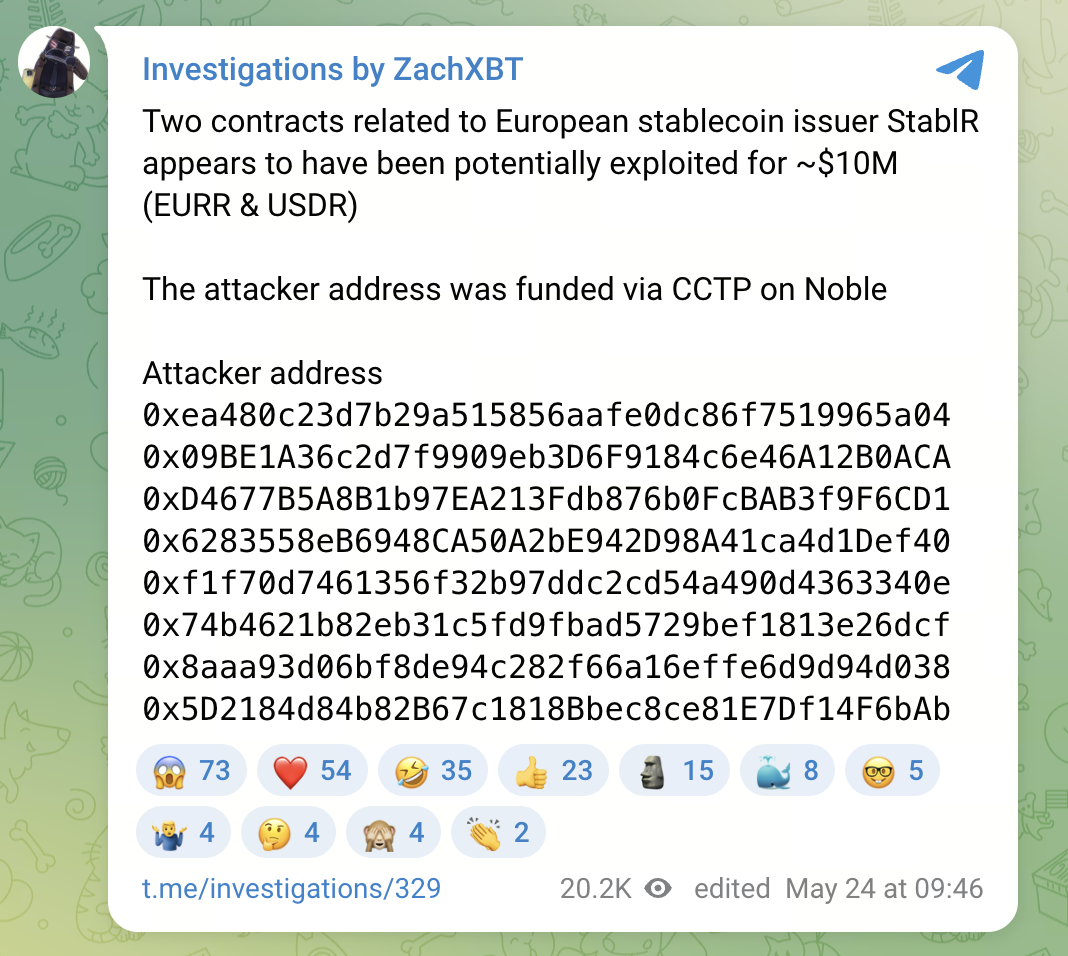
(Image source: ZachXBT)
The exploit did not appear to result from a flaw in the smart contract code itself. Instead, security firms indicated that the incident was primarily caused by weaknesses in governance controls and private key management.
How the Attack Occurred
Security analysis from blockchain monitoring firms suggested that one of the signing keys connected to StablR’s multisignature minting system had been compromised.
The platform reportedly used a 1-of-3 multisignature approval structure for administrative minting functions. Under this configuration, control of a single signer was sufficient to authorize changes to administrative permissions.
After obtaining access, the attacker allegedly inserted their own address as an administrator, replaced existing owners, and proceeded to mint approximately 8.35 million USDR and 4.5 million EURR.
The newly created tokens were then exchanged for ETH across decentralized trading platforms. Due to limited liquidity in trading pools, the attacker reportedly realized lower net proceeds than the nominal value of the minted assets, although millions of dollars were still extracted.
Researchers also noted that the attacker used administrative privileges to blacklist and burn tokens held by counterparties involved in redemption activity. This further demonstrated the extent of control obtained during the compromise.
Impact on EURR and USDR Stablecoins
The exploit significantly affected market confidence in both stablecoins.
EURR, which is designed to track the euro’s value, declined sharply from its expected exchange level. USDR also experienced severe losses relative to its intended dollar peg.
Stablecoin depegging events typically occur when confidence in redemption mechanisms, reserves, or issuer solvency weakens. In this case, the unauthorized token issuance created uncertainty about supply integrity and operational security.
Although StablR later acknowledged the exploit publicly and stated that containment efforts were underway, the delayed response became a subject of criticism within the digital asset community.
Regulatory Context and MiCA Considerations
The incident is particularly notable because StablR has positioned itself as a regulated European stablecoin issuer operating under the European Union’s Markets in Crypto-Assets (MiCA) framework.
The company reportedly holds an Electronic Money Institution license issued by Malta’s financial regulator and has emphasized compliance-focused stablecoin issuance.
StablR also utilized tokenization infrastructure associated with Tether and received strategic investments from both Tether and Kraken in previous funding rounds.
The exploit therefore raises broader questions regarding operational security standards for regulated stablecoin issuers, particularly in areas involving multisignature governance, administrative permissions, and key custody procedures.
The event also arrived during ongoing policy debates in Europe surrounding euro-denominated stablecoins. European regulators and central banking officials have continued discussing whether stablecoins could introduce financial stability concerns despite growing demand for blockchain-based payment systems.
Governance and Key Management as Industry Risks
The StablR exploit reflects a wider trend seen throughout the digital asset industry in recent years. Increasingly, some of the largest losses in decentralized finance have stemmed not from coding vulnerabilities, but from failures involving governance systems, operational controls, and key management.
Multisignature wallets are commonly used to distribute authority across multiple parties. However, security experts generally view low signing thresholds as higher-risk configurations because fewer compromised keys are needed to gain control over sensitive functions.
The incident therefore serves as an example of how operational architecture can become a critical security factor, even for regulated platforms with compliant business structures.
Researchers have also pointed out that blockchain systems remain highly dependent on human governance processes despite the automation provided by smart contracts.
The Broader State of Euro Stablecoins
Euro-backed stablecoins remain significantly smaller than dollar-backed stablecoin markets.
On Ethereum, euro-denominated stablecoins represent only a small percentage of the broader fiat-backed stablecoin ecosystem. Nevertheless, policymakers and infrastructure providers continue exploring their role within European digital finance.
Projects such as EURR and USDR have attempted to establish regulated euro stablecoin alternatives that align with European compliance standards while supporting blockchain-based payments and settlement activity.
However, incidents involving governance failures may slow institutional confidence and intensify regulatory scrutiny surrounding operational safeguards.
Conclusion
The StablR exploit highlights the importance of governance security and operational resilience within modern stablecoin infrastructure. Although the underlying smart contracts themselves were not reportedly compromised, weaknesses in administrative controls allowed attackers to mint unauthorized assets and destabilize the platform’s stablecoins.
As stablecoin adoption expands under evolving regulatory frameworks such as MiCA, incidents like this demonstrate that compliance alone does not eliminate technological and operational risks. The event may ultimately encourage issuers, regulators, and infrastructure providers to place greater emphasis on key management standards, multisignature security models, and governance transparency across the digital asset industry.
* The information is not intended to be and does not constitute financial advice or any other recommendation of any sort offered or endorsed by Gate.
* This article may not be reproduced, transmitted or copied without referencing Gate. Contravention is an infringement of Copyright Act and may be subject to legal action.


Related Articles

What Is Technical Analysis?

What Is Fundamental Analysis?

Risks You Must Be Aware Of When Trading Crypto

Influence360 Introduces AI-Powered Infrastructure for Data-Driven Web3 Influencer Campaigns

What Kalshi’s New Employer Disclosure Rule Means for Prediction Markets and Insider Trading