
Programmable Escrow in Mexico: Kustodia Launches SPEI-Integrated Blockchain Settlement for High-Value Transactions
Escrow Infrastructure Built on Existing Payment Rails
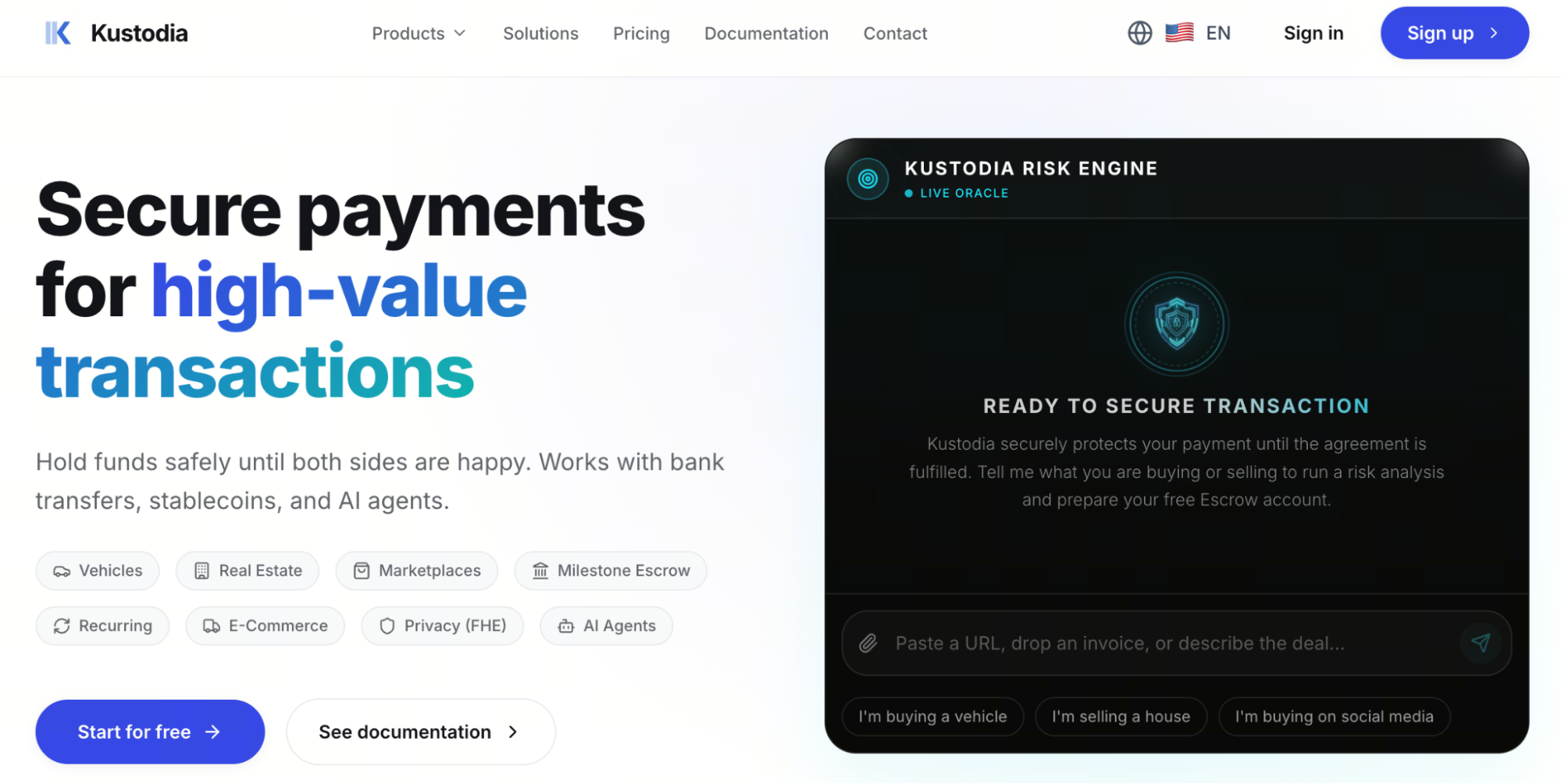
(Image source: Kustodia)
Kustodia’s platform is designed to operate alongside SPEI, Mexico’s real-time interbank transfer network. Instead of replacing traditional payment rails, the system overlays blockchain-based escrow functionality onto existing financial infrastructure.
In practice, funds sent through SPEI are automatically locked into a smart contract deployed on Arbitrum. These funds remain inaccessible to both buyer and seller until predefined conditions—typically confirmation of delivery—are met. Once both parties validate the transaction outcome, the funds are released to the seller.
This design removes the need for a human intermediary while maintaining the familiar user experience of bank-based payments.
Addressing Fraud in High-Value Transactions
The introduction of programmable escrow responds to a significant economic issue: payment fraud. Global estimates suggest that fraud resulted in tens of billions of dollars in losses in recent years, with Latin America experiencing particularly high rates.
In Mexico, the impact is amplified in sectors characterized by informal or peer-to-peer transactions, such as the used vehicle market. These transactions often occur between individuals without formal guarantees, increasing exposure to fraud.
By introducing a mechanism where funds are conditionally locked and only released upon mutual confirmation, Kustodia’s model seeks to reduce counterparty risk and improve trust in such transactions.
Operational Model and User Interaction
A notable feature of the system is its emphasis on accessibility. Users interact with the platform through widely used communication tools such as WhatsApp, without needing specialized knowledge of blockchain technology.
The transaction flow can be summarized as follows: a buyer transfers pesos to a designated account, the funds are converted into a blockchain-based representation and locked in a smart contract, the seller fulfills the transaction, and upon confirmation, the funds are released back into the traditional banking system.
To maintain price stability, the platform uses a peso-backed stablecoin, MXNB, which is pegged 1:1 to the Mexican peso. This ensures that users are not exposed to cryptocurrency volatility, as all inputs and outputs remain denominated in fiat currency.
Additionally, blockchain transaction fees are abstracted away from the user. Instead, the platform incorporates these costs into a service fee, simplifying the user experience.
Efficiency and Cost Structure
Compared to traditional escrow services, which often involve multi-day settlement periods and higher fees, Kustodia’s system is designed for faster execution and reduced cost. Transactions can be completed near-instantly once conditions are met, and fees are structured as a percentage-based commission.
This efficiency gain is largely attributable to the automation provided by smart contracts, which eliminate manual verification processes and reduce administrative overhead.
Expanding Use Cases and Integration Capabilities
While the initial focus is on the used vehicle market, the platform is adaptable to a range of high-value transaction types. These include real estate deposits, business-to-business agreements, and crowdfunding arrangements.
The system also incorporates identity verification and data validation services, such as vehicle history checks, to enhance transaction reliability. For developers and platforms, Kustodia provides API and webhook support, enabling integration into online marketplaces and other digital services.
Cross-border functionality is also being explored, with support for U.S.-to-Mexico transfers and planned expansion into other regional payment systems.
AI Agents and Programmable Transactions
An additional dimension of the platform is its support for AI-driven agents. Through dedicated infrastructure, automated systems can create and manage escrow contracts programmatically. This capability aligns with a broader trend toward machine-mediated commerce, where transactions may be initiated and executed by software rather than human users.
In this context, escrow mechanisms become particularly important, as they provide a trust framework for autonomous interactions between parties that may not directly verify each other.
Broader Implications for Financial Infrastructure
Kustodia’s approach illustrates how blockchain technology can be integrated into existing financial systems without requiring users to adopt new behavioral patterns. By embedding smart contracts into familiar payment workflows, the platform lowers the barrier to entry while introducing additional security guarantees.
This model also reflects a shift toward programmable finance, where transaction conditions can be encoded directly into the payment process. Such systems have the potential to reduce fraud, improve transparency, and enable new forms of digital interaction across both human and automated participants.
Conclusion
The launch of a blockchain-based escrow system integrated with SPEI represents a significant development in the application of distributed ledger technology to real-world financial challenges. By combining stablecoin-based settlement, smart contract automation, and traditional payment rails, Kustodia provides a hybrid solution tailored to high-risk transaction environments.
As digital and traditional financial systems continue to converge, models that emphasize usability, security, and interoperability are likely to play a central role in shaping the next generation of payment infrastructure.
* The information is not intended to be and does not constitute financial advice or any other recommendation of any sort offered or endorsed by Gate.
* This article may not be reproduced, transmitted or copied without referencing Gate. Contravention is an infringement of Copyright Act and may be subject to legal action.
Share
Content


Related Articles

What Is Technical Analysis?

What Is Fundamental Analysis?

Risks You Must Be Aware Of When Trading Crypto

Influence360 Introduces AI-Powered Infrastructure for Data-Driven Web3 Influencer Campaigns

What Kalshi’s New Employer Disclosure Rule Means for Prediction Markets and Insider Trading