
Bank of Italy Study Examines Whether Stablecoins Improve Cross-Border Remittance Efficiency
Stablecoins and Cross-Border Payments Under Review
Stablecoins have often been viewed as a potential solution for improving global payments by offering faster settlement and lower transaction costs through blockchain technology. However, a recent study conducted by researchers at the Bank of Italy suggests that stablecoin-based remittances do not always provide a clear advantage over traditional payment systems.
The research found that the main factors influencing cost and speed were not blockchain fees, but rather the processes required to convert between digital assets and local currencies, as well as the efficiency of existing payment infrastructure.
Study Compares USDC Transfers Across Global Corridors
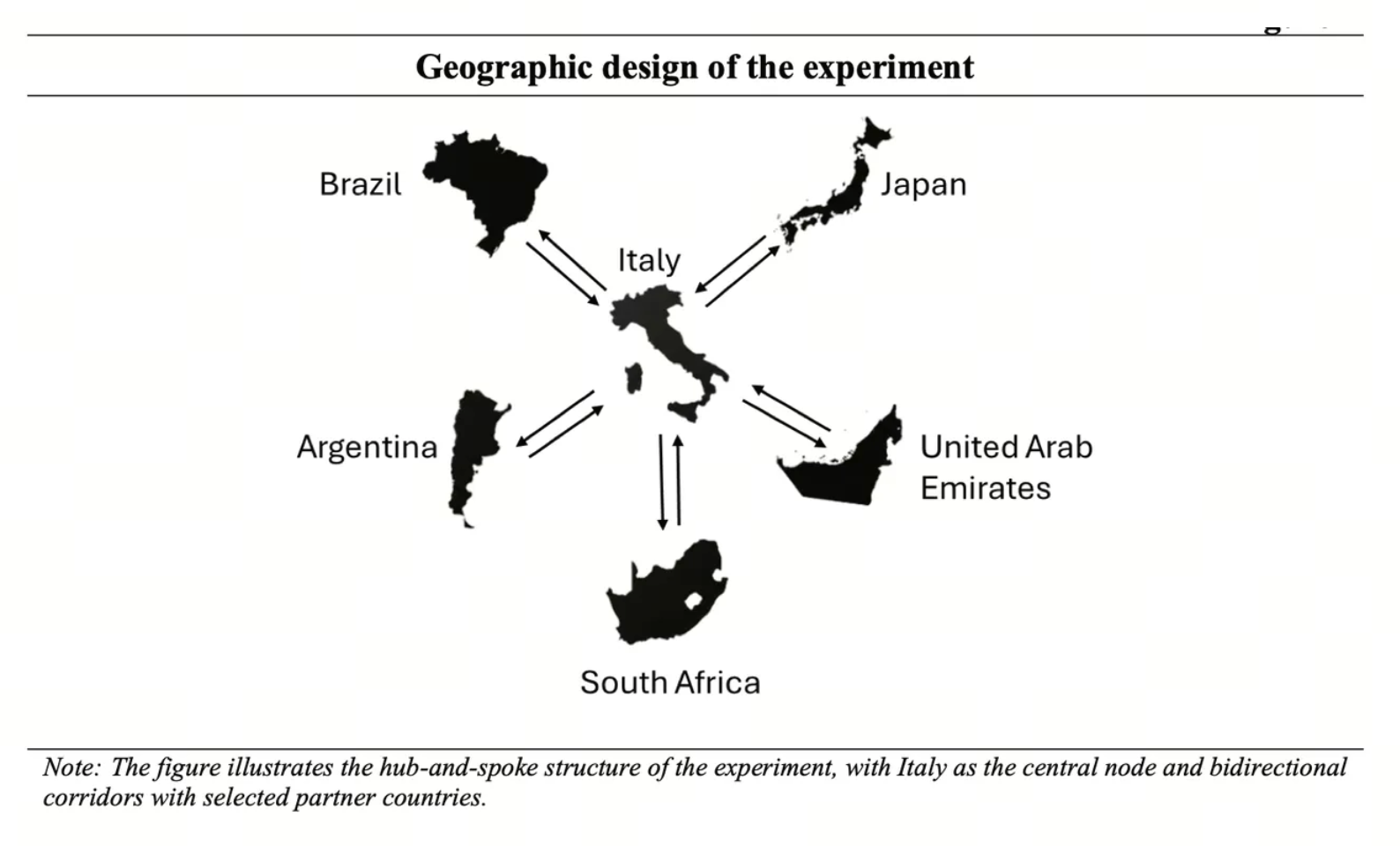
(Geographic design of the remittance experiment. Source: Bank of Italy)
To evaluate the effectiveness of stablecoin payments, researchers conducted an experiment involving 200 USDC remittance transactions across 10 two-way payment routes.
The selected corridors connected Italy with several international markets, including:
- Brazil
- Argentina
- Japan
- The United Arab Emirates
- South Africa
The study compared stablecoin transfers with traditional remittance services by examining total costs and settlement times from the sender to the recipient.
The findings showed that exchange fees and currency conversion expenses represented the largest portion of transaction costs, while blockchain network fees accounted for only a limited share.
Stablecoin Costs Depend on Local Payment Conditions
The research revealed significant differences between payment corridors. Depending on the destination market, total costs for stablecoin transfers ranged from approximately 0.3% to nearly 9%.
Settlement speed also varied based on local financial infrastructure. In regions with instant payment systems, transactions could be completed in under 20 minutes. However, where such systems were unavailable, settlement could take between one and two business days.
Compared with the World Bank’s reported global average remittance cost of 6.65%, stablecoin transfers were cheaper across most tested corridors. However, when compared with Wise, a traditional digital payment provider, stablecoin transfers were found to have lower costs in only three out of seven comparable payment routes.
Payment Infrastructure Remains a Key Factor
The Bank of Italy researchers emphasized that blockchain technology alone does not determine the efficiency of stablecoin payments. Instead, the broader payment environment plays a crucial role. Improvements in domestic instant payment networks could increase the competitiveness of stablecoin-based remittance solutions by reducing delays between digital assets and local financial systems.
The study also highlighted that stablecoins could become significantly more efficient if they could be used directly for everyday payments without requiring conversion back into fiat currencies. Potential use cases could include payments for goods and services, housing expenses, or education costs, allowing stablecoins to function more like digital money rather than simply acting as a bridge between currencies.
Regulation Influences Stablecoin Adoption and Efficiency
Beyond technology and infrastructure, the study also examined how regulatory approaches affect stablecoin usage. Researchers noted that highly restrictive regulatory environments may not eliminate demand for stablecoins. Instead, they may encourage users to rely on offshore platforms or alternative channels with weaker oversight.
At the same time, overly complex compliance requirements can increase operational difficulties for everyday users and businesses. These findings come as global regulators continue developing frameworks for digital assets. The European Union has introduced the Markets in Crypto-Assets (MiCA) regulation, while the United States has established the GENIUS Act to create rules for payment stablecoins.
Stablecoin Market Continues to Expand
Despite questions surrounding efficiency improvements, the stablecoin sector continues to grow. According to DefiLlama data, the total stablecoin market capitalization has reached around $307 billion, representing growth of approximately 16% over the past year.
The expansion reflects increasing interest in blockchain-based payment solutions, but the Bank of Italy’s research suggests that wider adoption will depend not only on blockchain technology itself, but also on improvements in financial infrastructure, regulatory clarity, and real-world usability.
Conclusion
The Bank of Italy’s study provides a more balanced view of stablecoin remittances by showing that blockchain-based transfers do not automatically guarantee lower costs or faster payments. While stablecoins can offer advantages in certain payment corridors, factors such as fiat conversion processes, local payment systems, and regulatory conditions remain critical in determining their effectiveness. As stablecoins continue to develop as a global financial tool, their long-term value may depend on deeper integration with everyday payment systems rather than simply replacing traditional remittance channels.
* The information is not intended to be and does not constitute financial advice or any other recommendation of any sort offered or endorsed by Gate.
* This article may not be reproduced, transmitted or copied without referencing Gate. Contravention is an infringement of Copyright Act and may be subject to legal action.
Share
Content
Stablecoins and Cross-Border Payments Under Review
Study Compares USDC Transfers Across Global Corridors
Stablecoin Costs Depend on Local Payment Conditions
Payment Infrastructure Remains a Key Factor
Regulation Influences Stablecoin Adoption and Efficiency
Stablecoin Market Continues to Expand
Conclusion


Related Articles

What Is Technical Analysis?

What Is Fundamental Analysis?

Risks You Must Be Aware Of When Trading Crypto

Influence360 Introduces AI-Powered Infrastructure for Data-Driven Web3 Influencer Campaigns

What Kalshi’s New Employer Disclosure Rule Means for Prediction Markets and Insider Trading