In the second quarter of 2026, the number of active AI agents on-chain surpassed 250,000, representing a 400% year-over-year increase. The total value locked (TVL) managed by autonomous AI agent DeFi protocols reached $4.7 billion, while 68% of newly deployed decentralised finance protocols incorporated AI agent components. These figures highlight a clear trend: artificial intelligence is moving beyond the stage of "content generation" and entering an era where AI systems actively participate in economic activities.
As AI Agents evolve from simply answering questions to executing transactions, accessing data, and operating across applications, a fundamental challenge has emerged: how can these execution processes be verified? How can data sources remain transparent? How can multiple AI agents coordinate effectively?
Traditional AI architectures face inherent limitations in addressing these challenges. Execution processes are often difficult to verify, data origins may lack transparency, and permission management can become increasingly complex. This is where blockchain infrastructure becomes increasingly relevant.
A report published by global asset management firm Franklin Templeton in July 2026 highlighted that autonomous AI systems require blockchain infrastructure to enable machine-to-machine payments, identity verification, and transaction settlement. The report cited forecasts suggesting that by 2028, 38% of organisations expect AI Agents to collaborate with employees, while the Agentic Commerce economy could reach between $3 trillion and $5 trillion by 2030.
This perspective aligns closely with views expressed by institutions such as Andreessen Horowitz (a16z) and Delphi Digital in their 2026 outlook reports: the crypto industry is transitioning from speculative cycles toward structural maturity, with "Agentic Finance" emerging as a key narrative.
Talus Network is positioned precisely within this evolving landscape as an on-chain execution layer for AI Agents.
Talus Network: Trusted Execution Infrastructure for AI Agents
Talus Network is a decentralised AI Agent infrastructure platform built on the Sui blockchain. Its core objective is to leverage blockchain technology to provide verifiable execution, decentralised workflows, and automated task coordination capabilities for AI Agents.
Unlike many AI-focused projects that primarily compete on model performance, Talus follows a different strategic direction: becoming the foundational infrastructure layer that enables AI Agents to operate reliably.
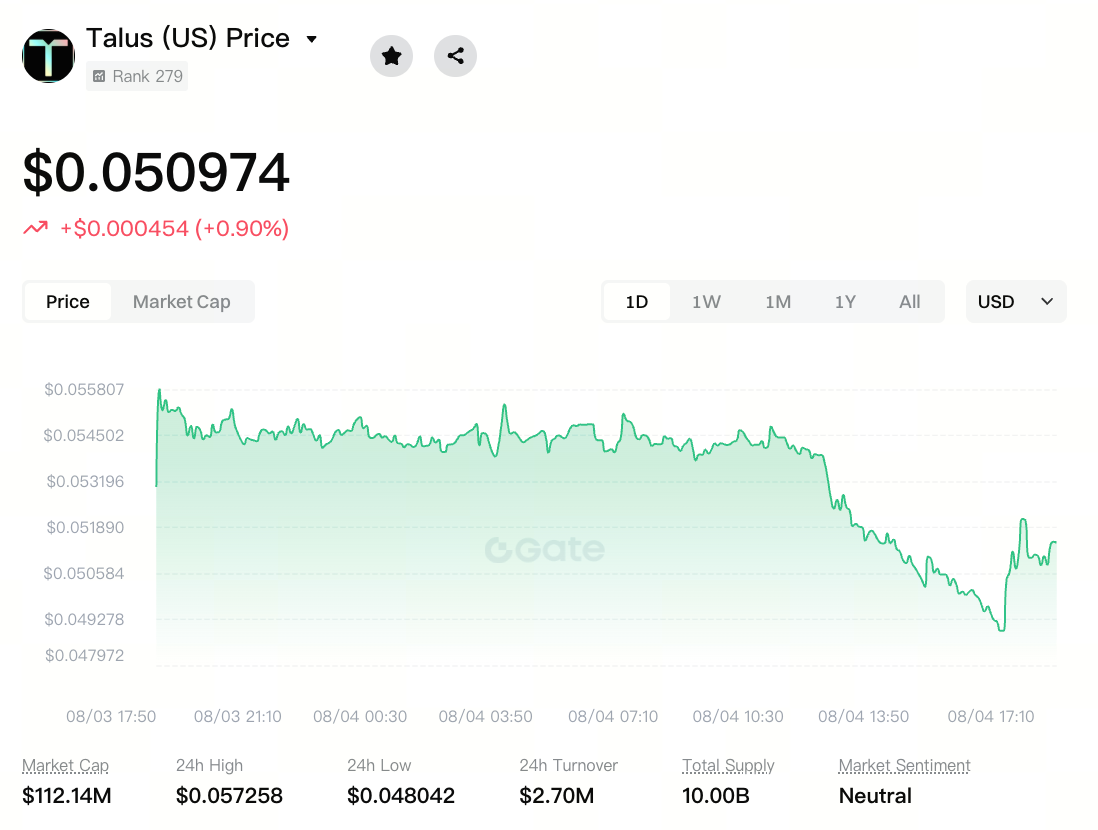
The importance of this sector is increasingly being recognised by the market. According to Gate market data as of 4 August 2026, Talus’ native token US was priced at $0.051461 , with a 24-hour change of +0.15% , a 7-day increase of +17.43% , and a 30-day gain of +209.39% . Over the past year, US recorded an increase of +147.90% .
Against the backdrop of the broader crypto market experiencing its third consecutive quarterly decline, with total market capitalisation at approximately $2.27 trillion and a quarter-over-quarter decrease of 4.46% , US’s performance reflects differentiated market interest in AI Agent infrastructure projects.
Source: Gate Market Data
Nexus: The Technical Core of Talus’ Decentralised Execution Layer
Nexus serves as the core infrastructure component of Talus, providing AI Agents with workflow execution environments, on-chain task verification, and multi-Agent collaboration capabilities.
Its key technical value lies in connecting "intelligent decision-making" with "verifiable execution". AI Agent decision processes can be recorded through blockchain infrastructure, while execution outcomes can be verified on-chain, creating a complete and auditable activity trail.
This architecture addresses one of the central themes emerging from the convergence of AI and blockchain in 2026: verifiability has become a critical industry requirement .
As AI-generated content continues to expand, demand for content provenance, authenticity verification, and accountability mechanisms has increased significantly. Blockchain’s immutable records and timestamp capabilities are increasingly viewed as foundational infrastructure for ensuring traceable decision-making.
Talus’ Nexus layer applies this principle directly to AI Agent execution scenarios, enabling autonomous systems to operate within a more transparent and verifiable framework.
Talus Vision: Lowering the Barrier to AI Agent Creation
Talus Vision reduces the complexity of AI Agent development through a no-code approach, allowing users to create intelligent agents, deploy automated workflows, and participate in the Agent ecosystem without requiring advanced programming skills.
This product direction addresses a key market gap: AI Agents need to move beyond developer-focused tools and become accessible applications for a broader user base.
From a product perspective, Talus Vision can be viewed as a "no-code platform" for the AI Agent sector. Through visual interfaces and template-based designs, non-technical users can build automated workflows and customise Agent behaviours.
This approach has direct value in expanding AI Agent application scenarios, increasing on-chain activity, and improving overall ecosystem engagement.
Idol.fun: A Consumer-Focused Validation Scenario
Idol.fun targets everyday users by exploring AI Agent applications in entertainment and social environments. Its strategic value lies in bringing AI Agents from the infrastructure layer into real-world user scenarios and testing the practical usability of the technology.
A second-quarter 2026 report from the National Institution for Finance & Development of the Chinese Academy of Social Sciences noted that the integration of AI Agents and crypto finance is moving from the experimental stage toward broader adoption.
Within this trend, Idol.fun can be viewed as Talus’ consumer-facing application layer. By accumulating user interaction data through entertainment-driven applications, Idol.fun helps demonstrate the scalability and practical capabilities of an on-chain AI Agent execution infrastructure.
US Token: Value Capture in the AI Agent Economy
US is the native token of Talus Network, with a total supply of 10 billion tokens and a current circulating supply of 2.2 billion tokens .
Its core functions cover three key areas:
Payment Function:
US is used for AI Agent execution fees and network service interactions. As the number of on-chain AI Agents increases, transaction execution and service payments may become an important source of network demand.
Staking Mechanism:
US supports network security and node participation. Talus adopts a gradually decentralised Leader network architecture, with staking mechanisms playing an important role in maintaining network security and operational reliability.
Ecosystem Incentives:
US supports application development, community participation, and ecosystem growth. This reflects the broader evolution of token economics in 2026, with projects increasingly moving beyond governance-only models toward mechanisms linked to platform activity and ecosystem development.
The Franklin Templeton report highlighted that AI Agents require native cryptocurrencies to record transactions on blockchain networks, and that increasing machine-to-machine activity could drive greater demand for network tokens used for payment processing.
The value capture logic of US is based on this broader trend: as AI Agents become more active economic participants, infrastructure-layer tokens may play a larger role in facilitating automated interactions.
Market Positioning and Competitive Landscape
Talus Network operates at the intersection of AI Agent technology and blockchain infrastructure. Its core competitive advantage is not AI model performance, but whether it can become a standard execution infrastructure layer for AI Agents.
This sector is increasingly gaining recognition from mainstream industry participants.
In its 2026 outlook, a16z introduced the concept of "KYA (Know Your Agent)" , suggesting that AI Agents will require cryptographically signed credentials to conduct transactions, potentially creating a new identity infrastructure layer.
Coinbase has also highlighted that AI Agents could increasingly utilise crypto payment channels, driving demand for crypto-native settlement infrastructure.
Talus’ Nexus execution layer and Vision development tools are positioned at the intersection of these emerging trends, providing both execution infrastructure and application-building capabilities for the AI Agent economy.
On 3 August 2026, US’s market capitalisation surpassed two important tokens within the Sui ecosystem, DEEP and WAL. The market interpreted this movement as a potential reassessment of Talus Network’s valuation and ecosystem position.
Amid broader crypto market pressure, this shift reflects growing investor attention toward AI Agent infrastructure as a structural growth theme rather than a short-term speculative narrative.
Risks and Future Outlook
Talus Network faces several potential risks, including slower-than-expected AI Agent commercial adoption, increasing competition among similar infrastructure projects, and regulatory uncertainty surrounding the integration of AI and crypto technologies.
Although the updated version of the US CLARITY Act has introduced a more systematic regulatory discussion framework for decentralised finance, the legal status, accountability mechanisms, and compliance responsibilities of AI Agents as emerging economic participants remain areas that require further clarification.
From a longer-term perspective, the integration of AI Agents and blockchain technology is entering a critical transition phase from narrative development toward practical implementation.
A 2026 analysis by MetaEra suggested that payments and identity infrastructure may mature first within the next one to two years, verifiable workflows could become standard capabilities within two to three years, and a genuine machine economy or Agentic Economy may emerge over a longer timeframe.
Whether Talus Network can complete technological validation and ecosystem development during this critical window will determine whether it can establish itself as a foundational infrastructure layer for the AI Agent era.
FAQ
What makes Talus Network different from traditional AI projects?
Traditional AI projects primarily focus on model training and inference capabilities, while Talus Network focuses on providing AI Agents with a verifiable on-chain execution environment.
Its core value proposition is enabling AI Agent decisions and execution processes to become traceable, verifiable, and auditable, addressing trust challenges created by traditional AI "black box" systems.
What are the main use cases of the US token?
US is the native token of Talus Network. Its primary functions include paying for AI Agent execution fees and network services, participating in node staking to support network security, and contributing to ecosystem governance and incentive mechanisms.
As on-chain AI Agent activity expands, the potential demand drivers for US may also increase alongside network usage.
What products are included in the Talus ecosystem?
Talus consists of three major components:
- Nexus: A decentralised execution layer for AI Agents, providing workflow execution and on-chain verification.
- Talus Vision: A no-code AI Agent creation platform designed to reduce development barriers.
- Idol.fun: A consumer-oriented AI entertainment application designed to test real-world AI Agent use cases.
Why do AI Agents need blockchain infrastructure?
When AI Agents execute transactions, access data, or operate across applications, they face challenges including unverifiable execution processes, unclear data sources, and difficulties coordinating multiple Agents.
Blockchain infrastructure provides AI Agents with a trusted execution environment through immutable records, smart contract automation, and decentralised coordination mechanisms.