Trading activity around Meme tokens on the Solana blockchain is experiencing a significant rebound. According to DefiLlama data, as of late July 2026, Meme tokens accounted for approximately 42% of Solana’s daily decentralised exchange (DEX) trading volume, reversing the downturn in late 2025 when the share temporarily fell below 10%.
As one of the core infrastructure platforms supporting Solana’s Meme ecosystem, Pump.fun contributed approximately $492 million in daily trading volume, representing a significant portion of Solana’s total daily DEX volume of around $1.178 billion.
Meanwhile, the total market capitalisation of Solana ecosystem Meme tokens has recovered to nearly $6.7 billion, up from approximately $5.1 billion at the beginning of the year.
Against the backdrop of this structural recovery in the Solana Meme ecosystem, Qkacoin (QKA)—a community-driven Meme token themed around the Australian quokka—has demonstrated notable short-term price elasticity.
This article analyses how low-market-cap Meme assets attract capital attention through community consensus and social distribution, while also examining their inherent high-volatility characteristics from the perspectives of Solana Meme ecosystem data, QKA’s community narrative, and market performance.
How Community-Driven Meme Assets Work: From Attention to On-Chain Liquidity
The value formation mechanism of Meme tokens differs fundamentally from traditional crypto assets.
Academic research defines Meme tokens as crypto assets "inspired by internet memes and sustained by online communities." Their demand is primarily driven by collective behaviour and social interaction rather than technical roadmaps or application utility.
Cluster analysis shows that animal-themed Meme tokens, including QKA’s category of "animal and novelty designs," are commonly associated with keywords such as "cats," "dogs," and "cute," highlighting emotional resonance and easily understandable narratives.
These types of tokens typically achieve faster market recognition, with average market entry times of approximately 7,129 seconds, significantly shorter than other thematic categories. This reflects their ability to be quickly understood and widely shared.
QKA provides a representative example. The project originated from the transition of the XMC mining project. After considering feedback from community members and exchanges, the team shifted its focus toward the Meme token sector and introduced the quokka—the animal widely known online as the "world’s happiest animal"—into the crypto ecosystem.
In the mid-2010s, quokkas gained widespread attention on social media due to their naturally smiling expressions. The "quokka selfie" trend attracted participation from public figures including Chris Hemsworth and Margot Robbie.
QKA transformed this cultural symbol into a digital asset on the Solana blockchain, using the Meme token format to build a brand narrative centred around "happiness" and "positivity."
Community-driven mechanisms give Meme tokens a unique "social layer." When enough users continuously discuss, trade, and identify with an asset, the token can maintain market attention even without traditional fundamental support.
According to CoinGecko data, the total market capitalisation of Meme tokens reached an all-time high of $150.6 billion in 2024, while average daily trading volume increased from $1.1 billion in 2023 to $9.7 billion in 2024. These figures demonstrate the potential capital impact when community attention becomes concentrated around a specific narrative.
QKA Market Performance: Price Elasticity and Drivers Behind a Low-Market-Cap Meme Asset
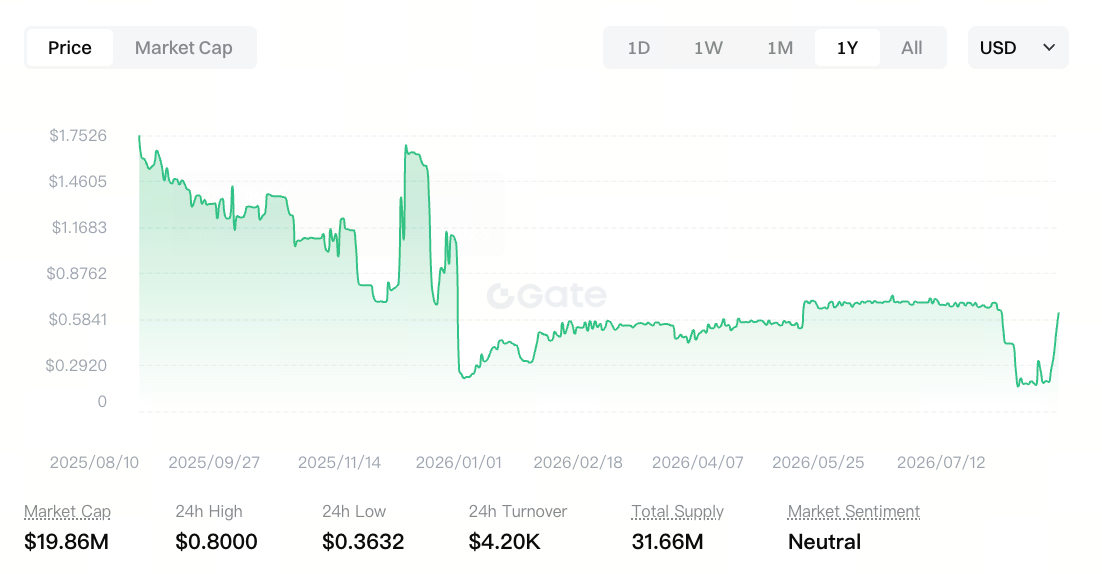
As of 10 August 2026, Gate market data shows that Qkacoin (QKA) is trading at $0.6272, with a 24-hour increase of 50.41%.
The token has gained 156.62% over the past seven days, while its market capitalisation stands at approximately $19.86 million, ranking 771st globally.
Over the past seven days, QKA has traded between a low of $0.1791 and a high of $0.8000, showing significant volatility.
From a longer-term perspective, QKA has declined 6.72% over the past 30 days, 5.42% over the past 90 days, and 58.47% over the past year. This indicates that after reaching its historical high of $2.50 in July 2025, the token has remained within a broader correction cycle but has recently shown signs of a short-term rebound.
Source: Gate Market Data
The drivers behind QKA’s price elasticity can be understood from two perspectives.
First, the broader recovery of Meme trading activity across the Solana ecosystem has provided structural support.
Pump.fun’s daily trading volume previously exceeded $2 billion before declining, but renewed activity has recently helped restore liquidity across Solana-based Meme tokens.
Second, QKA itself remains a relatively low-market-cap asset, with a market capitalisation of approximately $19.86 million.
Academic research indicates that the 95th percentile market capitalisation of animal-themed Meme tokens is approximately $24,970.5, suggesting that many assets in this category remain extremely small in scale.
Although QKA has exceeded this range, it remains significantly smaller than leading Meme tokens. As a result, it is more sensitive to capital inflows and demonstrates stronger price elasticity.
However, low market capitalisation and high price elasticity represent two sides of the same characteristic.
When community sentiment improves or positive discussions emerge on social platforms, capital can quickly flow into the asset and drive prices higher.
Conversely, when attention shifts or profit-taking increases, price corrections can also become substantial.
QKA’s recent price trajectory reflects this pattern. On 26 July, the token reached a low of $0.1551 before rising to $0.8000 within several days, representing a maximum rebound of more than 400%. The subsequent pullback is consistent with the typical behaviour of low-liquidity Meme assets.
Solana Meme Market Structure: The "Launchpad–Trading Volume–Attention" Growth Loop
The reason Solana has become the primary ecosystem for the latest Meme token cycle lies in its combination of low transaction costs and high throughput, which provides infrastructure suitable for high-frequency trading activity.
Pump.fun effectively industrialised the Meme token launch process by enabling users to create, launch, and trade tokens through an extremely low-barrier, almost one-click process.
This mechanism allows large numbers of new Meme tokens to emerge daily on Solana, creating a self-reinforcing loop of "launchpad–trading volume–attention."
According to a Messari report, Pump.fun generated $124.7 million in revenue for Solana during the first quarter of 2026, accounting for 36% of Solana’s total application revenue of $342.2 million.
Since launching in January 2024, Pump.fun’s cumulative revenue has exceeded $1 billion, making it one of the largest revenue-generating platforms within the Solana ecosystem.
This data indicates that Meme token speculation has become deeply embedded within Solana’s economic structure.
However, this growth loop also contains structural risks.
Institutional signals have shown divergence. Goldman Sachs exited its Solana ETF position, while Italy’s Intesa Sanpaolo reduced more than 99% of its Solana ETF holdings and shifted capital allocation toward Bitcoin ETFs.
Meanwhile, Solana DeFi total value locked (TVL) declined 22% during the first quarter of 2026 to $6.16 billion. Messari attributed this primarily to the 33% decline in SOL price during the same period rather than significant user outflows.
The difference between short-term Meme trading activity and long-term institutional capital preferences remains an important factor when assessing ecosystem sustainability.
Risk Analysis: Price Discovery and Liquidity Constraints of High-Volatility Assets
As a community-driven Meme token, QKA’s risk profile can be evaluated from several perspectives.
First, holder concentration remains a key factor.
Historical data indicates that the number of QKA holding addresses was extremely limited, at one point ranging between only 77 and 78 addresses.
Under such concentrated ownership conditions, buying or selling activity from a small number of large holders could significantly influence price movements.
Second, limited market depth may result in higher slippage costs.
With 24-hour trading volume of approximately $4,129.91 compared with a market capitalisation close to $20 million, turnover remains relatively limited. This means large orders may trigger substantial price fluctuations.
Third, Meme token valuations are highly dependent on community engagement and social media attention.
Academic analysis suggests that sentiment volatility is an important indicator for measuring genuine participation and potential bot activity within Meme token markets.
When social discussions decline or attention shifts toward new trends, Meme token valuations may contract rapidly.
Finally, historical performance also highlights long-term uncertainty.
Since reaching its $2.50 historical high in July 2025, QKA has declined approximately 74.9%. Although the token has gained 156.62% over the past seven days, it remains significantly below its previous peak, and no clear long-term trend has yet formed.
The high volatility of Meme tokens creates both trading opportunities and significant risk exposure.
Conclusion: Community Consensus as the Core Pricing Variable for Meme Assets
The Solana Meme token market experienced a notable recovery in trading activity from late Q2 to early Q3 2026, with Meme assets regaining a central share of Solana DEX trading volume.
Within this structural environment, QKA has demonstrated significant price elasticity among low-market-cap assets through its quokka cultural identity and community-driven mechanism.
However, the value formation of Meme tokens remains highly dependent on the sustainability of community attention and the effectiveness of social distribution.
Factors including concentrated ownership, limited market depth, and differences between retail-driven enthusiasm and institutional allocation preferences collectively represent inherent risks.
For market participants, understanding how community consensus functions as a pricing variable, while managing risk exposure in highly volatile environments, remains essential when evaluating Meme token opportunities.
FAQ
Q1: What is Qkacoin (QKA), and what is its cultural background?
Qkacoin (QKA) is a community-driven Meme token built on the Solana blockchain, inspired by the Australian quokka.
Due to its naturally smiling facial expression, the quokka is often called the "world’s happiest animal." It gained widespread popularity on social media during the mid-2010s through the "quokka selfie" trend.
The QKA project brings this internet culture symbol into the crypto ecosystem through the Meme token format.
Q2: How has QKA performed recently?
As of 10 August 2026, QKA is trading at $0.6272, with a 24-hour increase of 50.41% and a seven-day increase of 156.62%.
Its market capitalisation is approximately $19.86 million.
Over the past seven days, the price range has been between $0.1791 and $0.8000, showing significant volatility.
Compared with its historical high of $2.50 in July 2025, QKA remains down approximately 58.47% over the past year.
Q3: What percentage of Solana DEX trading volume comes from Meme tokens?
According to DefiLlama data, as of late July 2026, Meme tokens accounted for approximately 42% of Solana’s daily DEX trading volume, recovering from below 10% at the end of 2025.
Pump.fun contributed approximately $492 million in daily trading volume and remains a major liquidity source for the Solana Meme ecosystem.
Q4: How does the community-driven mechanism of Meme tokens influence prices?
The value of Meme tokens is primarily driven by community attention and social distribution.
When users continuously discuss, trade, and identify with a token, it can create a positive feedback loop of attention and capital inflows.
However, this model also makes prices highly sensitive to sentiment changes. When attention concentrates, price elasticity can be significant; when interest fades, corrections can occur rapidly.
This characteristic is particularly pronounced among low-market-cap Meme tokens.
Q5: What risks should investors consider when evaluating QKA?
Key risks include:
- A limited number of holding addresses, resulting in higher ownership concentration and greater sensitivity to large transactions;
- Limited market depth, which may increase slippage costs;
- Strong dependence on community sentiment and social media activity;
- Significant distance from previous highs, with no confirmed long-term price trend.
Meme tokens can provide strong short-term opportunities, but their high volatility requires careful risk management.