The deep integration of liquid staking, stablecoin infrastructure, and adaptive market-making mechanisms is emerging as a key direction in the next phase of DeFi efficiency competition. Built by Magma Finance, this integrated framework aims to bring these concepts together within the Sui ecosystem. Starting from the fundamentals of liquid staking and combining them with the evolving dynamics of the DeFi stablecoin market, this article provides an in-depth analysis of Magma Finance (MAGMA), including its product structure, token functions, and recent market activity.

Overview of Magma Finance (MAGMA)
Magma Finance is a decentralised finance protocol built around liquid staking, stablecoin issuance, and DeFi liquidity management, deployed on the Sui blockchain. It functions not only as a decentralised exchange (DEX) but also as a liquidity hub, with the core objective of improving on-chain capital efficiency and addressing liquidity fragmentation.
From a product positioning perspective, Magma Finance is not limited to a single financial application. Instead, it aims to become a "liquidity engine" for the Sui ecosystem by transforming idle capital into actively managed yield-generating assets. The protocol launched its mainnet in December 2025 and introduced the MAGMA token. Prior to this, it completed a $6 million strategic funding round involving investors including HashKey Capital, SNZ Holding, and SevenX Ventures.
According to Gate market data, as of 20 August 2026, the MAGMA token was priced at $0.22932 , with a 24-hour increase of +35.85% and a 7-day increase of +28.35% . Its market capitalisation was approximately $41.45 million , while 24-hour trading volume stood at around $493,300 . Market sentiment was rated as "neutral".
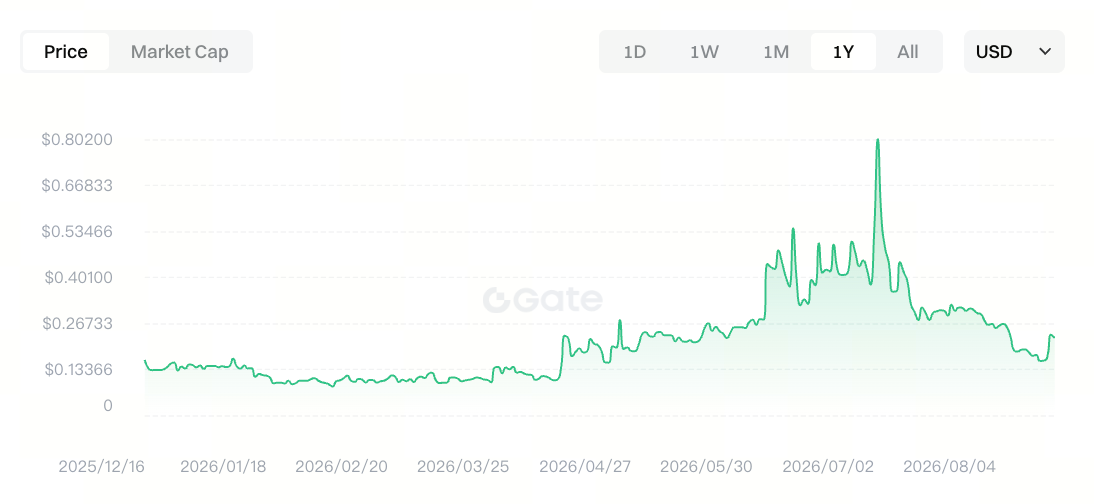
Source: Gate market data
What Is Liquid Staking?
To understand the value proposition of Magma Finance, it is important to first clarify the fundamental concept of liquid staking.
Under traditional Proof-of-Stake (PoS) staking models, users lock their assets with validators to help secure blockchain networks and receive staking rewards. However, this mechanism comes with a major limitation: staked assets lose liquidity , preventing users from simultaneously participating in other DeFi activities such as lending, trading, or liquidity provision. When market opportunities arise elsewhere, capital efficiency may be reduced.
Liquid staking addresses this limitation by introducing "staking representations". After users stake their assets, protocols issue Liquid Staking Tokens (LSTs), which represent ownership of the underlying assets and associated staking rewards. For example, within the Magma ecosystem, users staking MON on the Monad blockchain can receive gMON as a liquid staking representation.
These tokens can be traded on decentralised exchanges or used as collateral in lending protocols and liquidity mining applications, enabling users to combine staking rewards with broader DeFi participation .
Magma Finance extends this concept further. Its protocol architecture is designed not only to support the issuance of liquid staking assets but also to integrate these assets into broader liquidity pools and stablecoin collateral frameworks through adaptive liquidity management mechanisms. In this model, LSTs become a foundational asset layer within DeFi infrastructure.
Why Is Stablecoin Infrastructure Becoming a Core Direction for DeFi?
Stablecoins serve multiple essential roles within the DeFi ecosystem, including trading mediums, liquidity instruments, yield tools, and on-chain settlement assets. As real-world assets (RWA) move on-chain, institutional participation expands, and the scale of blockchain-based finance grows, the importance of stablecoin infrastructure continues to increase.
One notable market trend is the emergence of "yield-bearing stablecoins" and "LST-backed stablecoins" as potential growth areas. For example, Prisma Finance enables users to mint stablecoins using various LST assets, including wstETH and sfrxETH, while leveraging the Curve ecosystem for liquidity incentives. Another example is fxUSD issued by f(x) Protocol, which is over-collateralised by yield-generating assets such as stETH and WBTC. Through its internal mechanism, the stable component and leveraged component are designed to complement each other. By August 2026, fxUSD’s circulating market capitalisation had grown to approximately $64 million .
The underlying logic behind this trend is that traditional stablecoins such as USDC and USDT generally do not generate native yield, while stablecoins backed by yield-generating collateral can potentially transfer underlying staking returns to stablecoin holders, improving overall capital efficiency .
Magma Finance’s approach in this sector is represented by its ioUSD stablecoin — a stablecoin primarily backed by on-chain collateral, including liquid staking tokens (LSTs), with potential future exploration of RWA integration. By using LSTs as underlying collateral, ioUSD aims to connect staking-based returns, trading liquidity, and stablecoin demand within a unified framework.
What Is the Utility of the MAGMA Token?
MAGMA is the native governance and utility token of Magma Finance. The total supply is 1 billion tokens , with approximately 190 million tokens in circulation as of mid-May 2026 , representing a circulating ratio of around 19% .
Its primary functions include the following aspects:
Protocol Governance
Users can lock MAGMA tokens to obtain veMAGMA (vote-escrowed MAGMA), allowing them to participate in governance decisions such as liquidity pool incentive allocation, asset listing proposals, and adjustments to key protocol parameters. Longer lock periods provide greater voting influence and a higher share of protocol fee-related incentives.
Ecosystem Incentives
MAGMA serves as an incentive mechanism for liquidity providers and traders, supporting the distribution of protocol-related rewards and ecosystem incentives.
Liquidity Participation
Core liquidity pools within the protocol may use MAGMA as a paired asset or incentive mechanism. MAGMA holders can also participate in liquidity provision activities and receive transaction fee allocations based on applicable pool structures.
Community Development
MAGMA is also used in early ecosystem development initiatives, including community incentive programmes and rewards related to activities such as testnet participation and mainnet liquidity contributions.
Magma Finance adopts the ve(3,3) tokenomics model , a governance framework that combines Curve’s vote-escrow mechanism with Solidly’s incentive design. This model has also been adopted and explored by protocols such as Velodrome and Aerodrome.
How Is Magma Finance Different from Traditional DeFi Protocols?
From the perspective of product architecture and strategic positioning, Magma Finance differs significantly from traditional DeFi protocols:
| Dimension | Traditional DeFi Protocols | Magma Finance |
|---|---|---|
| Objective | Provide users with access to yield opportunities | Improve the overall efficiency and utilisation of on-chain assets |
| Technical features | Standardised modules such as AMMs and lending pools | Adaptive Liquidity Market Maker (ALMM) + discrete price ranges + dynamic fee mechanisms |
| Application scope | Trading, lending, and staking operate as separate functions | Integration of staking representations, stablecoin issuance, and liquidity management |
Magma Finance’s core technology component, ALMM (Adaptive Liquidity Market Maker) , launched in September 2025 and represents one of the protocol’s key differentiators compared with traditional AMM models.
Unlike conventional AMMs, which distribute liquidity across continuous price curves, ALMM divides liquidity into discrete "price ranges". The protocol algorithm dynamically reallocates liquidity into more efficient ranges based on market activity. Combined with a fee structure that adjusts according to market volatility, this mechanism is designed to improve capital efficiency while potentially reducing trading slippage.
In addition, Magma Finance plans to advance the Magma 2.0 upgrade, introducing a quote-driven dedicated AMM model ( propAMM ). This architecture aims to combine off-chain adaptive pricing with on-chain settlement while further incorporating machine learning and algorithmic execution capabilities.
Conclusion
Liquid staking addresses the efficiency challenges associated with locked assets, while stablecoin infrastructure provides more efficient settlement and value-transfer mechanisms for on-chain finance. The combination of these two areas is contributing to DeFi’s transition from an "asset-locking model" toward a more "asset-utilisation-focused model".
Starting from the Sui ecosystem, Magma Finance is attempting to integrate these two major narratives into a unified liquidity protocol framework. Its ALMM technology and ve(3,3) token model represent differentiated approaches within the DeFi infrastructure landscape.
According to Gate market data, as of 20 August 2026, MAGMA recorded a 35.85% increase over 24 hours and a 28.35% gain over the past seven days , with the token price at $0.22932 and a market capitalisation of approximately $41.45 million . As a representative protocol positioned at the intersection of Sui ecosystem liquid staking and stablecoin infrastructure, Magma Finance’s future product development and ecosystem expansion remain areas worth monitoring.
FAQ
Q1: What is the total supply of the MAGMA token?
The total supply of MAGMA is 1 billion tokens . As of mid-May 2026, approximately 190 million tokens were in circulation, representing a circulating ratio of around 19% .
Q2: Which blockchain is Magma Finance primarily deployed on?
Magma Finance is deployed on the Sui blockchain , leveraging Sui’s parallel execution architecture and Move programming language to support high-performance transaction processing.
Q3: What is Magma Finance’s ALMM mechanism?
ALMM (Adaptive Liquidity Market Maker) is one of Magma Finance’s core innovations. It improves capital efficiency by dividing liquidity into discrete price ranges and dynamically adjusting fees based on market conditions, with the goal of reducing trading slippage and improving liquidity utilisation.
Q4: What is ioUSD, and what assets support it?
ioUSD is a stablecoin issued by Magma Finance. It is primarily supported by on-chain collateral, including liquid staking tokens (LSTs), with potential future exploration of integration with real-world assets (RWA).
Q5: How can users participate in Magma Finance governance?
Users can lock MAGMA tokens to receive veMAGMA , enabling participation in protocol governance votes, including decisions related to liquidity incentive allocation, asset listings, and other key protocol parameters.