Trading Type
Spot
Trade crypto freely
Promotions
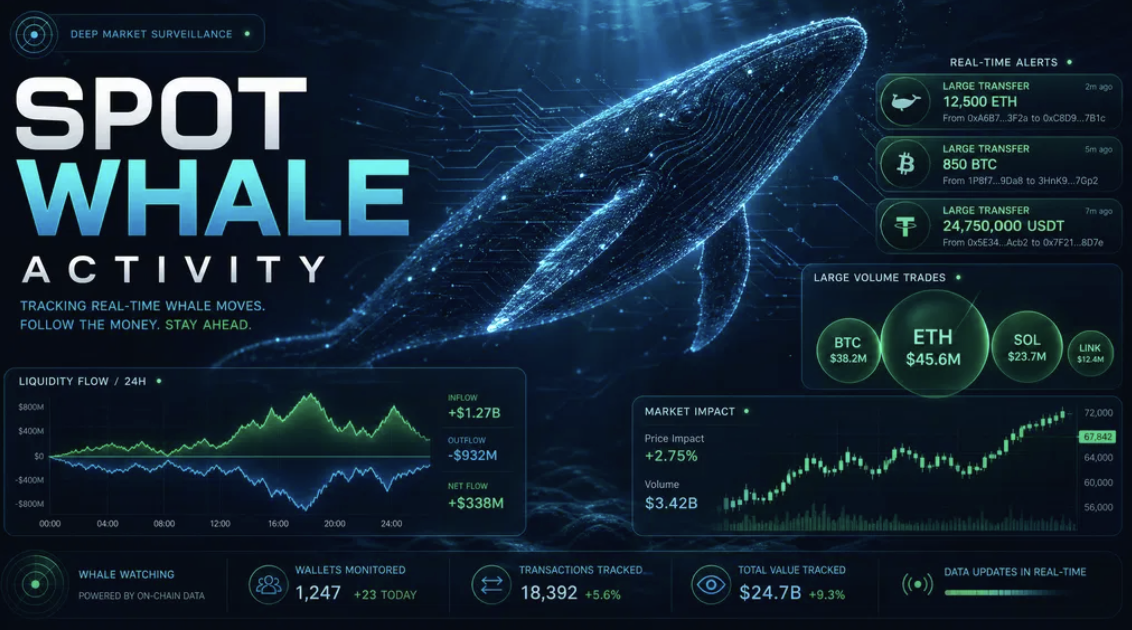
Spot whale activity refers to the buying and selling actions of individuals, institutions, funds, or entities that hold exceptionally large amounts of a particular asset. Because of their substantial holdings, these market participants have the potential to influence market conditions more significantly than typical retail traders.
In cryptocurrency markets, whales are often associated with early adopters, large investment funds, institutional investors, exchanges, or corporate treasury holders. Their transactions can involve millions or even billions of dollars, making their activity highly visible on blockchain networks and trading platforms.
While whales exist in traditional financial markets as well, cryptocurrency markets attract particular attention because blockchain technology allows many large transactions to be tracked publicly. This transparency has led to the development of specialized analytics tools that monitor whale wallets and significant asset movements.
Large investors can influence market behavior because their trades affect both liquidity and supply-demand dynamics. When a whale accumulates a significant position, the increased demand can contribute to upward price pressure. Conversely, large-scale selling may increase available supply and create downward pressure on prices.
Market participants often pay close attention to whale activity because it can provide insight into how sophisticated investors view current market conditions. If major holders are steadily accumulating assets during periods of uncertainty, some traders may interpret this as a sign of long-term confidence. On the other hand, large transfers to exchanges are sometimes viewed as a potential indication that whales are preparing to sell.
However, whale transactions do not always reflect immediate trading intentions. Assets may be moved for custody management, portfolio rebalancing, or operational purposes. As a result, whale activity should be analyzed within a broader market context rather than viewed as a standalone trading signal.
Whales can interact with spot markets in several different ways, each carrying potential implications for market participants.
Accumulation is one of the most closely monitored behaviors. During accumulation phases, whales gradually purchase assets over time, often attempting to avoid significantly impacting market prices. This process can occur during market corrections or consolidation periods when assets are perceived as undervalued.
Distribution represents the opposite behavior. In this scenario, whales gradually reduce positions and sell holdings into market strength. Large-scale distribution can increase selling pressure and sometimes coincide with the later stages of bullish market cycles.
Whales may also engage in strategic portfolio management, rotating capital between different assets based on changing market conditions. These reallocations can influence liquidity and trading activity across multiple sectors of the market.
The growth of blockchain analytics has made whale monitoring increasingly accessible, particularly in cryptocurrency markets. Traders often track large wallet movements, exchange inflows and outflows, and significant transaction activity to identify potential shifts in market behavior.
One common approach involves monitoring transfers between private wallets and exchanges. Large inflows to exchanges may attract attention because assets transferred to trading platforms are generally easier to sell. Conversely, significant withdrawals from exchanges are sometimes interpreted as a sign that investors intend to hold assets for longer periods.
Market participants also analyze wallet concentration data to understand how much of an asset’s supply is controlled by large holders. A high concentration of ownership among a small number of wallets can increase market sensitivity to whale activity, while broader distribution may reduce the influence of individual participants.
Although these indicators can provide useful insights, they are not foolproof. Large transactions often have multiple possible explanations, making careful interpretation essential.
Whale behavior can have a significant psychological impact on market participants. Because large investors are often perceived as experienced and well-informed, their actions may influence how other traders view market conditions.
When whales accumulate assets during periods of weakness, it can strengthen investor confidence and encourage additional buying activity. In contrast, reports of large-scale selling may increase uncertainty and contribute to bearish sentiment, even if the broader market fundamentals remain unchanged.
This influence on sentiment can sometimes create self-reinforcing market reactions. Positive interpretations of whale accumulation may attract additional demand, while concerns about whale selling can increase fear and selling pressure. As a result, whale activity often affects not only market liquidity but also investor psychology.
Understanding this relationship can help traders distinguish between genuine market signals and emotional reactions driven by headlines or social media discussions.
In recent years, institutional investors have become increasingly important participants in cryptocurrency spot markets. Asset managers, hedge funds, family offices, and publicly traded companies now account for a growing share of large-scale market activity.
Unlike individual whales, institutional investors often follow structured investment strategies and risk management frameworks. Their buying and selling decisions may be influenced by portfolio allocation models, regulatory requirements, or macroeconomic trends rather than short-term market speculation.
The increasing involvement of institutions has changed how many traders interpret whale activity. Large transactions are now more likely to reflect long-term strategic positioning rather than purely speculative behavior. This shift has contributed to greater market maturity while also increasing the importance of understanding institutional investment trends.
As institutional participation continues to expand, whale activity is expected to remain a key area of focus for market analysts and investors alike.
Although whale tracking has become popular, relying solely on whale behavior can be misleading. Large transactions do not always reveal investor intentions, and market outcomes are influenced by numerous factors beyond the actions of a few major participants.
Whales can also divide transactions across multiple wallets or execute trades through over-the-counter channels that are less visible to public observers. In addition, market reactions to whale activity may differ depending on broader economic conditions, liquidity levels, and investor sentiment.
Successful traders typically combine whale analysis with other forms of research, including technical analysis, fundamental analysis, market structure evaluation, and macroeconomic assessment. This broader approach helps provide a more balanced understanding of market conditions and reduces the risk of overreacting to isolated events.
Ultimately, whale activity should be viewed as one piece of a much larger market puzzle.
Spot whale activity refers to the actions of large investors whose substantial holdings can influence liquidity, market sentiment, and price movements. Whether through accumulation, distribution, or strategic portfolio adjustments, whales play an important role in shaping market dynamics across both traditional financial markets and the cryptocurrency ecosystem.
By monitoring large transactions, wallet movements, and institutional participation, traders can gain valuable insight into broader market trends. However, whale activity should not be interpreted in isolation, as individual transactions often have multiple explanations and may not directly predict future price movements.
Understanding how large investors operate can help market participants better evaluate supply and demand conditions, identify potential shifts in sentiment, and develop a more comprehensive view of the forces driving modern financial markets.
* The information is not intended to be and does not constitute financial advice or any other recommendation of any sort offered or endorsed by Gate.
* This article may not be reproduced, transmitted or copied without referencing Gate. Contravention is an infringement of Copyright Act and may be subject to legal action.