Trading Type
Spot
Trade crypto freely
Promotions
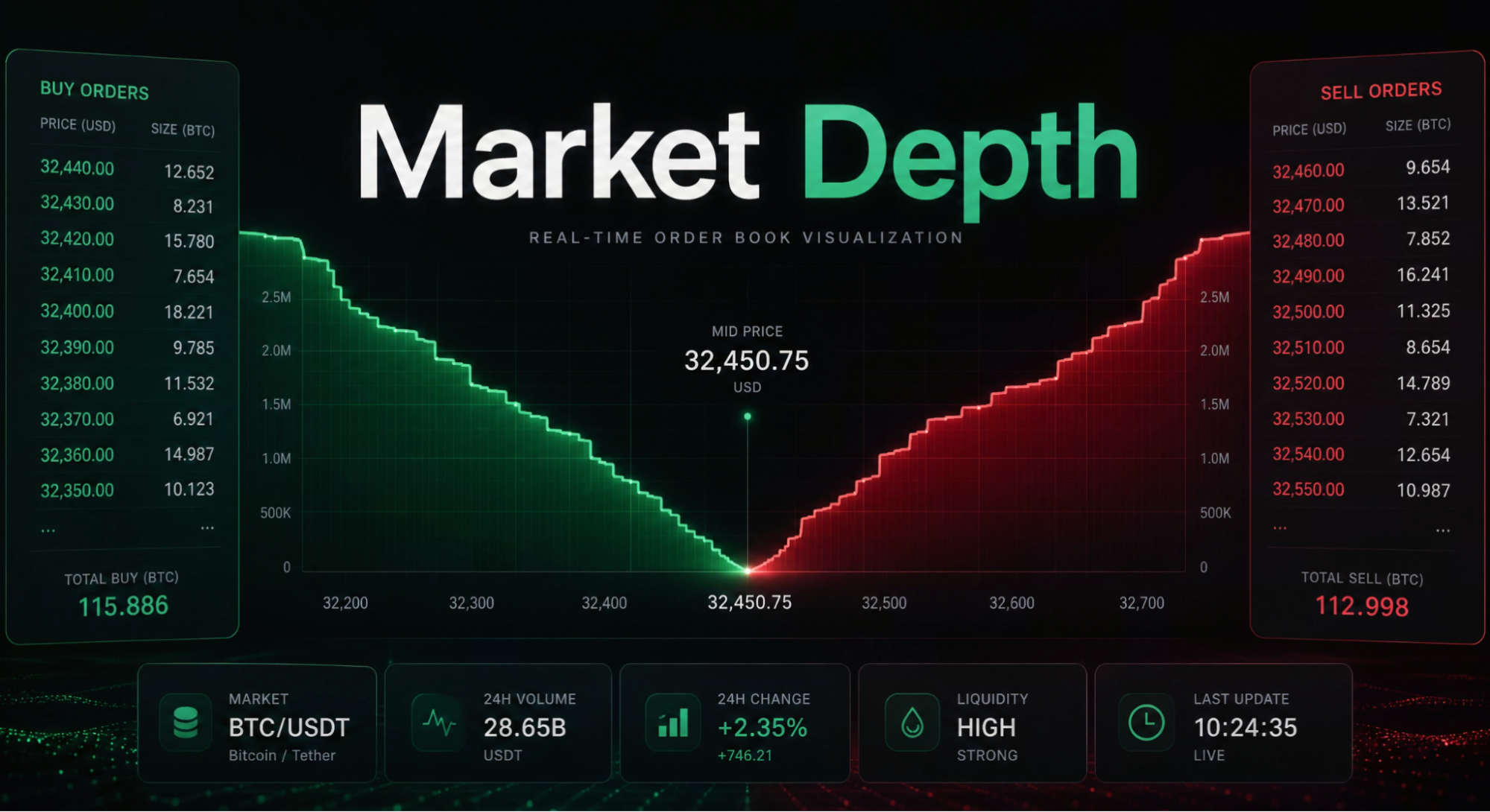
Spot market depth refers to the volume of buy and sell orders available at different price levels within a spot trading market. It represents how much liquidity exists in the order book and how capable the market is of handling large transactions without major price disruptions.
A market with strong depth typically contains large numbers of buy and sell orders close to the current market price. This allows traders to execute orders more efficiently with lower slippage.
In contrast, shallow markets have fewer orders available, meaning even relatively small trades may cause substantial price movements.
Spot market depth is commonly analyzed through order books and depth charts provided by exchanges.
Market depth is built through the interaction of buyers and sellers placing orders across various price levels.
The order book displays these pending buy orders (bids) and sell orders (asks). Together, they create a layered structure of liquidity around the current market price.
For example, if there are many buy orders slightly below the current Bitcoin price and many sell orders slightly above it, the market is considered relatively deep. This depth allows larger trades to occur without dramatically moving the market.
When liquidity is limited, however, large orders may consume available bids or asks quickly, causing prices to shift significantly during execution.
The greater the number and size of orders near the current price, the stronger the market depth becomes.
Market depth and liquidity are closely connected concepts, though they are not exactly the same.
Liquidity refers broadly to how easily assets can be bought or sold in the market, while market depth specifically measures the concentration of orders across price levels.
A deep market usually indicates strong liquidity because there are sufficient participants willing to trade near the current price. This creates tighter bid-ask spreads and smoother execution conditions.
Markets with weak depth often experience wider spreads, higher slippage, and greater short-term volatility.
In cryptocurrency trading, exchanges with deeper order books are generally viewed as more reliable and efficient trading venues.
Market depth plays a critical role in maintaining stable and efficient trading environments.
One major benefit of deep markets is reduced price impact. Large investors or institutional traders can execute sizable transactions without dramatically affecting market prices.
Deep markets also improve trading efficiency by reducing slippage during order execution. Traders are more likely to receive prices close to their intended entry or exit levels.
For retail traders, strong market depth can create a smoother trading experience with lower transaction costs and more predictable execution.
In broader financial markets, deep liquidity often reflects stronger investor confidence and healthier market participation.
Depth charts and order books are essential tools for analyzing market depth.
A depth chart visually displays cumulative buy and sell orders across different price levels. The buy side typically appears in one color while the sell side appears in another, illustrating supply and demand dynamics within the market.
Order books provide more detailed information by listing active buy and sell orders individually.
Traders often use these tools to identify potential support and resistance zones. Large clusters of buy orders may indicate strong support levels, while large sell walls can suggest resistance.
However, order book activity can change rapidly, especially in volatile cryptocurrency markets where traders frequently adjust positions.
Several factors affect the depth of a spot market.
1.Trading Volume
Markets with higher trading volume generally develop stronger depth because more participants contribute liquidity.
2.Market Participation
Institutional investors, market makers, and retail traders all influence overall order book strength.
3.Exchange Infrastructure
Reliable exchanges with fast execution systems and strong reputations often attract more liquidity providers.
4.Asset Popularity
Major assets such as Bitcoin and Ethereum usually have deeper markets compared with smaller or less established cryptocurrencies.
5.Market Volatility
During periods of extreme volatility, market depth may temporarily weaken as traders reduce exposure or widen spreads.
These factors continuously shape liquidity conditions across different trading environments.
Market depth has become especially important in cryptocurrency trading because digital asset markets remain highly fragmented across global exchanges.
Some platforms maintain very deep order books with substantial institutional participation, while smaller exchanges may experience thinner liquidity conditions.
Deep liquidity is particularly important for high-frequency traders, institutional investors, and algorithmic trading firms that rely on efficient execution.
Decentralized finance (DeFi) has also introduced alternative forms of market depth through liquidity pools and automated market makers (AMMs). Instead of traditional order books, liquidity in DeFi environments is often provided directly by users supplying assets into trading pools.
As cryptocurrency adoption grows, improving market depth continues to be a major focus for exchanges and trading infrastructure providers.
Market depth directly influences market volatility.
Deep markets can absorb buying and selling pressure more effectively, helping stabilize prices during periods of increased trading activity.
Shallow markets, by contrast, are more vulnerable to sudden price swings because limited liquidity allows trades to move prices more aggressively.
In times of market stress, declining depth may amplify volatility as traders withdraw orders or reduce market participation.
For this reason, market depth is often considered an important indicator of overall market resilience and stability.
Spot market depth is a critical component of financial and cryptocurrency markets because it reflects the strength and stability of trading liquidity. Deep markets support efficient execution, tighter spreads, lower slippage, and improved price stability.
Understanding market depth allows traders and investors to better evaluate trading conditions, liquidity quality, and potential market risks. As cryptocurrency markets continue to mature and attract larger institutional participation, market depth will remain a key factor shaping the efficiency and sustainability of digital asset trading ecosystems.
* The information is not intended to be and does not constitute financial advice or any other recommendation of any sort offered or endorsed by Gate.
* This article may not be reproduced, transmitted or copied without referencing Gate. Contravention is an infringement of Copyright Act and may be subject to legal action.
Share
Content