Trading Type
Spot
Trade crypto freely
Promotions
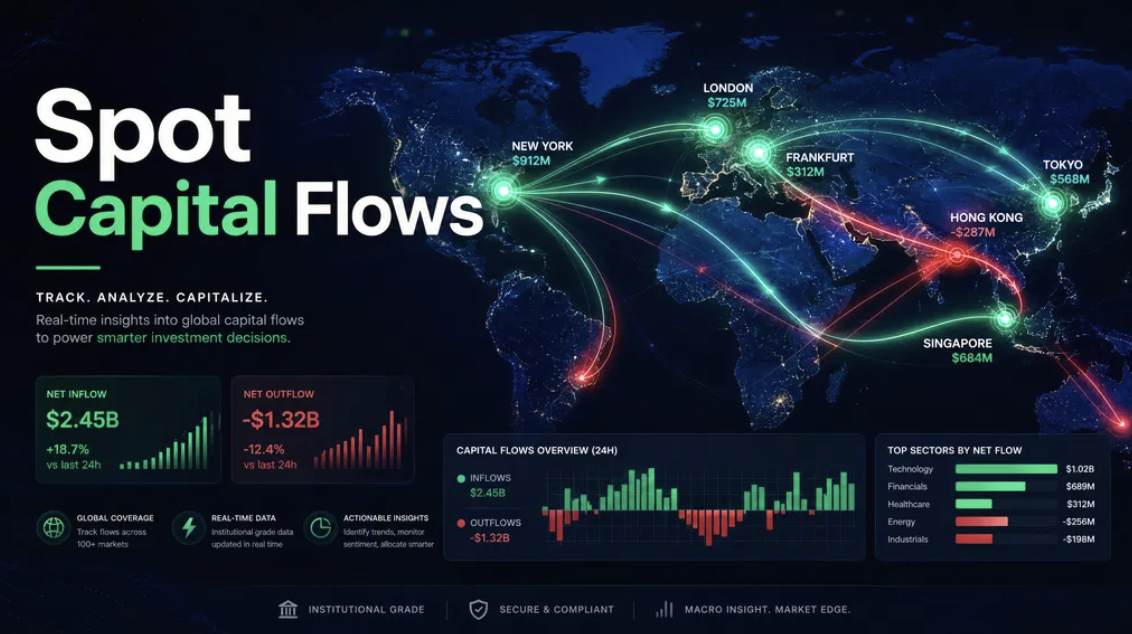
Spot capital flows refer to the movement of money into and out of assets that are traded in the spot market. Because spot transactions involve the direct purchase and ownership of an asset, capital flows provide a useful measure of actual investor demand rather than speculative exposure through derivatives.
When more money enters a particular asset or market than leaves it, the market is experiencing positive capital inflows. This generally reflects growing investor interest and stronger demand. Conversely, when investors withdraw capital or sell assets, negative capital flows occur, which may indicate weakening confidence or changing market preferences.
In cryptocurrency markets, capital flows can be observed through exchange activity, blockchain transactions, ETF inflows, and broader market liquidity trends. These movements often provide important clues about how investors are positioning themselves in response to market developments.
Capital flows are often viewed as a reflection of investor sentiment because they reveal where market participants are allocating their resources. While prices can be influenced by short-term speculation, sustained capital inflows typically indicate genuine demand and growing confidence in an asset or market segment.
For example, if significant capital begins flowing into Bitcoin or other digital assets, it may suggest that investors expect favorable future performance. Similarly, large outflows can signal increased caution, profit-taking, or concerns about potential market risks.
Because capital represents real buying and selling activity, analyzing money movement often provides deeper insight than price action alone. Investors frequently use capital flow data to determine whether market trends are supported by strong participation or driven primarily by short-term volatility.
Capital flows can occur in several forms, depending on the market structure and the behavior of participants.
One of the most common forms is direct asset accumulation, where investors purchase assets and add them to their portfolios. This creates positive inflows and often supports upward price momentum. Long-term investors and institutions frequently contribute to this type of capital movement when they identify attractive investment opportunities.
Another important category involves capital rotation. Investors may move funds from one asset class to another based on changing market conditions, economic expectations, or risk preferences. For example, capital may rotate from smaller cryptocurrencies into Bitcoin during uncertain periods, or from digital assets into traditional financial instruments when market sentiment weakens.
Capital flows can also occur at the sector level, where money moves into specific industries, themes, or ecosystems. In cryptocurrency markets, this may involve shifts between Layer 1 networks, DeFi protocols, AI-related tokens, or other emerging sectors.
Market participants use a variety of indicators and data sources to monitor capital movement. Trading volume is one of the most basic measures because increased buying activity often reflects fresh capital entering the market. However, volume alone does not always provide a complete picture.
In cryptocurrency markets, exchange inflows and outflows are commonly analyzed. Large transfers of assets from private wallets to exchanges may indicate potential selling activity, while significant withdrawals from exchanges are often interpreted as a sign of long-term holding behavior. Although these signals are not definitive, they can provide useful context regarding investor intentions.
Institutional investment data has also become increasingly important. Spot ETF inflows, corporate treasury allocations, and fund investment reports can reveal how larger market participants are positioning themselves. Since institutions often deploy substantial amounts of capital, their activity can significantly influence overall market trends.
The relationship between capital flows and market trends is often closely connected. Strong and sustained inflows typically support bullish conditions because new capital increases demand and provides liquidity for continued growth. As more investors enter the market, positive sentiment can strengthen, attracting additional participants and reinforcing upward momentum.
On the other hand, persistent outflows may indicate declining confidence and weakening demand. When investors consistently remove capital from a market, liquidity can decrease and selling pressure may increase, creating challenges for sustained price appreciation.
However, capital flows should not be analyzed in isolation. Short-term inflows may be driven by speculative activity, while temporary outflows do not necessarily signal long-term weakness. Understanding the broader context behind money movements is essential for accurate market interpretation.
Capital flow analysis has become particularly important in cryptocurrency markets because blockchain technology provides a level of transparency that is difficult to achieve in traditional finance. Many transactions can be tracked publicly, allowing analysts to observe how funds move between wallets, exchanges, and investment vehicles.
The introduction of spot cryptocurrency ETFs has further expanded the importance of capital flow data. ETF inflows and outflows are now closely monitored because they provide insight into institutional demand and broader investor sentiment. Significant ETF inflows often indicate growing acceptance of digital assets among traditional investors, while outflows may reflect changing market expectations.
In addition, capital flows between centralized exchanges, decentralized finance protocols, and blockchain ecosystems can reveal emerging trends within the crypto industry. Monitoring these movements helps investors identify sectors that are attracting attention and capital before broader market recognition occurs.
Although capital flow analysis is a valuable tool, it should not be viewed as a perfect predictor of future price movements. Capital can move for many reasons, including portfolio rebalancing, risk management, regulatory considerations, or operational requirements.
Large inflows do not always guarantee immediate price increases, just as significant outflows do not always lead to prolonged market declines. External factors such as macroeconomic conditions, interest rates, geopolitical developments, and market sentiment can influence how capital movements ultimately affect asset prices.
For this reason, experienced investors typically combine capital flow analysis with technical analysis, fundamental research, liquidity metrics, and broader market indicators. This comprehensive approach provides a more balanced understanding of market conditions and reduces the risk of drawing conclusions from a single data point.
Understanding capital flows can help investors identify where opportunities and risks may be developing within a market. Since money often moves before major trends become widely recognized, tracking capital allocation can provide an early indication of changing investor preferences and emerging market narratives.
Capital flow analysis also helps investors evaluate the strength of market trends. A rising market supported by strong inflows may be more sustainable than a rally driven primarily by speculation. Likewise, monitoring outflows can help investors identify periods of increasing caution or declining confidence.
By incorporating capital flow data into their research process, traders and investors can gain a deeper understanding of market structure and improve their ability to interpret evolving market conditions.
Spot capital flows represent the movement of money into and out of assets traded in spot markets. They provide valuable insight into investor behavior, market sentiment, liquidity conditions, and the strength of ongoing trends. Whether through direct asset purchases, institutional investment, or sector rotation, capital flows play a crucial role in shaping financial and cryptocurrency markets.
While capital flow analysis should not be used as a standalone indicator, it offers an important perspective on how market participants are allocating resources. By combining capital flow data with other forms of market analysis, investors can develop a more comprehensive understanding of market dynamics and make more informed investment decisions in an increasingly complex financial environment.
* The information is not intended to be and does not constitute financial advice or any other recommendation of any sort offered or endorsed by Gate.
* This article may not be reproduced, transmitted or copied without referencing Gate. Contravention is an infringement of Copyright Act and may be subject to legal action.
Share
Content