What Is Hyperliquid? A Complete Guide to the Popular On-Chain Perpetual Futures Trading Platform
Hyperliquid is a decentralized exchange (DEX) focused on on-chain perpetual futures trading. Built on a self-developed high-performance Layer 1 blockchain, it adopts a fully on-chain central limit order book (CLOB) mechanism, achieving trading speed and liquidity depth close to centralized exchanges (CEXs) while preserving asset self-custody and permissionless access.
Against the backdrop of rapid growth in on-chain derivatives trading, Hyperliquid has gradually established considerable trading volume and market influence through its high-throughput, low-latency, and truly on-chain matching architecture, becoming one of the key infrastructure platforms in the decentralized perpetual futures sector.
This article systematically explains what Hyperliquid is, how it operates, its main differences from centralized exchanges (CEXs), and further introduces its functional features, ecosystem structure, potential risks, and a beginner usage guide, helping readers gain a comprehensive understanding of this on-chain derivatives trading platform.
Key Takeaways
- Hyperliquid is a decentralized exchange focused on on-chain perpetual futures trading, built on its own high-performance Layer 1 blockchain rather than on Ethereum or a general-purpose Layer 2.
- Its core trading architecture uses a fully on-chain central limit order book (CLOB), aiming to combine the transparency and self-custody of a DEX with execution speed and liquidity closer to centralized exchanges.
- Compared with many perpetual DEXs that rely on AMMs or oracle-based pricing, Hyperliquid uses direct buy and sell orders, making it more suitable for active traders, market makers, and higher-frequency strategies.
- HYPE is the native token of the Hyperliquid ecosystem and is used for staking, governance, network security, ecosystem incentives, and other on-chain functions.
- Hyperliquid has expanded beyond perpetual trading through APIs, analytics tools, ecosystem applications, and other infrastructure built around its Layer 1 network.
- Hyperliquid still carries significant risks, including leverage and liquidation risk, smart contract or network vulnerabilities, liquidity stress during extreme markets, and the possibility of protocol rules changing as the ecosystem develops.
What is Hyperliquid? Project background and core positioning
Hyperliquid is a decentralized exchange (DEX) focused on on-chain perpetual futures trading. Unlike traditional DeFi projects, Hyperliquid did not choose to deploy on Ethereum or mainstream Layer 2 networks. Instead, it built its own Layer 1 blockchain from the ground up, specifically optimized for high-frequency financial trading.

Source: https://hyperfoundation.org/
The project was born out of a long-standing industry contradiction: decentralized trading is secure and transparent, but lacks performance; centralized trading offers strong performance, but carries custody risk. Hyperliquid’s core positioning is to find a balance between the two—providing speed and depth close to centralized exchanges while retaining asset self-custody, transparent rules, and permissionless access.
From a design perspective, Hyperliquid more closely resembles an “on-chain derivatives exchange” than a traditional DeFi protocol.
How does Hyperliquid work? On-chain order book mechanism explained
At the technical level, Hyperliquid’s most significant innovation lies in its fully on-chain central limit order book (CLOB) model.
In most perpetual DEXs, users do not trade directly with other traders, but instead interact with the protocol itself, with pricing dependent on oracles or internal pricing formulas. While this model reduces complexity, it has clear shortcomings:
- Significant slippage for large trades
- Poor high-frequency trading experience
- Limited market-making and arbitrage opportunities
The order book mechanism adopted by Hyperliquid is much closer to traditional financial markets:
- Buyers and sellers interact directly through limit and market orders
- Prices are determined by real supply and demand
- Greater depth results in more stable trading
To make on-chain order books viable, Hyperliquid implemented highly customized optimizations at both the consensus and execution layers, enabling extremely low latency and high throughput while maintaining decentralization.
As a DEX, how is Hyperliquid different from centralized exchanges (CEXs)?
Although the user experience is similar to that of CEXs, Hyperliquid remains a fully decentralized exchange at the fundamental level:
| Dimension | Hyperliquid | Centralized exchange (CEX) |
|---|---|---|
| Asset custody | User self-custody | Platform custody |
| Clearing & settlement | On-chain transparent execution | Internal system |
| Risk control rules | Publicly verifiable | Opaque |
| Counterparty risk | None | Custodial risk exists |
Users can trade directly through their wallets without KYC, while still enjoying matching efficiency close to centralized platforms. This is one of Hyperliquid’s core attractions.
How is Hyperliquid different from other perpetual DEXs?
Hyperliquid’s differentiation is mainly reflected by the following:
- Native Layer 1 blockchain rather than deployment on a general-purpose Layer 2
- Order book model rather than an AMM model
- No asset bridging required, with a single-margin system
- Extremely low latency, suitable for high-frequency and professional traders
By contrast, many perpetual DEXs are more oriented toward passive trading or long-term position management, whereas Hyperliquid is clearly geared toward active traders and market makers.
Further Reading: What is a Perp DEX? Overview of Mainstream Platform Types
Hyperliquid’s trading features and product characteristics
Hyperliquid currently focuses on perpetual futures trading, but its feature set is already highly mature:
- Support for major assets (BTC, ETH, SOL, etc.)
- High leverage (specific multiples depend on the asset)
- Limit orders, market orders, and stop-loss orders
- Real-time funding rate mechanism
- Cross-margin mode
In addition, its trading interface is highly professional, with candlestick charts, depth charts, and position information nearly indistinguishable from those of CEXs, significantly reducing user migration costs.
Further Reading: Hyperliquid Platform Features Explained: What Traders Need to Know
Hyperliquid Ecosystem: How is the ecosystem expanding?
While perpetual futures trading is the core product, the ecosystem for Hyperliquid continues to expand, with features including:
- Third-party analytics tools and data dashboards
- API support for quantitative and automated trading
- Community-driven strategy and tool sharing
- Potential governance and ecosystem incentive systems
This “trading first, ecosystem later” path closely mirrors the growth trajectory of early centralized derivatives exchanges.
Why is Hyperliquid able to attract large numbers of traders and liquidity?
Hyperliquid has accumulated significant trading volume in a short period mainly due to:
- Truly low-slippage on-chain order books
- Speed and experience close to CEXs
- No need to trust the platform with asset custody
- Active trading incentives and strong community engagement
For users tired of centralized risks but unwilling to sacrifice trading experience, Hyperliquid offers a highly compelling compromise.
HYPE token overview: the value and governance core of the Hyperliquid ecosystem
HYPE is the native token of the Hyperliquid ecosystem, serving multiple functions including network security, governance participation, and economic incentives. It is a foundational asset for the platform’s long-term operation. HYPE has a capped total supply and was initially distributed through a large-scale community airdrop to reward early active traders and ecosystem participants, a distribution strategy that significantly enhanced community engagement and decentralization.
Functionally, HYPE is used for on-chain governance voting, allowing holders to participate in key decisions such as protocol parameters, fee structures, and ecosystem development direction. At the same time, HYPE serves as the core staking asset in Hyperliquid’s proof-of-stake mechanism, helping secure and stabilize the underlying blockchain.
In addition, HYPE plays a value-capture role within the trading system. A portion of platform fee revenue is applied to token supply through buyback and burn mechanisms, theoretically creating a deflationary effect. As the Hyperliquid Ecosystem expands, HYPE is also used for on-chain fee payments, ecosystem incentives, and potential DeFi applications, making it not merely an auxiliary trading token, but a key economic hub spanning the entire Hyperliquid network.
How can beginners start trading on Hyperliquid?
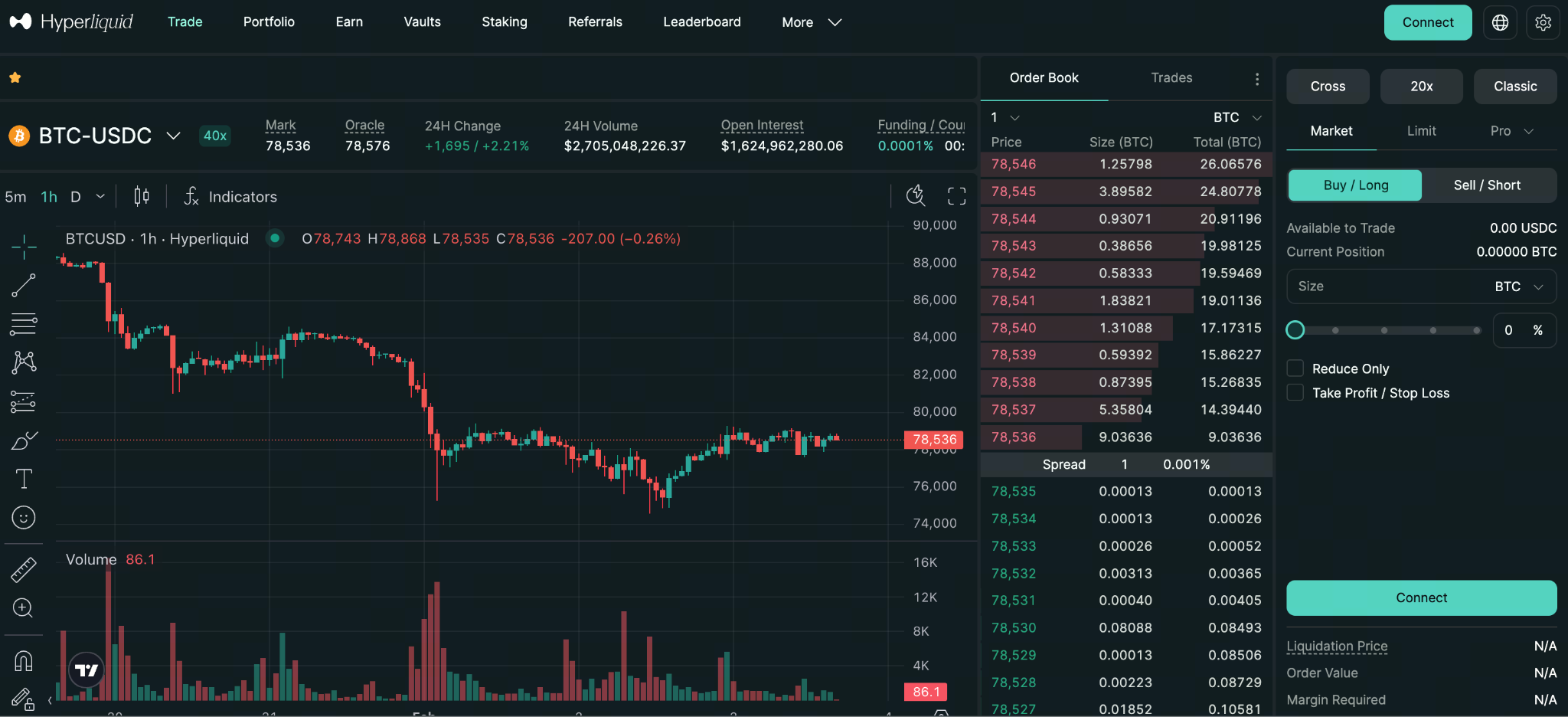
Source: https://app.hyperliquid.xyz/trade/BTC
Basic steps include:
- Prepare a supported crypto wallet (such as MetaMask)
- Deposit margin assets to the Hyperliquid-supported network
- Connect to the official website and enter the trading interface
- Select a trading pair, set leverage, and choose an order type
- Monitor positions and margin ratios in real time
The overall process is very friendly to users with CEX experience, and beginners can also get started quickly.
What risks should be considered when using Hyperliquid?
Despite its clear advantages, the following risks should still be considered:
- Liquidation risk from high-leverage trading
- Potential vulnerabilities in smart contracts and the underlying chain
- Liquidity and liquidation pressure during extreme market conditions
- The system is still in a rapid development phase, and rules may change
On-chain transparency does not equate to zero risk. Prudent position management remains essential.
Will Hyperliquid become the new standard for on-chain derivatives trading?
Based on its current development, Hyperliquid has demonstrated viability across multiple key dimensions. Its order book model and self-developed blockchain offer a new implementation path for on-chain perpetual futures.
While it still needs to withstand market cycles and extreme conditions, one thing is clear: Hyperliquid has already prompted the industry to rethink whether on-chain derivatives must necessarily compromise on user experience.
Regardless of the final outcome, Hyperliquid has become an important case study that cannot be ignored in the evolution of on-chain derivatives trading.
* The information is not intended to be and does not constitute financial advice or any other recommendation of any sort offered or endorsed by Gate Australia.
* This article may not be reproduced, transmitted or copied without referencing Gate Australia. Contravention is an infringement of Copyright Act and may be subject to legal action.
Share
Content


Related Articles

What Is Bitcoin? Understanding How Decentralized Digital Currency Works and Where Its Value Comes From
What Is Ethereum? ETH, Smart Contracts, and the Ethereum Ecosystem Explained

Where to Buy Dogecoin: Top Platforms and Essential Safety Tips
Hyperliquid and HYPE: Powering the Next‑Generation On‑Chain Financial Ecosystem

How to Buy XRP on Gate: A Step-by-Step Guide to Funding, Trading, and Storage